


Internal fire doors are the ones nobody thinks about: the door to the plant room, the cupboard that hides the pipework, the heavy leaf halfway down an office corridor. They spend their lives being walked through, wedged open and repainted, and then one day they are asked to hold back a fire for half an hour or a full hour. FD60 internal fire doors are the one-hour grade, the heavier end of the range, and buyers often choose them on instinct because more minutes sounds safer. Sometimes the wall demands them. Sometimes the extra weight creates problems of its own. By the end of this guide you will be able to tell where a 60 minute door is needed, what sets it apart physically, how glass changes the picture, and what to look for on the doors you already have.
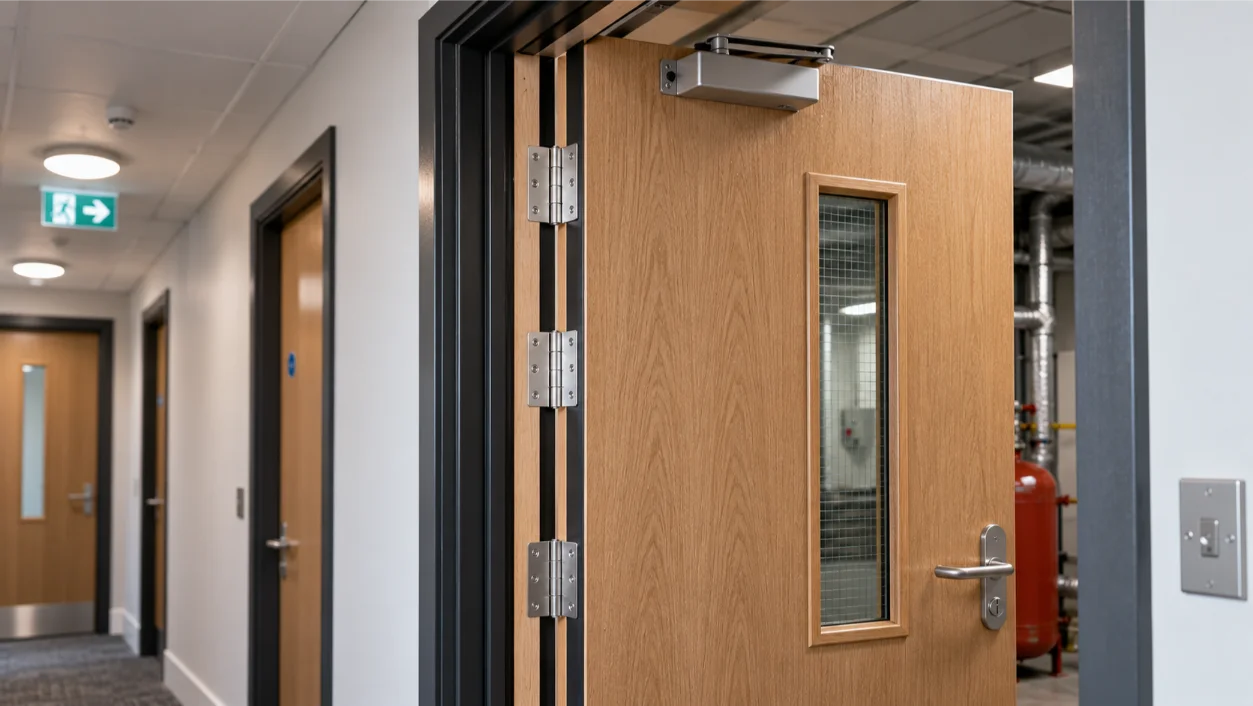
What is an internal fire door, and what makes one FD60?
An internal fire door is any fire-resisting door inside a building, away from the weather. It has two jobs. Closed, it holds fire and smoke in the room where they started. Open, it lets people through like any other door, which is why it has to shut by itself afterwards.
The letters and number give the grade. FD means fire door, and the figure is the number of minutes the door kept flames back in a standard furnace test, BS 476-22 in the British system. Add an S, as in FD60S, and the door has seals that limit cold smoke as well.
Stand a 60 minute door beside the more common 30 minute one and the differences are physical, easy to see once you know where to look.
A 30 minute leaf is usually 44 mm thick. A 60 minute leaf is usually 54 mm, with a denser core, and it weighs roughly half as much again. The intumescent strips, the seals that swell in heat to close the edge gap, tend to come as a single line on the lighter door and a double line or a wider one on the heavier. The frame changes too. FD30 frames are commonly softwood, while FD60 evidence typically calls for hardwood with a density of at least 650 kg/m³, because a softer timber chars through before the hour is up.
That last detail gets missed constantly.
The upgrade that is not an upgrade
You cannot turn an FD30 into an FD60 by adding strips, and you do not get an hour by hanging a 54 mm leaf in the frame that was already there. A fire door performs as the weakest part of the set. An FD60 leaf in an FD30 frame is, at best, an expensive FD30.
So before asking which grade is better, ask which one the wall around it needs.
Where do FD60 internal fire doors belong?
The door follows the wall. Every fire-resisting wall has a period assigned to it by the building’s fire strategy or by Approved Document B (ADB), the government guidance for England, and the doors in that wall take their rating from it. Sometimes the door matches the wall in full. In other positions the guidance accepts less.
In practice FD30 covers most of what you see day to day: doors along escape corridors, doors onto protected stairways, and doors to rooms that open off those routes. Sixty minutes tends to appear where the hazard is higher or the wall is doing heavier work.
- Doors in a compartment wall separating two different occupancies or buildings
- Plant rooms, boiler rooms and electrical switch rooms
- Stores holding large amounts of combustible material
- Basement and car park separations
- Some service shafts and riser cupboards, depending on the wall they sit in
Treat that as a pattern and not a rulebook. The right answer for a particular opening comes from the fire strategy drawings, and where they are silent, from a fire engineer or building control.
Internal fire doors for flats
Inside a single flat the requirement is lighter than many owners expect. Where the layout relies on a protected hallway, meaning an entrance hall kept clear of fire so you can reach the front door, ADB asks for the rooms off it to have doors of a 20 minute standard, written FD20. Almost nobody stocks a door at that grade, so in practice an FD30 leaf goes in. Current guidance for England does not ask for closers on doors inside a flat.
What about 60 minutes flat fire doors? Within the home itself they are rare. You meet them in the shared parts of a block instead: the bin store, the plant room, a riser cupboard on each landing. Some owners of tall residential buildings have also chosen to exceed the minimum since 2017 and fit FD60 where FD30 would comply. That is a client decision, not a legal one, and it has consequences worth understanding before you copy it.
Can you have internal fire doors with glass?
Yes, and in busy buildings you often should. A vision panel lets people see who is coming the other way, lets staff notice smoke in a room before opening it, and brings daylight into corridors that would otherwise need lamps all day. Glazing is FireResist’s own trade, so this is the part of the subject we would gladly talk about for an hour.
The glass has to be fire-rated, and there are two broad kinds. Integrity glass stays in place and keeps flame back but lets heat radiate through; wired glass such as Pilkington Pyroshield is the familiar older example. Insulating glass, sold under names like Pilkington Pyrostop and Pyroguard, contains clear layers that turn opaque and foam up in a fire, blocking heat as well as flame. On paper the first kind carries the letter E and the second EI.
Which one you need depends on position. ADB restricts uninsulated glass along escape routes, and in several locations permits it only above 1,100 mm from the floor, roughly waist height, so that people crouching below the smoke are shielded from radiated heat. Lower panels and larger areas generally call for the insulating type.
An hour’s rating raises the stakes. Insulating glass for 60 minutes is commonly over 20 mm thick and heavy with it, which is one reason the leaf grows to 54 mm, and the maximum size of the aperture shrinks compared with a 30 minute door.
Why you cannot cut the hole yourself
This is the mistake that costs the most. A certified door covers a stated glass type, pane size, bead profile and sealing system, and the glazing has to be done at the factory or by a licensed processor approved under the door’s certification scheme. A joiner who cuts an opening on site and beads in a pane, however neatly, has produced a door with no evidence behind it.
Order the door glazed. It is quicker, and it is the only version that comes with paperwork.
Is an FD60 always the safer choice?
No. This is where the heavier door shows its weakness, and where plenty of specifications go wrong.
A 54 mm leaf needs a stronger closer to pull it shut and hold it against the latch. A stronger closer makes the door harder to open. Approved Document M, the access guidance for England, sets a ceiling of 30 newtons on the force needed at the leading edge to start a door moving, and a heavy fire door with a firm closer struggles to stay under it. For a wheelchair user, an older resident or a child, that door is a daily obstacle.
The pattern you’ll notice in schools, care homes and offices is that the heavier the door, the more wedges you find on the floor. People prop open whatever annoys them. A fire extinguisher, a chair, a folded bit of cardboard: anything will do.
A propped-open FD60 gives you zero minutes.
Weight also wears things out. Hinges on a busy 60 minute door carry more load at every swing, the leaf drops by a millimetre or two over the years, and the gaps along the edges drift out of tolerance. Heavy traffic and heavy doors are a poor match, and no amount of careful buying changes that.
Here is my opinion, and not every fire engineer shares it. Fitting FD60 throughout a building in the belief that more is better is a mistake. I would take a well-kept FD30 that closes every time over a 60 minute door that spends its days wedged open. Horses for courses: put the hour where the wall demands it and nowhere else.
If a door has to stand open
There is a proper way to do it, which should reassure anyone managing a building where closed doors get in the way. A hold-open device keeps the leaf open in normal use and releases it when the alarm sounds. Some are magnets wired to the fire alarm panel. Others, such as the Dorgard unit made by Fireco, sit at the foot of the door, listen for the sounder and let go without any wiring. A fire risk assessor should approve the type and the locations, since they do not suit every door.
What should you check on the internal fire doors you already have?
Most buildings do not need new doors so much as attention to the old ones. The Fire Door Inspection Scheme, an industry body that trains inspectors, has reported that around three quarters of the doors its members examined in a year fell short in some respect. The usual causes are dull and cheap to cure.
Gaps come first: more than about 3 mm between leaf and frame along the top and sides, or a wide space underneath. Then closers that someone has backed off until the door drifts shut without latching. Strips and smoke seals go missing or disappear under paint. Hinges work loose, or a previous repair left two where the door needs three. A lock gets changed and the old holes stay unfilled. Someone trims an edge to stop the leaf sticking in summer and takes the lipping off with it. The certification label on the top edge is sanded away by a decorator. And signs reading fire door keep shut peel off and never return.
Each fault is small. Together they decide whether the rating on the drawing still exists in the corridor.
If your premises have not had a fire door inspection in the past year, arrange one now, and do not wait for the insurer or the fire service to ask. Six-monthly checks are common practice in busy buildings, and residential blocks in England over 11 m have a legal duty to check the doors in shared areas every three months.
Reading the label
A certified door identifies itself. Look on the top edge of the leaf for a label from the BWF Fire Door Alliance or Certifire, which states the rating and lets you trace the manufacturer. These schemes provide third-party certification: an independent body audits production and retests samples, so the door in your hand matches the one that was burned. From 2 September 2029, ADB stops recognising the British test route, and new doors will increasingly quote the European class instead, written E30 or E60 for integrity.
Specifying FD60 internal fire doors: a working order
Work through the decision in this order and the grade usually settles itself.
- Find the fire rating of the wall the door sits in, from the fire strategy or from building control.
- Read off the door rating that goes with that wall and position. Do not round up out of habit.
- Decide whether the door needs smoke seals, which most doors on escape routes do.
- Settle the glass: whether you want a vision panel, how large, and whether its position calls for insulating glazing.
- Think about who uses the door and how often, and plan a hold-open device where a closed door would get wedged.
- Buy a certified doorset with its matching frame, glazed at the factory.
- Put the door on an inspection list from the day it is hung.
On a small job, a loft conversion for example, the first three steps amount to a short conversation with your building control officer. In a larger building all seven belong in the spec.
FD60 internal fire doors are a matter of fit more than strength. They give an hour of resistance to flame and belong in the heavier walls of a building, around plant, storage, risers and separate occupancies, where they need a 54 mm leaf, a hardwood frame and more substantial seals than a lighter door. Inside a flat they are rare, while in the shared parts of a residential block they are common. Glass is welcome so long as it is fire-rated, correctly placed and fitted under the door’s certification. The hour is no bargain if the weight leads people to prop the door open, and it does not survive wide gaps, missing seals or a closer that no longer latches. Match the door to the wall, keep it closing, and check it on a schedule, and the 60 minutes on the label will be there when someone needs them.