


Fire door closers are the single most argued-over piece of ironmongery on any fire door, and the argument is almost never about right versus wrong. It’s fire safety pulling one way and accessibility pulling the other. A closer’s entire job is to shut a fire door fully and reliably, every single time, using a power size and closing action set against BS EN 1154 rather than guesswork or gut feel. After reading this article you’ll be able to pick the right closer type for a given door, adjust one correctly on site, and spot the exact point where a closing-force spec starts fighting wheelchair access instead of supporting fire safety.
What a fire door closer actually has to prove
BS EN 1154 classifies fire door closers with a six-digit code, and most of the arguments on site trace back to someone reading only one of those six digits. Category of use covers the opening angle a closer must recover from — Grade 3 from at least 105 degrees, Grade 4 from a full 180. Durability sits at a flat Grade 8 across the board, which means 500,000 test cycles: considerably tougher than the 200,000-cycle bar set for the hinges carrying the same door. Power size runs 1 to 7. Fire behaviour is binary – Grade 0 means not suitable for fire doors, Grade 1 means it’s been assessed as part of a genuine fire-tested doorset.
That last digit is the one people skip past fastest, and it’s the one that actually matters most. A closer isn’t fire tested in isolation; it earns its Grade 1 status by being part of a specific door assembly’s fire test, alongside the leaf, the seals, the intumescent detail. Swap a Grade 1 closer from one manufacturer’s tested assembly onto a completely different doorset and you haven’t necessarily kept the fire rating – you’ve just kept the label.
Types of fire door closers – matching the mechanism to the door
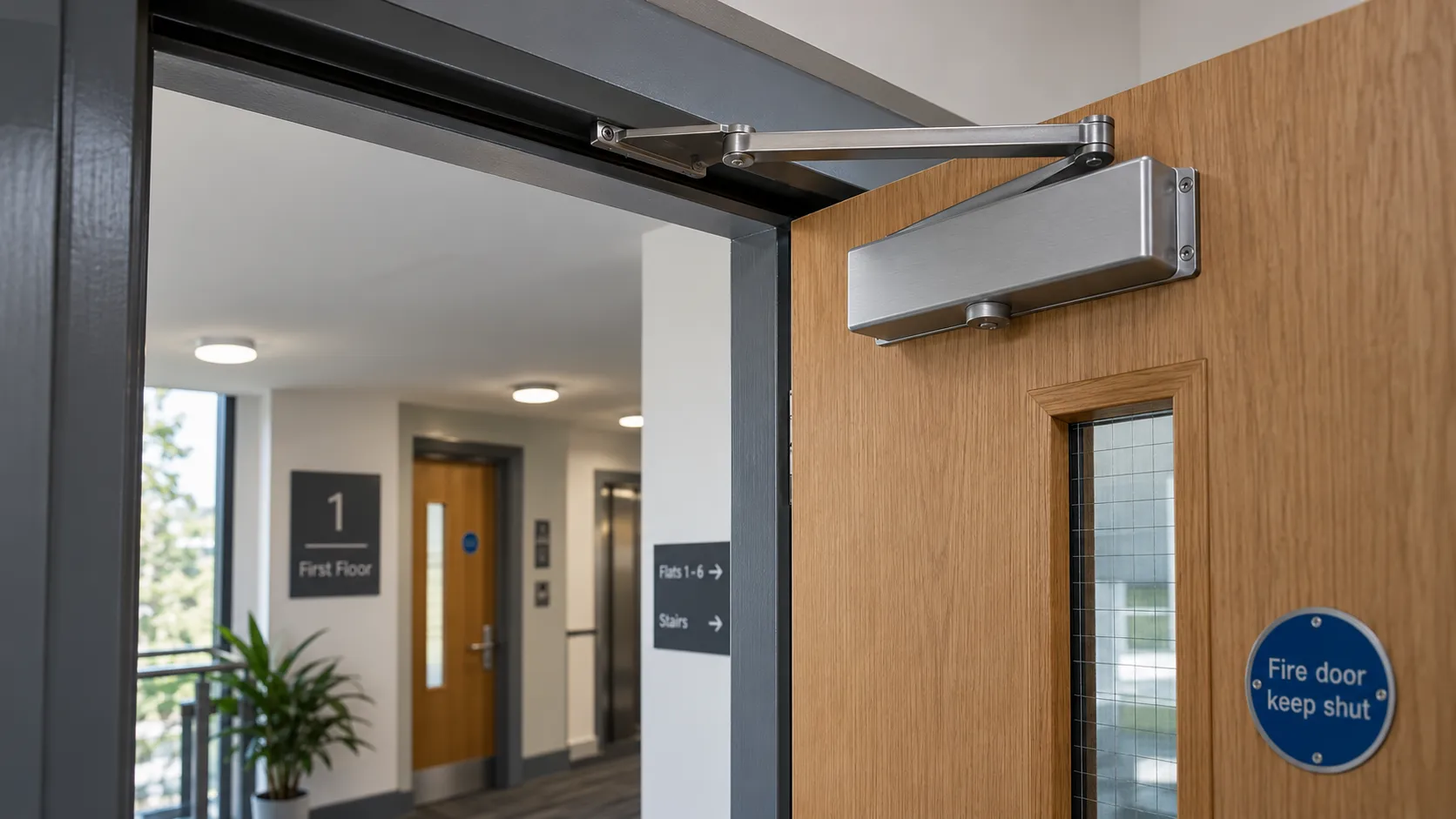
Walk into any commercial building and you’ll find the same handful of fire door closers repeating, each suited to a different job:
- Regular-arm surface-mounted closers – bolted to the door face with a standard arm, the cheapest and easiest to fit, visible on the door.
- Slide-arm (track-arm) closers – the arm runs in a track rather than pivoting freely, giving smoother action on doors that swing past 90 degrees regularly.
- Parallel-arm closers – mounted so the arm sits flush against the frame rather than projecting, useful where corridor width is tight.
- Concealed closers – morticed into the door leaf or frame, invisible when the door’s shut, considerably more expensive and fiddlier to service.
- Floor springs – set into the floor beneath the door, used on heavier doors and full-height glazed screens where an overhead unit would look wrong.
- Free-swing and hold-open closers – electromagnetically linked to the fire alarm, covered properly in the next section because they solve a different problem entirely.
Pick based on the door’s actual traffic pattern and the building’s aesthetic constraints, not on whichever unit happened to be on the van. A concealed closer on a door that gets kicked open by trolleys all day is an expensive way to generate a service call.
Door closers for fire doors – getting the power size right
Sizing fire door closers correctly starts with BS EN 1154’s power size table, which runs from Size 1 (doors up to 750mm wide, 20kg) through to Size 7 (up to 1600mm, 160kg), with each size step roughly adding 150mm of width and 20kg of test mass. Size 3, rated to 950mm and 60kg, covers the overwhelming majority of standard internal fire doors in UK buildings, and manufacturers ship most adjustable closers set to size 3 by default for exactly that reason.
Here’s the rule that trips people up: if a door’s width and its weight land in different size brackets, you specify the larger of the two, not an average, not whichever number looks tidier on the schedule. A narrow but unusually heavy fire door – a solid FD60 leaf on a tight stairwell opening, say – needs sizing against its mass even if the width alone would suggest something smaller. Get this wrong in a draughty stairwell and the door either won’t close against the pressure difference or it’ll slam so hard the backcheck valve gets no chance to do its job.
Electric fire door closers – hold-open or free-swing?
Both function types solve the same underlying problem – a fire door that needs to stay open for daily comfort but must close itself the instant something goes wrong – and they solve it in genuinely different ways. A hold-open closer, like DORMA’s TS73 EMF or the wider TS9x EMR range, holds the door open at a fixed angle using an electromagnet fixed to the wall or floor. Trip the fire alarm and the magnet de-energises instantly, letting the closer’s own spring pull the door shut. Fail-safe by design: lose power, lose the magnet, door closes.
Free-swing closers, GEZE’s TS4000EFS being a common example on care home and school specifications, take the opposite approach entirely. Under normal use the door moves as if no closer were fitted at all – negligible resistance, easy for a child, an elderly resident, or someone pushing a hospital trolley to manage one-handed. The moment the fire alarm activates, the same electromagnetic coupling releases and full spring tension engages, closing the door properly. ASSA ABLOY’s CE4F-E folds both functions into a single unit, switchable between hold-open and free-swing depending on the building’s actual pattern of use.
Both types answer to BS EN 1155, the standard covering electrically powered hold-open devices, separately from the BS EN 1154 rating governing the closer’s basic mechanical performance. Get both certifications on the paperwork before it goes anywhere near a fire risk assessment – one without the other is a closer doing half its job on paper, whatever it does in practice.
Fire door closer adjustment – the valves that actually decide compliance
Most adjustable fire door closers give you two or three valves, and knowing what each one changes is the difference between a door that passes inspection and one that merely looks adjusted. General closing speed controls how fast the door swings through most of its travel – too fast and it’s a hazard to anyone walking through; too slow and it never fully closes before something else props it open again.
Latching speed is the one people forget entirely. It governs the final few degrees of travel, right at the point the latch actually engages, and it needs to snap through faster than the general closing speed rather than drift in gently. A door can swing shut at a perfectly sensible pace and still fail to latch if that final stage is set too slow – and a fire door that’s shut but not latched offers no more protection than one standing wide open.
Backcheck is the valve nobody thinks about until the plasterboard behind a door handle starts cracking. It cushions the door as it’s flung open, absorbing energy before the leaf slams into a wall or door stop, and it protects both the wall and the closer’s own internal mechanism from years of enthusiastic opening. Skip setting it correctly and you’ll be replacing worn-out closers on a cycle that has nothing to do with their rated durability and everything to do with how hard people push doors open every morning.
The conflict nobody resolves cleanly
Here’s where most guides stop – and where you should keep going. Approved Document M and BS 8300 recommend a maximum opening force of 30N between 0 and 30 degrees, tightening to 22.5N between 30 and 60 degrees, specifically so wheelchair users and people with limited grip strength can operate a door unassisted. A closer strong enough to reliably shut and latch a fire door under BS EN 1154 very often exceeds that figure comfortably, and there’s no way to argue both requirements into agreement on the same mechanical spring.
The industry body that’s tried hardest to bridge this is the GAI – the Guild of Architectural Ironmongers – whose Technical Briefing 15 sets out exactly this tension and pushes back on manufacturers who claim generic Equality Act compliance without independent test data behind it. Mechanical closer strong enough for genuine fire performance should rarely be marketed as fully accessible-compliant out of the box; the two goals sit close enough to compromise but not close enough to solve with one spring. That’s precisely why free-swing and hold-open electromagnetic closers exist at all – they sidestep the argument rather than winning it, removing opening resistance entirely during normal use and only asking the spring to do its full job once the alarm sounds.
Even that workaround has a genuine limitation worth naming directly: it depends entirely on the fire alarm wiring being correct and tested, not merely present. A free-swing closer wired to a fault-riddled panel is worse than an ordinary spring closer, because everyone in the building has stopped noticing the door doesn’t self-close under normal conditions, right up until the one day it actually needed to.
What to do next
Check every one of your fire door closers for power size against the door’s actual width and mass, not the number stamped on the box from whoever installed it last — and pay particular attention to stairwells and anywhere draught pressure fights the closing spring. Then test the latching valve specifically, not just general closing speed, because a door that swings shut convincingly can still fail to latch on the exact degree that matters.
Put the fire alarm interface on any electromagnetic closer on your test schedule for the next 30 days, and confirm it actually releases on activation rather than assuming the commissioning certificate from three years ago still reflects what’s wired in today.