


The building may look safe. The walls may look solid, the doors may be labelled as fire-rated, and the inspection may appear to go smoothly. But if the assembly has not been properly tested, installed and checked against the right documentation, it may fail much earlier than expected in a real fire. That is exactly what ASTM E119 Fire Test Standards are designed to prevent.
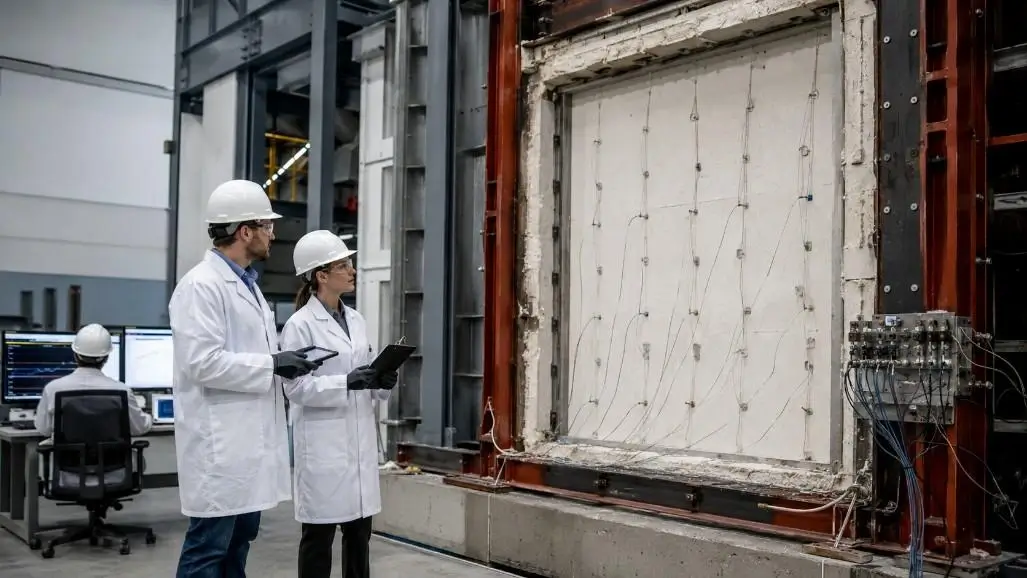
For building owners, architects, contractors, fire safety consultants and manufacturers, ASTM E119 Fire Test Standards matter because they turn fire resistance into something measurable. They do not just say a wall, floor, column or beam should resist fire. They test how long that assembly can continue doing its job when exposed to controlled fire conditions.
What ASTM E119 Fire Test Standards Actually Measure
At their core, ASTM E119 Fire Test Standards define a controlled form of fire resistance testing. A wall, floor, beam, column or similar assembly is placed in a furnace and exposed to a standard time-temperature curve. In simple terms, the test asks: how long can this assembly resist fire before it stops protecting the building?
The furnace temperature rises quickly. It reaches roughly 1,000°F, or 538°C, within the first five minutes and continues increasing as the test goes on. This does not copy every possible real fire. Instead, it creates a consistent and repeatable fire test so different assemblies can be compared fairly.
The assembly is judged on three main things.
First, it must keep carrying its load if it is a structural element. Second, it must stop flames and hot gases from passing through to the other side. Third, it must limit heat transfer, so the unexposed side does not get dangerously hot too quickly.
If the assembly fails one of these points, it fails the test. A wall that stays standing but lets flames through is not good enough. A floor that blocks flames but can no longer carry its load is not good enough either.
What the Rating Does Not Prove
ASTM E119 Fire Test Standards are powerful, but they are not magic. They test a specific assembly built in a specific way. They do not automatically prove that every version of that product, installed in every possible building, will perform the same way.
This is where projects often go wrong. The tested assembly may include certain boards, fixings, sealants, insulation, joints and installation methods. If the contractor changes one of those parts on site, the installed version may no longer match the tested version.
That is why the full test report matters. A short product listing or headline rating is not enough. The local authority, inspector, design team and contractor all need to make sure the tested design is the same as the installed design.
How the ASTM E119 Fire Rating Works
An ASTM E119 fire rating usually appears as a time period, such as 1 hour, 2 hours or 3 hours. This means the assembly met the test requirements for that length of time under the standard test conditions.
It does not mean the assembly is fireproof. It also does not mean the building is safe in every fire scenario. It means the assembly achieved a measurable level of resistance in a controlled test.
This distinction matters. A 2-hour rating is not a promise that every real fire will behave the same way. Modern fires can involve plastics, synthetic materials, batteries, dense storage and other fuel loads that burn differently from the materials used when older fire curves were developed.
So the rating gives you a benchmark. It helps you compare assemblies and meet code requirements. But it should still be used alongside the building’s actual risk profile, occupancy and fire strategy.
Restrained vs Unrestrained Assemblies
One of the most common specification mistakes under ASTM E119 Fire Test Standards involves restrained and unrestrained assemblies.
A restrained assembly is one where surrounding construction limits movement during a fire. For example, some concrete floor systems may be restrained by the structure around them. An unrestrained assembly has more freedom to expand or move as it heats up.
This matters because the rating can change. The same assembly may perform differently depending on whether it was tested as restrained or unrestrained.
A spec sheet may show the stronger result, but the real building condition may not match it. That is why you should check the test report, not only the marketing material. The report should show the condition under which the rating was achieved.
Why the Hose Stream Test Matters
Under ASTM E119 Fire Test Standards, many assemblies also go through a hose stream test after the furnace exposure. This part is easy to overlook, but it is important.
The hose stream test exposes the hot assembly to the force and shock of pressurised water. It represents some of the stress that can happen during firefighting. An assembly that survives the furnace but falls apart when hit by the hose stream has not provided reliable compartmentation.
In plain language, the assembly must stay together when it matters. Fire resistance is not only about surviving heat. It is also about maintaining a barrier long enough for people to escape and for firefighters to work.
ASTM E119 and Other Standards
The term astm e119 is commonly used in North America. You may also see it written as e119, astm e 119, astm test e119 or astm e119 fire test in project documents, product listings and technical submittals.
In the UK and Europe, other standards are normally used, such as BS 476 and EN 1363. That means an assembly tested only to ASTM E119 is not automatically accepted for every UK or European project.
This is especially important when products are imported or substituted during procurement. A North American manufacturer may provide an astm e119 fire rating, but the design team still needs to confirm whether that evidence satisfies the local building regulations and project requirements.
Where Specifications Go Wrong
ASTM E119 Fire Test Standards are most useful when the specification is precise. Problems begin when a project specifies a rated product but not the full tested assembly.
For example, a fire-rated board on its own is not the same as a fire-rated wall. The wall rating depends on the boards, framing, insulation, fixings, joints, penetrations and installation method working together.
The same applies to floors, beams, columns and doors. The tested assembly is the thing that earns the rating, not just one material inside it.
Before approving a substitution, ask one simple question: does the new product keep the assembly identical to the tested design? If the answer is unclear, the substitution needs more review.
What to Check Before Approval
Before you specify, approve or install a fire-rated assembly, pull the full test report. Check the rating duration, the tested assembly build-up, the restrained or unrestrained condition, the hose stream result and any limits on use.
Then compare that report with what is actually being installed on site. Look for changed fixings, different insulation, missing sealants, unapproved penetrations or substituted boards. Small changes can have big consequences.
Getting ASTM E119 Fire Test Standards right is not about collecting paperwork for compliance. It is about making sure the wall, floor, column, beam or door can protect people when the building is under real stress.
The most important follow-up is simple: revisit the assembly before installation is complete. Procurement changes happen quickly, and by the time everything is covered up, the tested design and the installed design may no longer be the same. That is the gap that fire testing is meant to close.