


Fire rated cement boards are one of the most versatile passive fire protection products on the market, and yet they remain poorly understood in a lot of UK procurement conversations. The confusion often comes down to one question that gets asked too late: is cement board fire rated, or just fire resistant in a material sense? The honest answer is that it depends entirely on what you are asking the board to do and what evidence backs the system around it.
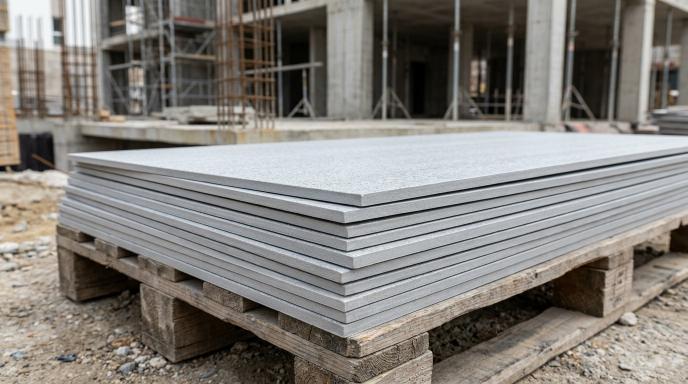
Most fibre cement and glass fibre reinforced cement panels used in UK construction are non-combustible to EN 13501-1 classification A1, which is the highest reaction to fire class and means the material does not contribute to fire development. That classification matters and it is a genuine strength. But A1 under EN 13501-1 describes reaction to fire, not fire resistance as a structural or separating element. Those are two different measurements, and treating them as the same leads to mis-specified jobs where the board is genuinely excellent but the system around it was never designed to hold a rated period.
What cementitious boards are actually made of?
Standard fibre cement boards are manufactured from a mixture of Portland cement, cellulose fibre, and siliceous binders, with the wet mix formed into sheets and cured using autoclaved processing under high steam pressure and temperature. That autoclaved production step is what gives the boards their dimensional stability, consistent density above 1200 kg/m³, and resistance to moisture, frost, and chemical attack over extended service life. Glass fibre reinforced cement boards, used in higher performance applications including tunnel cladding and shaft wall systems, substitute glass fibre reinforcement for cellulose and typically achieve a denser, less permeable cross section with better performance in wet state MOR testing.
Both families are classified to BS EN 12467, the harmonised standard for fibre cement flat sheets, which assigns Category A, B, or C depending on exposure class, with Category A boards intended for applications subject to heat, high moisture, and severe frost. That classification is product level, not system level, so it tells you the board can survive the environment it is placed in without losing structural integrity, not that a wall built from it will hold fire for 60 or 120 minutes.
Is cement board heat resistant?
People ask is cement board heat resistant almost as often as they ask is cement board fire rated, and the practical answer is yes, but the useful follow up question is: heat resistant enough for what?
Fibre cement products tested to BS 476 Part 4 are classified as non-combustible at material level, which confirms they will not sustain ignition or contribute calorific value to a fire. Kemwell’s WeatherKem fibre cement board, for example, carries an A1 classification to EN 13501-1 confirmed by BRE test, a Class 0 surface spread of flame under BS 476 Part 6 and 7, and satisfies the criteria of BS 476 Part 22 when used in partition assemblies to achieve EI 60 and EI 120 ratings.
The distinction between material non-combustibility and system fire resistance is the most important concept in this article. A board can be A1 and still not deliver EI 60 on its own, because fire resistance depends on the board thickness, the framing type, stud spacing, fixings, insulation, and the total tested construction. When a client specifies fire rated cement boards and just names a product, without referencing a system or tested construction, the job is already behind where it needs to be.
Cementitious board fire rating levels and how they are expressed
Cementitious board fire rating is expressed using the EN 13501-2 classification system for elements of construction, which separates load bearing capacity (R), integrity (E), and insulation (I), followed by the time in minutes. An EI 60 rating means the construction maintained both integrity and insulation for 60 minutes under a standard temperature-time curve. An EI 120 means 120 minutes, and so on.
The important detail is that fire resistance classifications apply to constructions, not individual boards. Aestuver fire protection boards, which are glass fibre reinforced cement panels with a density of 690 to 980 kg/m³ and thermal conductivity of 0.183 W/mK at 20 mm thickness, can support fire endurance from 60 to 240 minutes depending on thickness and system design, and are used in partitions, suspended ceilings, steel encasement, and structural concrete protection. That range is possible because the EI or R rating belongs to the tested assembly, and the board’s role within that assembly changes based on thickness, configuration, and what the construction is protecting.
The cellulosic fire curve used for most building applications follows the ISO 834 standard time-temperature profile, and it is the basis for most commercial fire rated cement board systems in the UK. Higher performance applications, particularly tunnel linings, use the hydrocarbon curve (HC or HCM) and the RWS curve, which simulate far more intense and rapid heat rise. Aestuver’s Tx board is engineered specifically for the RWS scenario and can withstand temperatures up to 1350 degrees C, which is well beyond the scope of any standard building partition requirement but illustrates how specialised the product family actually is at its upper end.
1 hour fire rated cement board: what systems deliver it
A 1 hour fire rated cement board system typically means a partition, wall lining, or ceiling construction that has been tested and classified EI 60 or REI 60 depending on whether load bearing capacity is also required.
In practice, a 1 hour fire rated cement board partition might use fibre cement boards such as Kemwell WeatherKem fixed to a metal stud frame, with mineral wool insulation in the cavity and boards applied on both sides in a configuration that has been tested to BS 476 Part 22. WeatherKem’s published test data confirms it achieves EI 60 in such configurations, and its screw pull-out strength of 810 to 930 N and racking resistance data confirm it behaves structurally under installation load, not just in a fire.
For specifiers writing a 1 hour fire rated cement board clause, the minimum information to include is the board product and its BS EN 12467 category and reaction to fire class, the stud or framing type and spacing, the insulation type and thickness, the required EI classification, and the test or assessment reference that confirms the build up. Without the test reference, you have a materials list, not a specification.
2 hour fire rated cement board: where it is used and how it is specified
Two hour fire periods are common in higher risk applications, taller buildings, plant rooms, service shafts, escape stair enclosures, and industrial compartments where fire strategy or structural requirements demand longer resistance. A 2 hour fire rated cement board solution achieves EI 120 or REI 120 depending on load bearing requirements.
Aestuver BSP boards deliver this performance in several configurations, with tested systems supporting 120 minutes under the cellulosic curve in partition walls, shaft walls, and encasement applications. The field of application is critical here, because a tested 2 hour fire rated cement board system for a partition wall is not automatically valid for structural steel encasement without a separate assessment or test for that configuration. This is one of the most common frustrations for site managers: a product has been tested to 120 minutes, but in a different geometry than the one being built, and the approval chain breaks down.
For a 2 hour fire rated cement board shaft wall system, the tested construction should confirm the stud type, board layer count and thickness, board orientation, fixing centres, horizontal joint detail, and whether the test included one sided or two sided fire exposure. All of that information belongs in the DoP and the ETA documents that accompany properly certified products, and requesting those documents is the fastest way to verify whether a product can actually deliver what a contractor is claiming.
Concrete spalling protection and structural encasement
One specialist use of fire rated cement boards that rarely gets explained in standard specification guides is protection against concrete spalling in fire. When ordinary concrete is heated rapidly, steam pressure builds inside the structure and causes explosive surface failure that exposes reinforcement and reduces load bearing capacity far faster than the nominal fire resistance suggests.
Aestuver boards are used in tunnel and building applications to absorb heat and slow temperature rise at the concrete surface, delaying the onset of spalling and helping the structure maintain its designed capacity for longer. At structural steel level, cement board encasement performs a related function by providing a protective barrier that slows temperature rise in the steel section, which loses around 40 to 50 percent of its strength when the temperature exceeds 400 to 500 degrees C.
This is where cement fire board products differentiate themselves most clearly from intumescent coatings, which also protect steel but rely on a reactive expansion mechanism that behaves differently under different fire scenarios. For steel in aggressive environments, plant rooms, or areas where physical damage to coatings is a risk, a cement board encasement system offers a more robust physical barrier, and several Aestuver systems carry ETA documentation for exactly this structural use case.
External use, moisture, and Category A board requirements
Many UK specifiers want to use fire rated cement boards in external or semi-exposed positions, and this is where BS EN 12467 category rating becomes directly relevant.
Category A boards to BS EN 12467 are tested for applications subject to heat, high moisture, and severe frost, which means the product has been verified as dimensionally stable and structurally sound in challenging outdoor exposure conditions. WeatherKem is a Category A board with a minimum expected service life of 30 years, a thermal expansion coefficient of 7.43 x 10 to the power of minus 6 mm/mm/°C, and density above 1200 kg/m³ measured to ISO 8336. Those physical properties tell you it will not delaminate, cup, or lose its fire performance in the kind of temperature and humidity cycles that an external façade backing board experiences over decades.
When selecting cement fire board for external walls, confirm three things. First, check that the board carries Category A classification to BS EN 12467, not just a generic fire label. Second, confirm the reaction to fire class is A1 to EN 13501-1. Third, if the fire strategy requires the wall to deliver an EI period, request the tested system details that include the external substrate, frame, and insulation used in the test, because changing any of those can invalidate the field of application.
A practical specification checklist
Use this checklist before you finalise any fire rated cement board scope:
- Name the board product, its EN 13501-1 reaction to fire class, its BS EN 12467 category, and its DoP reference.
- State the required EI or REI classification and fire period, for example EI 60 or EI 120, and confirm this refers to the system not just the material.
- Reference the tested or ETA assessed construction detail, including board thickness, number of layers, frame type, stud spacing, insulation, and fixing pattern.
- For external positions, confirm Category A certification and request dimensional stability data including wet state MOR and thermal expansion figures.
- Confirm the fire curve the construction is tested against. Most UK building applications use the cellulosic curve, but plant rooms, energy facilities, and tunnels may require HC, HCM, or RWS resistance.
- Require third party certification documentation, not just a product brochure or a sales reference to fire rating.
If a contractor or supplier cannot answer these points from their data pack, the product has not been properly evidenced for the intended use. That is the practical definition of a specification that will not survive building control or handover review.
Cement fire board is a strong, durable, and genuinely non-combustible family of materials, and properly specified fire rated cement boards deliver real compartmentation for demanding periods including EI 120. The challenge is not with the products themselves, it is with the gap between product classification and system performance that regularly appears in UK tender documents when board type is named without tested system evidence. Close that gap early, and fire rated cement boards are one of the most reliable tools a fire strategy can depend on.