


A window is the weakest point in most fire-resisting walls. Ordinary glass cracks and falls out within minutes of a fire reaching it, and once it has gone, flames and heat pass freely to whatever lies beyond. Fire rated window shutters are one way of closing that gap: a steel curtain that sits rolled up above the opening and drops into place when a fire starts. They suit some situations well and others poorly, and the difference is rarely explained at the point of sale. By the end of this guide you will be able to tell where a shutter makes sense, understand what a rating such as one hour does and does not promise, and weigh a shutter fairly against fire-rated glazing.
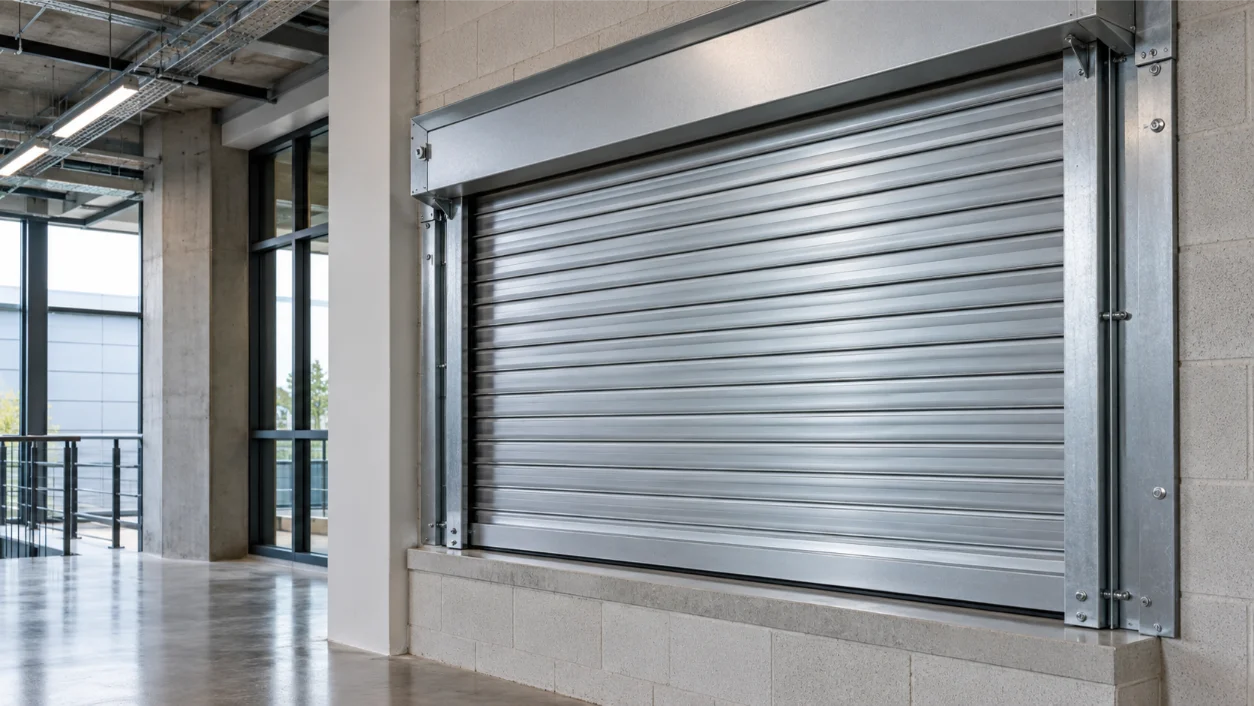
Where do fire rated window shutters earn their place?
Most windows need no fire protection at all. The requirement appears only where an opening sits in a wall that has a fire-separating job to do, and Approved Document B (ADB), the government guidance for England, points to a small number of recurring cases.
- Windows close to a site boundary, where fire could jump to a neighbour
- Windows beside an external escape stair
- Serving hatches between a kitchen and a dining or public area
- Internal windows in a wall dividing one fire compartment from the next
- Openings facing another wing across a narrow courtyard or lightwell
Two figures from ADB explain a good share of enquiries. A wall within 1 m of the boundary may contain only tiny unprotected areas, so any normal-sized window there needs protecting. And glazing within 1.8 m of an external escape stair has to resist fire, because people must be able to walk past it while the room behind burns.
The serving hatch is the classic shutter job. A school kitchen, a pub servery, a hospital reception desk: each needs a wide opening that stays clear all day and seals shut in a fire. Glass cannot do that. A shutter can.
For the other cases the choice is less obvious, and it depends on how the thing closes.
How do automatic fire shutters for windows close?
The hardware is simple. Interlocking steel laths form the curtain, which winds onto a barrel hidden inside a hood above the opening. Steel guides run down each side, and a heavy bottom rail keeps the curtain straight as it travels.
What varies is the trigger. There are two common ones, and many installations combine them.
The older method is a fusible link, a small metal tag held together with solder that melts at about 72°C. While intact it holds the curtain up. When hot air from a fire reaches it, the solder gives way and the shutter falls. No wiring, no power, nothing to programme.
The modern method ties the shutter to the fire alarm. A signal from the panel releases a solenoid or tells the motor to close, usually after a few seconds of warning from a sounder and beacon so that nobody is standing underneath. The better designs use what the trade calls a gravity fail-safe: the motor only ever lifts the curtain, and when power or signal disappears the weight of the steel brings it down at a governed speed. I admire that arrangement. It means the failure of every electrical part produces the safe result.
Battery backup covers the units that need power to close, and the alarm engineer records which detector triggers which shutter in a document known as the cause and effect.
One rule people get backwards
You might assume every shutter should drop the moment the alarm sounds. ADB says otherwise for a shutter across an escape route: it should release only on heat detected close to the opening, such as a fusible link, and not on a general alarm or smoke signal. The reasoning is plain once you hear it. An alarm on the third floor should not seal a route on the ground floor that people still need.
What does a 1 hour fire rated shutter promise?
Less than the phrase suggests, and this is the single most useful thing to understand before you buy.
Fire test results come in three grades, each marked by letters in front of the minutes. E stands for integrity: the product stays in place and keeps flames and hot gases on the fire side. EW adds a limit on radiated heat, capping it at 15 kW/m² measured 1 m from the cool face. EI is the full package, integrity plus insulation, which keeps the far surface cool enough to touch nothing off.
A standard steel shutter achieves E. So a 1 hour fire rated shutter, written properly as E 60, holds back flame for 60 minutes. It does not hold back heat. A single skin of steel facing a furnace at over 900°C becomes a radiator, and the room on the safe side receives that warmth in full.
The steel stays up. The heat comes through.
For many uses that is acceptable, and ADB allows integrity-only protection in a range of positions. It becomes a problem where people must pass close by, or where stock, furniture or curtains stand within reach of the glowing surface. Insulated shutters exist, built from twin-skin laths packed with mineral fibre, and they reach EI ratings. They are also bulkier, dearer and available in fewer sizes.
The paperwork to ask for
Since 1 November 2019, fire shutters sold in the UK have had to carry product marking under BS EN 16034, the standard for fire-resisting doors and shutters, read together with BS EN 13241 for industrial doors. In practice that means the supplier owes you a declaration of performance stating the class, such as E 60 or E 120, and the test evidence behind it. Manufacturers such as Bolton Gate, with its Fireroll range, and Hörmann publish ratings running up to four hours of integrity.
Older shutters often cite BS 476-22 instead. ADB stops recognising that route on 2 September 2029, so a new installation should come with the European classification.
Which raises a fair question: if steel lets the heat through, why not use glass that does not?
Fire resistant window shutters or fire-rated glazing?
Often you can, and often you should. FireResist manufactures fire-rated glazing, so weigh this section with that in mind, but the reasoning stands on its own.
A shutter is an active measure. It protects the opening only if a link melts or a signal arrives, a release works, and nothing blocks the path of the curtain. Fire-rated glass is passive. It is already in position on the day of the fire, with no trigger, no power supply and no moving parts, and it comes in EW and EI grades that limit or stop the heat as well as the flame. It also lets daylight in for the other 364 days.
My view, which shutter suppliers will dispute, is that for an opening that functions as a window, meaning it exists for light and outlook, rated glazing is the better default. Their counter-argument is cost, and it has weight: a steel shutter over an existing frame is usually cheaper than replacing the whole window.
Shutters keep clear advantages in three places. The opening has to stay open in daily use, as with a hatch or counter. The existing windows cannot reasonably be replaced, perhaps in a retrofit where the frames must remain. Or the span is too wide for glass at a sensible price.
What fire resistant window shutters do badly
Be clear-eyed about the drawbacks. A dropped shutter turns a window into a steel wall, so it must never cover an opening that people rely on for escape or rescue. It needs headroom above the opening for the hood, often 300 mm or more, which many existing reveals lack. It depends on servicing for its whole life. And an ordinary security shutter, however solid it looks, carries no fire rating whatever; the two products share a shape and little else.
If a supplier describes a security shutter as fire resistant without a declaration of performance, walk away.
Why fire rated window shutters fail when they are needed
The pattern you’ll notice in buildings a few years after handover is that the shutter itself is sound and something around it has changed.
The commonest fault is an obstructed sill. A kettle, a till, a display stand or a stack of trays sits in the line of the curtain, and Sod’s law says the fire arrives on the day somebody left the tea urn there. Next comes the painted-over link, sealed in gloss by a decorator who had no idea what the little tag was for. Some shutters never got wired to the panel in the first place, or lost the connection when the alarm system was replaced. Batteries go flat unnoticed. Installers fix guides to plasterboard alone, when the test evidence assumed masonry or steel behind them. A trolley clips the bottom rail and bends it, so the curtain jams halfway. And the gap between the hood and the wall, which needs fire stopping like any other joint, gets left open because it is out of sight.
None of this shows until the shutter is asked to move.
So ask it. Under the Fire Safety Order of 2005, the responsible person for a building must keep fire equipment in working order, and for a shutter that means two habits. Run a drop test at regular intervals (many premises do it alongside the weekly alarm test) and watch the curtain travel the full height and seat on the sill. Then have a competent engineer service it at least once a year, or as often as the maker’s manual states. The Door & Hardware Federation, the trade body known as the DHF, publishes guidance on what that visit should include.
If you cannot find a service record for a shutter in your building, book the visit this week. An untested shutter is an assumption.
There is comfort in how little effort the routine takes. A drop test lasts two minutes, most faults it reveals cost little to put right, and a shutter that has closed cleanly fifty times in practice will almost certainly close on the day it matters.
Choosing between a shutter and the alternatives
Take the decision in this order and most of the confusion falls away.
- Confirm that the opening needs protection at all, and for how many minutes. Your fire strategy, fire risk assessor or building control officer will tell you.
- Ask whether integrity alone is enough, or whether people or combustible items near the opening call for heat protection as well.
- Decide how the opening is used. If it must stay open during the day, a shutter is the natural fit. If it is there for light and view, price fire-rated glazing first.
- Check the practical limits: headroom for the hood, solid structure for the guides, and a clear sill.
- Agree the trigger with the alarm engineer, keeping in mind the rule for escape routes.
- Collect the declaration of performance at handover and set up drop tests and servicing from day one.
Smaller premises, a café with one hatch for instance, can settle all six points in a single conversation with a competent supplier. Larger buildings should put them in the spec.
Fire rated window shutters are a sound answer to a narrow set of problems. They close an opening automatically, by a melting link or an alarm signal, and the best of them fall under their own weight if everything electrical fails. A standard steel model stops flame for its rated period and lets heat radiate through, so a 1 hour fire rated shutter suits positions where nobody and nothing stands close behind it, while insulated versions or fire-rated glazing serve where heat matters. Hatches, counters and awkward retrofits favour the shutter; true windows more often favour glass. Whichever you choose, the rating lasts only as long as the sill stays clear, the link stays unpainted and the service visits keep happening, and those three habits cost far less than the shutter did.