


A landlord cancels the six-monthly service visit to save a few hundred pounds, keeps running the weekly call-point test, and assumes that covers it. It doesn’t. Six months later the standby battery, the backup power supply that keeps the system running if the mains cuts out, has quietly lost most of its capacity, and nobody finds out until the power fails. That’s the shape most fire alarm maintenance shortcuts take: invisible for months, then expensive all at once.
What a Fire Alarm Maintenance Contract Should Actually Include
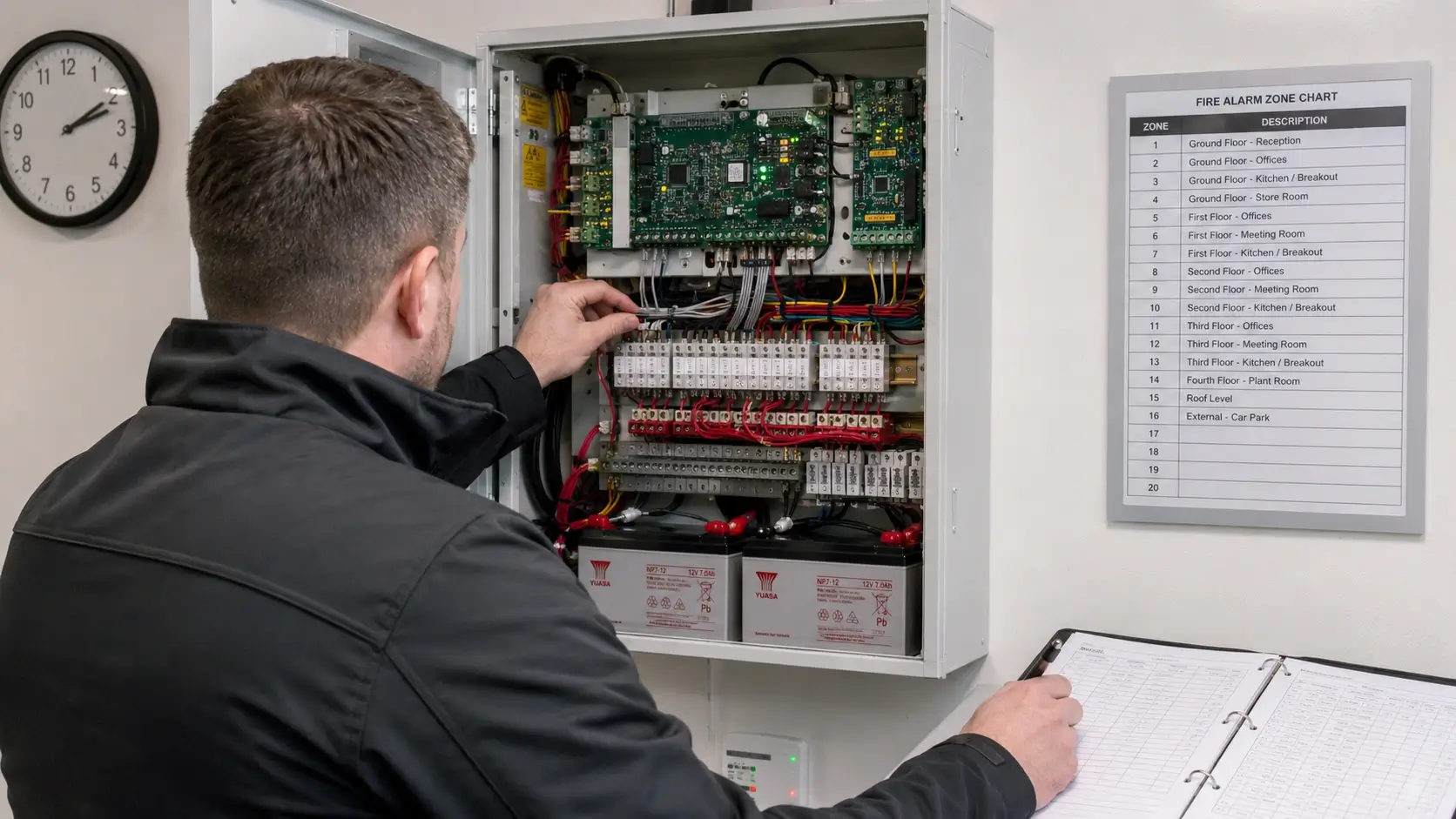
Fire alarm maintenance in the UK runs on two separate tracks, and treating them as one is the most common mistake. The weekly test needs no engineer: someone on-site presses one manual call point, the red break-glass alarm button by an exit or corridor, rotating through a different one each week. That only confirms the system still sounds; it says nothing about battery condition, detector sensitivity or wiring faults. The second track covers that: a full inspection and service by a “competent person,” a properly trained engineer, at intervals of no more than six months. Both are required under BS 5839-1, the British Standard for fire detection and alarm systems, and a good fire alarm maintenance contract spells out both. BS 5839-1:2025 now allows a five to seven month window around that six-month figure rather than a strict deadline, and added checks older contracts may not mention. At every visit, the engineer must now:
- Correct the panel’s clock
- Confirm the zone chart is current (the site plan showing which part of the building each alarm zone covers)
- Write the battery’s fitted date on the battery itself, so its age is easy to track
If your current contract predates 2025, it’s worth asking your provider whether it has been updated to match.
Fire Alarm Control Panel Maintenance: What the Engineer Is Actually Checking
The control panel, sometimes labelled the CIE (control and indicating equipment) on spec sheets, receives signals from every detector and call point and decides what to do with them. This is where fire alarm panel maintenance earns its keep; glancing at the display and calling it done isn’t fire alarm control panel maintenance. BS 5839-1 requires the standby battery to keep the whole system running for 24 hours after a mains failure, then still have enough charge to sound every alarm zone at full volume for a further 30 minutes.
Sealed lead-acid batteries, the type most panels use, degrade through sulphation, where lead sulphate crystals build up on the plates and reduce how much charge the battery can hold, long before it fails outright. Most need replacing every three to five years, sooner in a hot plant room. A battery can look fine on a simple voltage check and still fail when actually asked to power the system, which is why a competent engineer tests it under load, meaning while it’s supplying real current, rather than trusting the panel’s own reading.
Why Skipping Fire Alarm Maintenance Gets Expensive Fast
False alarms triggered by dust, steam or cooking fumes, what fire and rescue services log as an Unwanted Fire Signal, cost UK businesses more than £1 billion a year in lost production, evacuations and call-outs. Merseyside Fire and Rescue Service alone attends around 3,500 a year. A poorly maintained system doesn’t just risk missing a real fire; it generates the false alarms that make staff stop taking the alarm seriously.
That complacency effect is the harder cost to put a number on. Insurers frequently ask to see maintenance records before paying a fire-related claim, and under the Regulatory Reform (Fire Safety) Order 2005, the Responsible Person (usually the landlord, employer or building manager) must keep fire detection equipment in efficient working order. Skip a service visit to save money, and that exposure sits quietly until an inspector, an insurer or an actual fire asks to see the logbook, the on-site record of every test, fault and visit.
Choosing Fire Alarm Maintenance Companies: What Actually Separates Them
Not every business offering fire alarm maintenance near me on a search results page is equally qualified to touch your panel. The credential worth checking is BAFE SP203-1, a third-party certification scheme for fire alarm companies, audited by UKAS, the UK’s national accreditation body. It’s modular, so a company can hold the maintenance module without holding installation, worth checking if you’re comparing fire alarm maintenance companies for an existing system rather than a new one.
Price rarely tells you much on its own. Ask instead:
- What’s actually included in the visit
- Whether the engineer updates your zone chart and logbook on-site
- How quickly they respond to a genuine fault call, not just a scheduled one
Finding Fire Alarm Servicing Near You
Searching for fire alarm servicing near me surfaces plenty of local names, but proximity isn’t the credential that matters. BAFE runs a public register where you can check a company’s certification rather than taking a website’s word for it. A BAFE-registered engineer twenty miles away who answers a fault call within hours beats an uncertified one next door who doesn’t.
A Practical Fire Alarm Maintenance Checklist
A working fire alarm maintenance checklist for a typical commercial premises covers:
- A weekly call-point test, rotated and logged
- A six-monthly engineer visit, within the 2025 standard’s five to seven month window
- A standby battery check done under load, not just a visual inspection
- A zone chart review against how the building is actually laid out now
- Confirmation that decommissioned detectors or call points are actually removed, not just switched off
In most cases, that standard cycle is enough. Higher-risk premises, such as care homes, hotels, or buildings with a Category L1 system (the most thorough automatic detection, covering the whole building rather than just escape routes), often move to quarterly inspections instead. Worth asking your provider which category your building falls into.
Where This Leaves Your Next Service Visit
Check the date of your last fire alarm maintenance visit against the 2025 standard’s five to seven month window, and pull the logbook to confirm the weekly tests actually happened, not just got scheduled on paper. If your provider can’t say when your standby battery was last tested under load, that’s the question to ask before the next mains failure answers it for you.