


A landlord treats fire doors like any other joinery: fit once, forget about it. Then an inspector runs a proper fire door survey across the block and most doors fail on the first pass, not because they were bought wrong, but because nobody kept up with the fire door maintenance requirements that came with them. That gap between “installed” and “still performing” is where most compliance problems live.
Are Fire Door Inspections a Legal Requirement?
Yes, and the legal basis is broader than most people assume. Article 17 of the Regulatory Reform (Fire Safety) Order 2005 places a general duty on the Responsible Person, whoever has day-to-day control of a non-domestic premises, to ensure fire-resisting doors and escape doors are correctly installed and adequately maintained. That’s the core of fire door maintenance requirements in the UK: it applies whether you manage an office, a warehouse or a block of flats’ common parts, and there’s no size threshold that lets you opt out of it.
On top of that general duty, residential blocks above 11 metres carry a specific schedule under the Fire Safety (England) Regulations 2022: quarterly checks on fire doors in communal areas, and a “best endeavours” annual check on flat entrance doors. Below that height, the underlying fire door maintenance requirements still apply, they’re just not tied to a fixed inspection calendar the way Regulation 10 sets one out.
What a Fire Door Survey Actually Checks
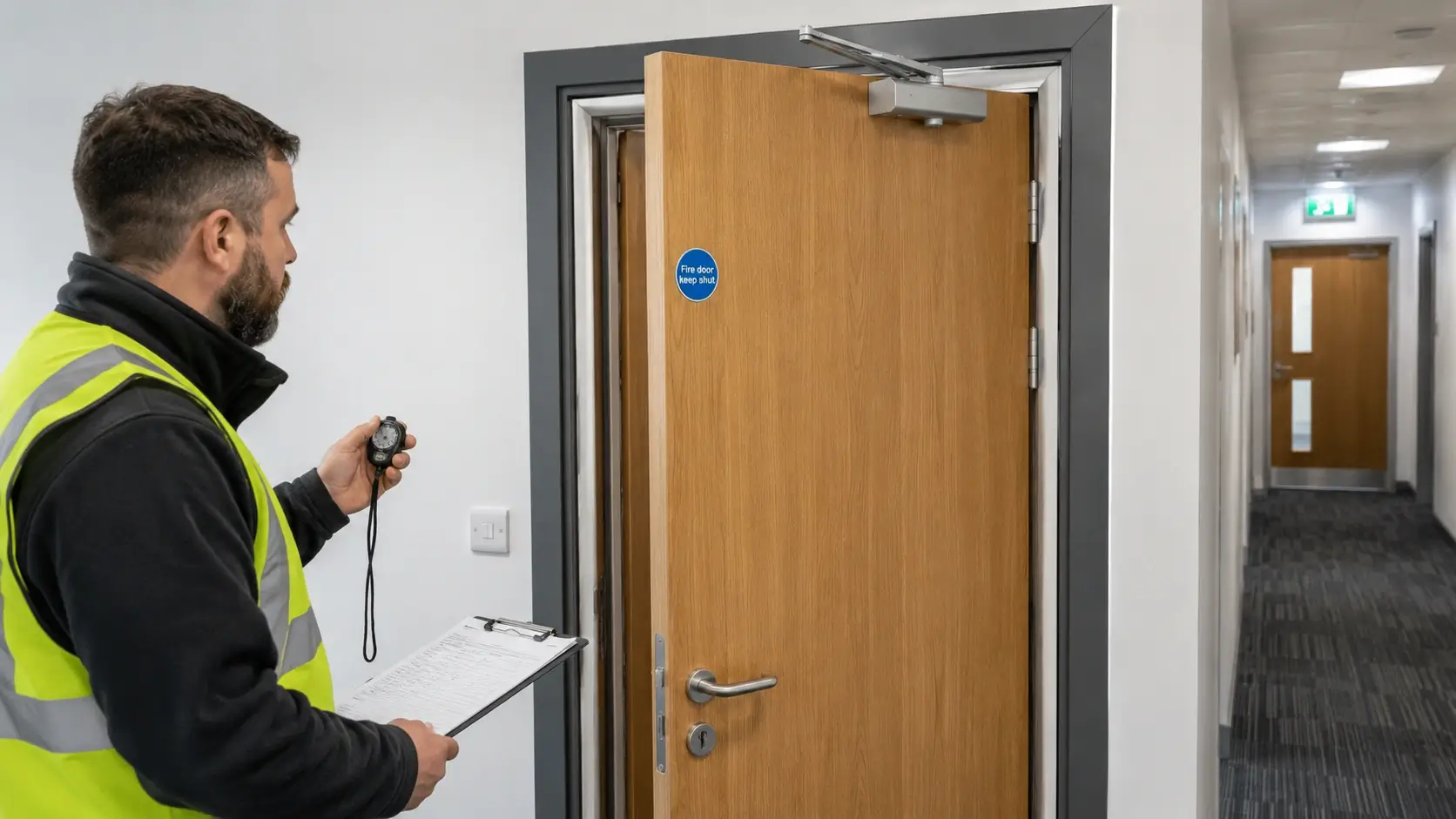
A fire door survey goes well past a visual glance from the corridor, and it’s the clearest way to confirm your fire door maintenance requirements are actually being met rather than assumed. The people trained to do it properly are certificated through FDIS, the Fire Door Inspection Scheme, owned by the British Woodworking Federation and delivered jointly with the Guild of Architectural Ironmongers. It’s a personnel certification, accredited by UKAS to BS EN ISO/IEC 17024:2012, meaning the individual inspector holds the qualification, not just the company they work for.
A proper survey covers a fixed set of checks rather than a general impression:
- Hinges: a minimum of three CE or UKCA-marked hinges to BS EN 1935 for an FD30 door, often four for FD60, with intumescent pads fitted underneath each one
- Self-closing devices: the door must close fully and latch from any angle, typically within 3 to 5 seconds from a 90-degree opening
- Intumescent and cold smoke seals: continuous around the frame, not compressed, cut short, or missing at the corners
- Signage: “Fire Door Keep Shut” for self-closing doors, “Fire Door Keep Locked” for manual ones, positioned at eye level on both faces
- Ironmongery matching the doorset’s original test evidence; a locksmith fitting a non-fire-rated handle or letterbox can invalidate the whole assembly, even if the replacement looks identical to what was there before
One UK fire door inspection firm reports that around 75% of doors fail on their first FDIS survey, a figure worth sitting with. That’s not a sign the product market is broken. It’s a sign fire door maintenance requirements get treated as a box ticked at fire door installation and then quietly ignored.
Fire Doors Maintenance Isn’t the Same Thing as an Annual Survey
Here’s the distinction that trips people up. A formal survey is a snapshot, usually annual or quarterly depending on the building. Fire doors maintenance is what happens in the gaps between those snapshots: someone noticing a door’s been wedged open with a fire extinguisher, a closer arm hanging loose, a missing screw in a hinge, the kind of thing a resident would walk past without a second thought. None of that needs an FDIS-certified visit to fix. It needs a member of staff who’s been told what to look for and given the authority to report it, because fire door maintenance requirements don’t pause between scheduled inspections just because nobody’s watching.
Skipping that day-to-day layer and relying purely on the scheduled survey is a common and expensive mistake, worth saying plainly. A door can fail badly between one quarterly check and the next.
Finding Fire Door Inspection Near You
Searching for fire door inspection near me or fire door maintenance near me turns up plenty of local contractors, but location isn’t the credential worth screening for. Check whether the individual inspector is FDIS-registered, or whether the company holds BM TRADA or FIRAS accreditation for the maintenance work itself. A nearby firm with no verifiable certification isn’t a shortcut on fire door maintenance requirements, it’s a different problem wearing a local postcode.
A Practical Fire Door Maintenance Checklist
Between formal surveys, a working fire door maintenance checklist for on-site staff covers:
- Confirming the door isn’t wedged, chocked or held open outside an approved hold-open device
- Checking the closer pulls the door fully shut and the latch engages, every time
- Looking for daylight around the frame that suggests the gap has widened
- Confirming signage is present, legible and undamaged on both faces
- Reporting any drilled holes, added locks or swapped hardware to whoever manages the fire door maintenance requirements for the building
This isn’t a replacement for a certified survey. It’s what keeps a building safe, and the survey passing, in between them.
Where This Leaves Your Next Fire Door Check
Pull the record of your last formal survey and check the date against your building’s height and Regulation 10’s quarterly or annual schedule, not just against when it feels due. If nobody on-site has ever been shown the day-to-day checklist above, that gap is worth closing before the next scheduled survey finds it for you. Fire door maintenance requirements don’t reset the clock when a tenant changes or a lease renews; whatever was overdue stays overdue.