


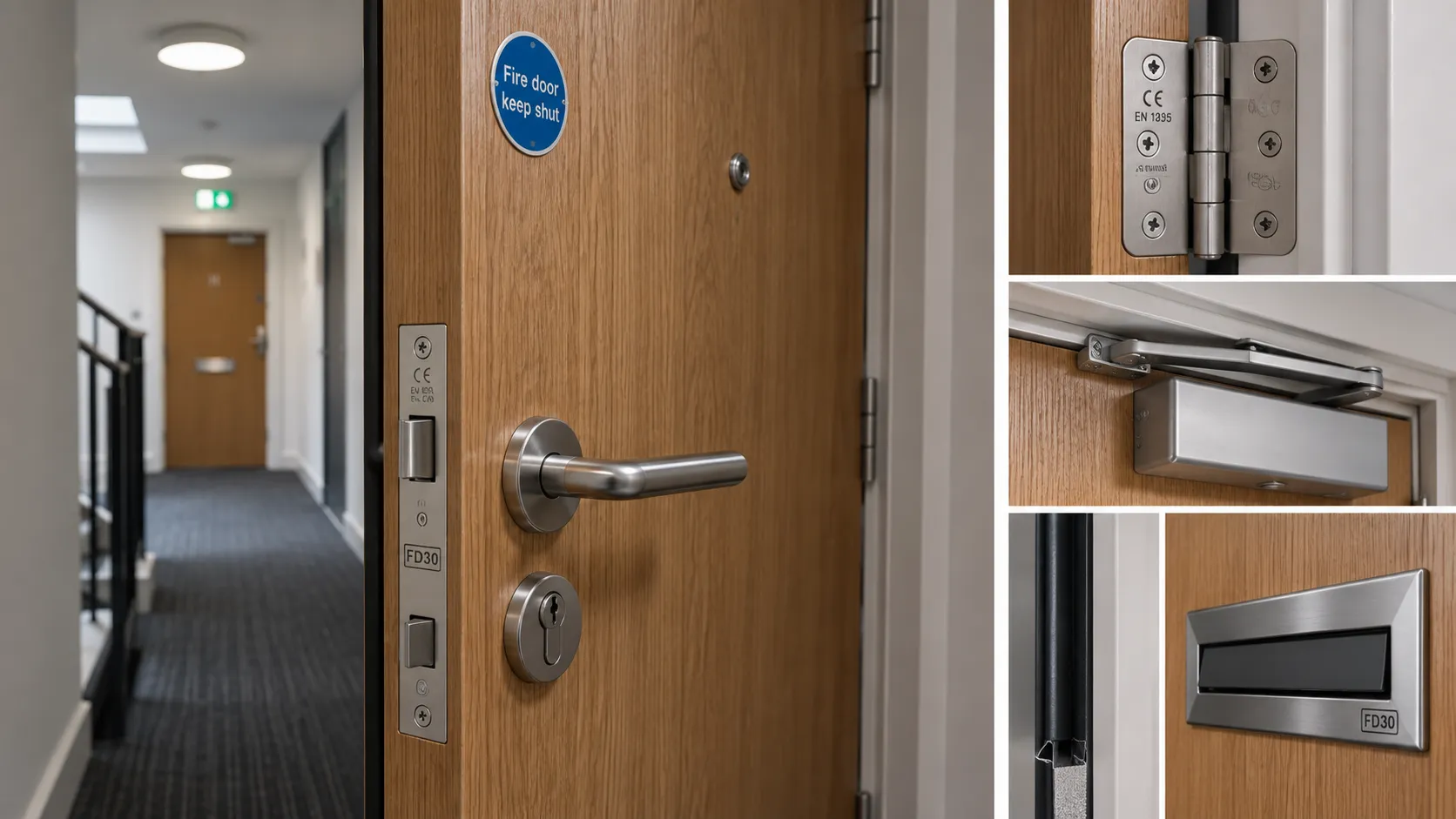
Fire door ironmongery is where a perfectly compliant doorset quietly stops being compliant, and it almost never happens through cutting corners – it happens through a well-meaning maintenance swap. Ironmongery is the trade term for everything bolted to a fire door that isn’t the leaf itself: hinges, closer, lock, latch, letterplate. Every one of those items carries its own fire test evidence, independent of whatever rating the door leaf holds on its own. After reading this article you’ll be able to look at any fire door’s hardware and tell within a minute whether it’s still doing the job the doorset was tested to do, or whether somebody’s quietly undone that testing with a handle grabbed off the wrong shelf.
What actually counts as fire door ironmongery
A fire door is tested and certified as a complete doorset – leaf, frame, hinges, closer, lock, seals, glazing, all of it together – and every hardware item in that assembly, the fire door ironmongery itself, needs its own Declaration of Performance stating the fire duration it was tested to, alongside a CE or UKCA mark. That paperwork isn’t decorative. If a single load-bearing component in the doorset lacks valid evidence, building control can reject the whole installation, not just flag the missing part.
Here’s the detail that catches out even experienced contractors: the test evidence has to match the actual door leaf material. A hinge tested on a timber substrate doesn’t automatically carry its rating over to a steel doorset, whatever the box says about fire duration. Specifiers who assume “CE marked” means “interchangeable” are working from a misunderstanding that costs money the first time an assessor asks for the paperwork behind a specific installation.
Hinges: the three-hinge rule, and where it actually fails
Hinges are the most heavily regulated category of fire door ironmongery. BS EN 1935 governs fire door hinges, and the baseline most FD30 doors need is Grade 11 durability – tested to 200,000 open-close cycles. Heavier leaves, high-traffic corridors, FD60 doors carrying real weight: those typically move up to Grade 13, stainless steel, twin ball bearings, rated to hold up to 120kg. Three hinges minimum, always, on any fire door leaf. Not two.
That last point matters more than it should. Two-hinge fire doors turn up constantly on older residential stock and converted commercial buildings, and it’s not a subtle defect – it’s a straightforward compliance failure the moment anyone actually checks. The pattern you’ll notice on second-fix inspections is that the missing third hinge almost always coincides with a leaf that’s started to sag at the closing edge, because two hinges simply weren’t built to carry the load over years of daily use. Intumescent hinge pads matter here too, protecting the timber beneath the hinge from charring – skip them and you’ve built in a weak point exactly where the door needs to stay rigid longest.
Door closers: what power size 3 actually means
Closers are the second most heavily regulated category of fire door ironmongery. Under BS EN 1154, a fire door closer has to hit a minimum power size of 3 – sizes 1 and 2 simply aren’t rated for the job, whatever they cost or how smoothly they swing. The closer also needs a Grade 1 fire classification within the standard’s own coding system, and it has to shut the door fully from any opening angle, overcoming whatever resistance the latch or the smoke seal throws back at it.
Testing this properly takes thirty seconds and most people skip it anyway. Open the door to 90 degrees, let go, and watch it swing shut and latch. Then try it again from something closer to 45 degrees. A closer that only performs from a wide-open start is one bad afternoon away from failing on a door that’s only ever nudged half-shut by a resident carrying shopping.
One habit worth naming directly, because it’s genuinely dangerous rather than merely non-compliant: dogging a fire door – wedging or locking the latch retracted so it stays permanently open – voids the fire rating outright. If a door genuinely needs to stay open during the day, the only compliant route is an EN 1155 hold-open device wired into the building’s fire alarm, releasing the door the instant the alarm sounds. A doorstop and a bit of gaffer tape is not that device, belt-and-braces or not.
Fire door locks regulations: what’s actually required
Locks and latches on fire doors fall under BS EN 12209, and Grade 1 fire classification is the floor, not a nice-to-have. Beyond the fire rating itself, there’s a separate and equally strict requirement running underneath it: anyone on the inside of a final exit door has to be able to open it without a key, full stop. Approved Document B expects key-free egress on escape routes, which is precisely why thumbturn cylinders sit on the inside face of so many fire-rated flat entrance doors even where the outside face takes a full euro cylinder.
The most common failure here isn’t a design decision at all – it’s a repair. A domestic-grade latch, the kind sold for an ordinary internal bedroom door, gets fitted onto a fire door during routine maintenance because it was on the van and it physically fits the mortice. It looks identical from the corridor. It is not fire rated, and a fire-rated door with a non-rated latch is a full compliance failure regardless of how solid everything else on that doorset happens to be.
Letterplates and vision panels: the fire door ironmongery people forget
Ironmongery doesn’t stop at hinges, closers and locks – anything cut into the leaf counts too, and this is the category installers overlook most often because it doesn’t feel like hardware. A letterplate through a flat entrance fire door needs an intumescent bag or cowl fitted behind it, sized and positioned exactly as the door’s test certificate specifies, because an unprotected letterbox aperture is a direct route for flame and smoke straight through a supposedly 30-minute barrier. Fit one bought off a general hardware shelf, in the wrong position, at the wrong size, and you’ve cut a hole in a fire door that the original test evidence never accounted for.
Vision panels carry the same logic. Fire-rated glazing has to sit within beading and intumescent glazing tape specified by the doorset’s test evidence, not whatever trim matches the paintwork best. Cutting any new aperture into an existing certified fire door – a viewer, a cat flap, a second letterplate for a redirected postal address – voids the certification outright unless it’s been assessed against the original test data first. That’s not bureaucratic caution. It’s the same principle running through every hinge and closer in this guide: the doorset was tested as a whole, and every hole you cut into it afterwards has to answer to that same test.
Fire door lock types: panic hardware versus emergency exit devices
Two European standards govern the hardware on escape route doors, and which one applies depends entirely on who’s using the building, not on personal preference. BS EN 1125 covers panic exit devices – the horizontal bar, sometimes called a crash bar on site – for doors where the people escaping might never have used that exit before: shops, schools, venues, anywhere the public gathers without training. BS EN 179 covers emergency exit devices, operated by a lever or push pad, for doors used by people who already know the building and the escape route: staff-only back-of-house doors, mainly.
Is it ever both at once? Occasionally, yes – a single building commonly needs EN 1125 on its public-facing final exit and EN 179 on a staff exit twenty metres away, and the assessment genuinely runs door by door rather than building-wide. Get that assignment backwards and you’ve fitted hardware rated for trained, familiar users onto a door the general public might hit at a dead run.
The paperwork problem nobody wants to own
Here’s where most guides stop – and where you should keep going. Certification evidence for fire door ironmongery isn’t just a specification detail; it’s the thing that gets scrutinised hardest after something goes wrong. The Grenfell Tower Inquiry’s Phase 2 report, published in September 2024, singled out weak traceability between tested products and what actually ends up installed on site – hardware swapped, certification unclear, nobody able to produce the paperwork proving what was actually fitted matched what was actually tested.
That’s not a historical problem confined to one tragedy. It’s a live one on any building where hardware gets replaced piecemeal over a decade by different contractors, none of whom checked what the original doorset certificate actually specified. In most retrofit projects, the fix costs very little – keep the DoP for every hinge, closer and lock in the building’s fire safety file, and refuse any swap that doesn’t come with its own paperwork. The uncomfortable truth is that ironmongery compliance can’t fix everything on its own, either: perfectly certified hardware bolted to a warped leaf or an out-of-square frame will still fail, because the rating belongs to the tested assembly, not to any single component sitting inside it.
What to do next
Walk your fire doors and count hinges first – three minimum, no exceptions, and check for sagging at the closing edge while you’re there. Then test every closer from both a full swing and a shallow angle, and confirm nothing on your escape routes has been dogged open without an EN 1155 device behind it.
Pull the Declarations of Performance for every piece of fire door ironmongery currently fitted – lock, closer and hinge – match them against the doorset’s original test certificate, and flag anything that doesn’t have paperwork behind it – then put that same check back on your calendar in 30 days, because the next contractor through the door won’t know what you just found unless you tell them.