


A facilities manager compares two quotes for fitting forty flat-entrance doorsets. One installer is Q-Mark certified and costs more. The other has “years of experience” and nothing on paper to back it up. It’s tempting to assume a fire door is a fire door once it’s hung, but the test evidence behind that doorset only holds if the fitting matches it exactly. Q-Mark fire door installation exists precisely to close that gap between a certified product and a competent fit.
What Q-Mark Fire Door Installation Actually Certifies
Q-Mark Fire Door Installation, scheme reference STD 052, is operated by BM TRADA, a UKAS-accredited certification body. It’s worth clearing up a common assumption straight away: the scheme doesn’t personally examine every fitter on a job. It’s built around training one nominated individual, who takes responsibility for the training and work carried out by the operatives under them. That person completes a two-part process, a seminar called – Fire Doors Explained, followed by a second classroom session and written exam, before certification is granted. The company then gets audited on an ongoing basis to keep it, which is what separates a genuine Q-Mark fire door installation from a firm simply claiming to follow best practice.
That structure matters because it puts accountability somewhere specific. If a doorset fails inspection, there’s a named individual whose training and sign-off are on record, not just a company logo on a van.
Why Q-Mark Fire Door and Q-Mark Fire Door Installation Aren’t the Same Thing
Here’s the mix-up that trips up a lot of specifications. BM TRADA runs separate Q-Mark schemes for different points in the supply chain: one certifies the manufacturer of the fire door itself, confirming it’s built to a tested specification, and a completely different one, the installation scheme, certifies the contractor fitting it. A door leaving the factory with a genuine Q-Mark manufacturer’s certificate tells you nothing about who hung it. Fit a correctly certified door badly, oversized gaps, the wrong hinges, seals cut short at the corners, and the fire performance the manufacturer proved in a lab doesn’t carry over to the wall it’s sitting in.
What Actually Gets Checked During Fire Door Fitting
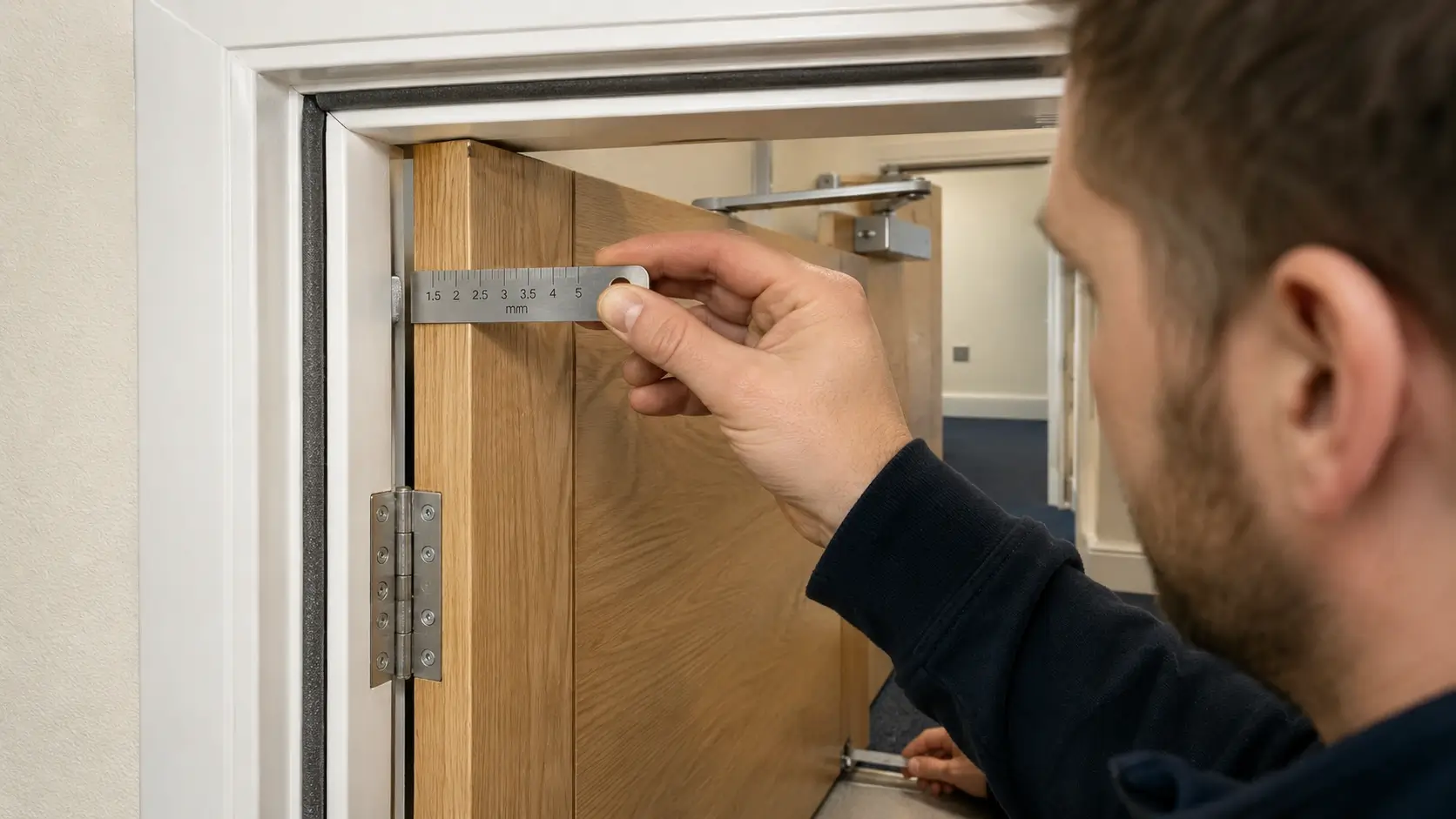
Fire door fitting lives or dies on tolerances most people would never think to measure. During a proper Q-Mark fire door installation, an installer is checking against a short list of fixed points, not general joinery good sense:
- Head and jamb gaps of roughly 3mm, with 2 to 4mm generally accepted, so the intumescent seal, the strip that expands under heat, can bridge the gap before flame gets through
- A threshold gap of 8 to 10mm on a standard door, dropping to 3mm or needing a threshold seal if the doorset must also control cold smoke
- Hinges, closers and locks matching the exact ironmongery listed in the door’s test evidence, since swapping in a similar-looking but untested component can void the fire rating just as easily as a bad gap
- Intumescent and smoke seals fitted continuously around the frame, not stopped short at the corners
Go wider than that gap tolerance and the math stops working: the seal simply can’t expand fast enough to close a bigger space before hot gases get through.
BS 8214:2026, published this March, is the current code of practice behind those numbers. It replaced the 2016 edition and, notably, extended its scope beyond timber doors to cover steel, aluminium and composite assemblies too, with clarified installation guidance specifically aimed at reducing the kind of on-site misinterpretation that used to slip past inspection.
What Poor Fire Door Installation Actually Risks
Here’s the blunt version. A badly fitted fire door doesn’t fail gradually, it just doesn’t perform when it’s needed, and nobody finds out until an inspection or a real fire proves it. In most cases, catching a bad installation early is a cheap fix: repacking a hinge, swapping a seal, adjusting a closer. Catch it after decoration and handover, and correcting a warped frame or an oversized aperture can mean reopening finished plasterwork around it, which is a different order of cost and disruption entirely. Insurers and building control inspectors both tend to ask the same question when a fire door fails a check: who fitted it, and can they prove it.
That’s the part a certificate doesn’t fully protect against on its own, worth saying plainly: even a Q-Mark installer can hang a door badly on an off day. What certification buys you is a documented, auditable process and someone accountable for fixing it, not a guarantee that every single door is perfect.
Choosing a Q-Mark Fire Door Installation Certification Holder
Poyntell, a London and South East installer, states it was the third company in the UK certified under the Q-Mark scheme for both fire door installation and maintenance, and says it certifies over 10,000 commercial fire doors a year under that arrangement. Whether or not that’s the exact company you use, it’s the right shape of claim to ask any contractor to back up: a current certificate number, the name of the nominated individual responsible for your job, and confirmation of what BM TRADA’s audit actually covers for that firm.
Price alone won’t tell you whether you’re buying genuine Q-Mark fire door installation or just a confident quote. A certificate number you can look up does.
Where This Leaves Your Next Fire Door Order
Ask your installer for their Q-Mark certificate number before the doorsets arrive on site, not after they’re hung. You can verify that number against BM TRADA’s own certified company list rather than taking a subcontractor’s word for it, since a certificate that’s lapsed or never existed looks identical on a quote to one that’s current. If any of your doors are steel, aluminium or composite, check the fire door installation guidance against BS 8214:2026’s newer material-specific annexes rather than assuming timber-door rules apply across the board. That’s the detail worth revisiting on any project already underway, since the standard changed underneath it this year, and a specification drawn up against the withdrawn 2016 edition may no longer match what a building control officer is checking it against.