Fire services are busier than they have been in a decade, but less of that work is fighting fires. In England, crews attended 638,454 incidents in the year to June 2026, up 1.3% on the year before (MHCLG, Oct 2026), and 21% more than five years earlier (MHCLG, Oct 2026). Scotland’s crews attended 78,565 incidents in 2025-26, up 5.3% (Scottish Fire and Rescue Service, Oct 2026), while Wales went the other way, with 37,012 incidents, 3% fewer than the year before (Welsh Government, Oct 2026).
The UK has no single set of fire statistics. England, Scotland, Wales and Northern Ireland each count on their own schedule, so this page reports each nation separately and uses rates per person when it compares them. Every figure links to the body that produced it, with the date it was published. Nothing is taken from another statistics roundup.
Updated November 2026Refreshed monthly122 sourced statistics
Fire Resist supplies fire-rated doors, glazing, curtain walls and smoke vents, so this page pays closest attention to what happens inside buildings: how far fire spreads, whether alarms work, and whether buildings pass their fire safety checks.
Key Takeaways
- Fire services in England attended 158,659 fires in the year to June 2026, down 4.5% on the previous year (MHCLG, Oct 2026)
- Scotland’s fires rose 10.9% to 25,423 in 2025-26 (Scottish Fire and Rescue Service, Oct 2026)
- Wales recorded 11,373 fires in 2025-26, up 12% and the most since 2018-19 (Welsh Government, Oct 2026)
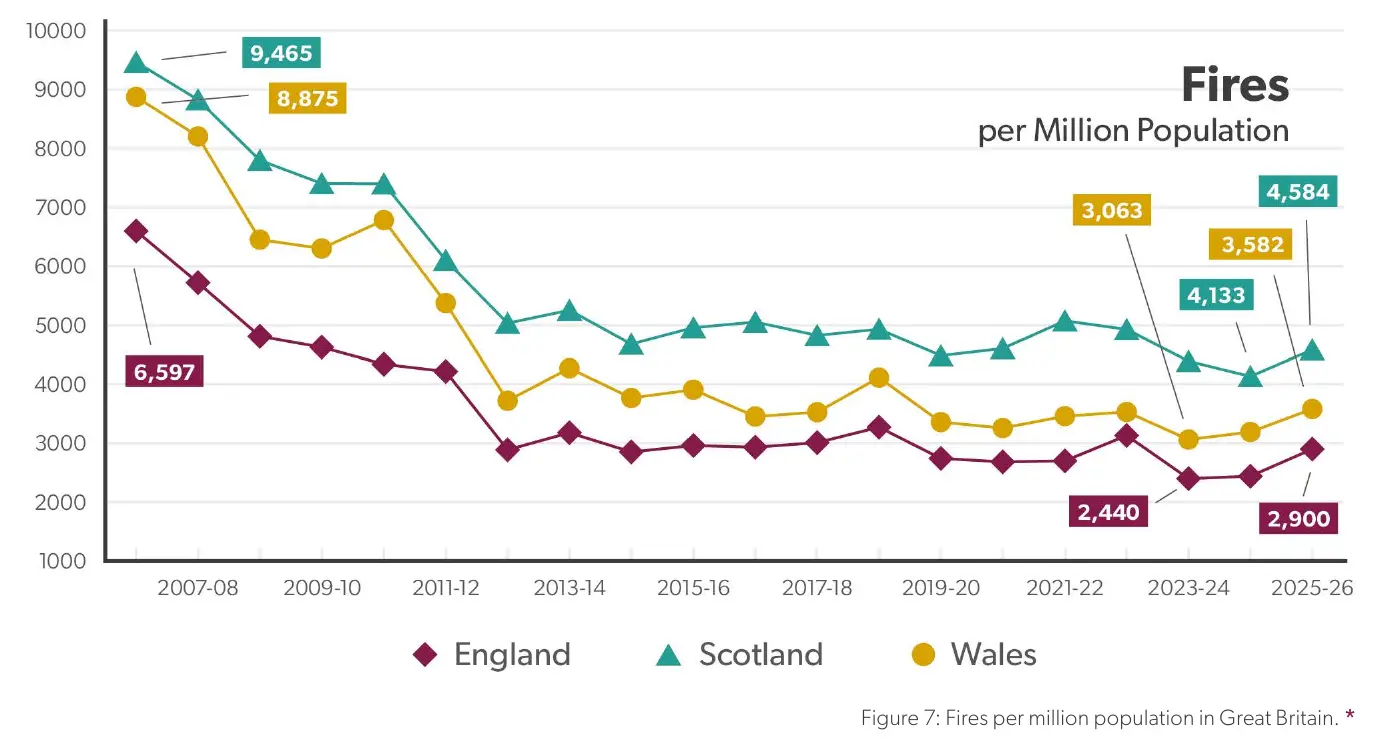
- Scotland has 4,584 fires per million people, against 3,582 in Wales and 2,900 in England (Scottish Fire and Rescue Service, Oct 2026)
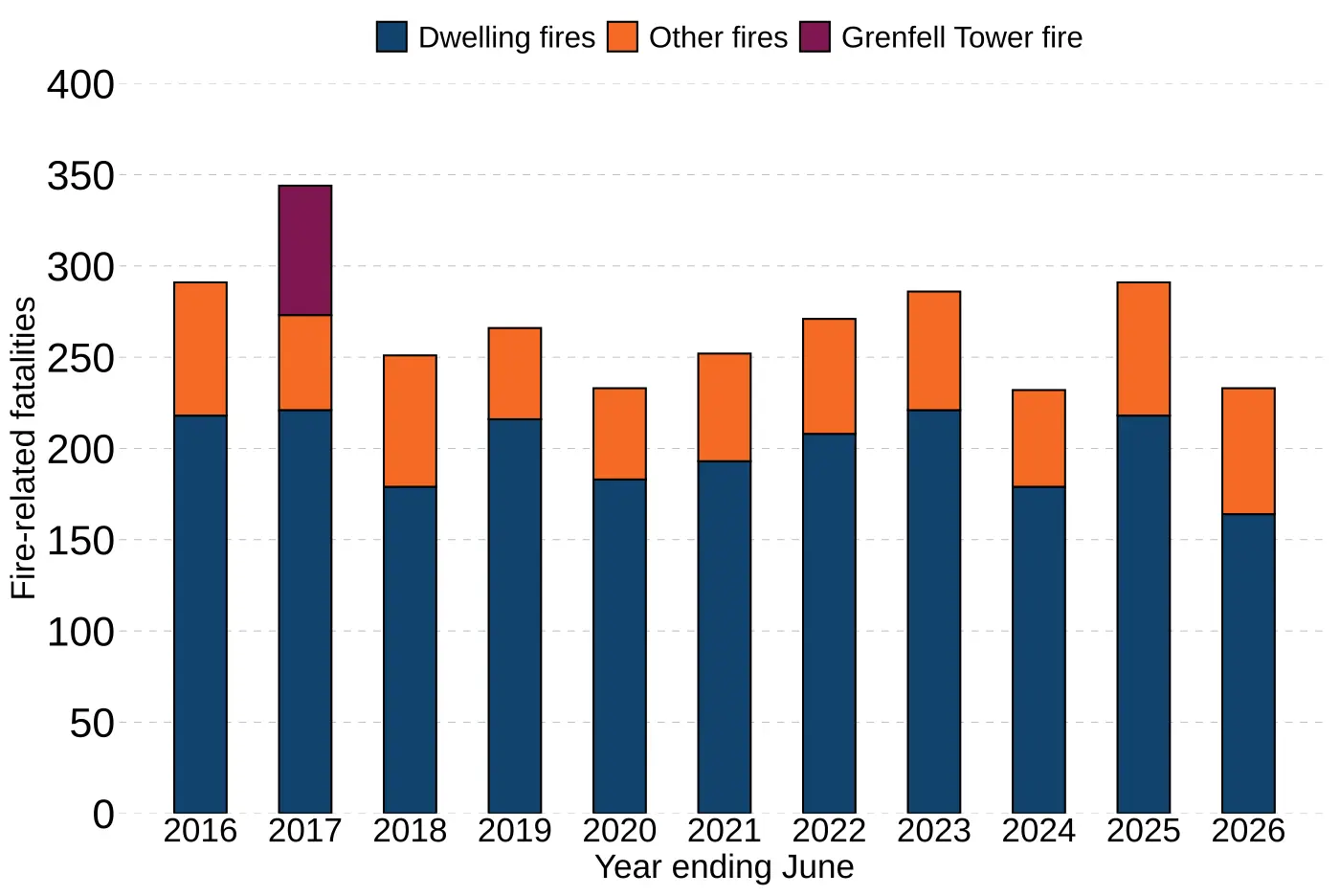
- Fire deaths in England fell 20%, from 291 to 233 (MHCLG, Oct 2026)
- Northern Ireland had 16 house fire deaths in 2025, the highest number since 1999 (Northern Ireland Fire & Rescue Service, Jan 2026)
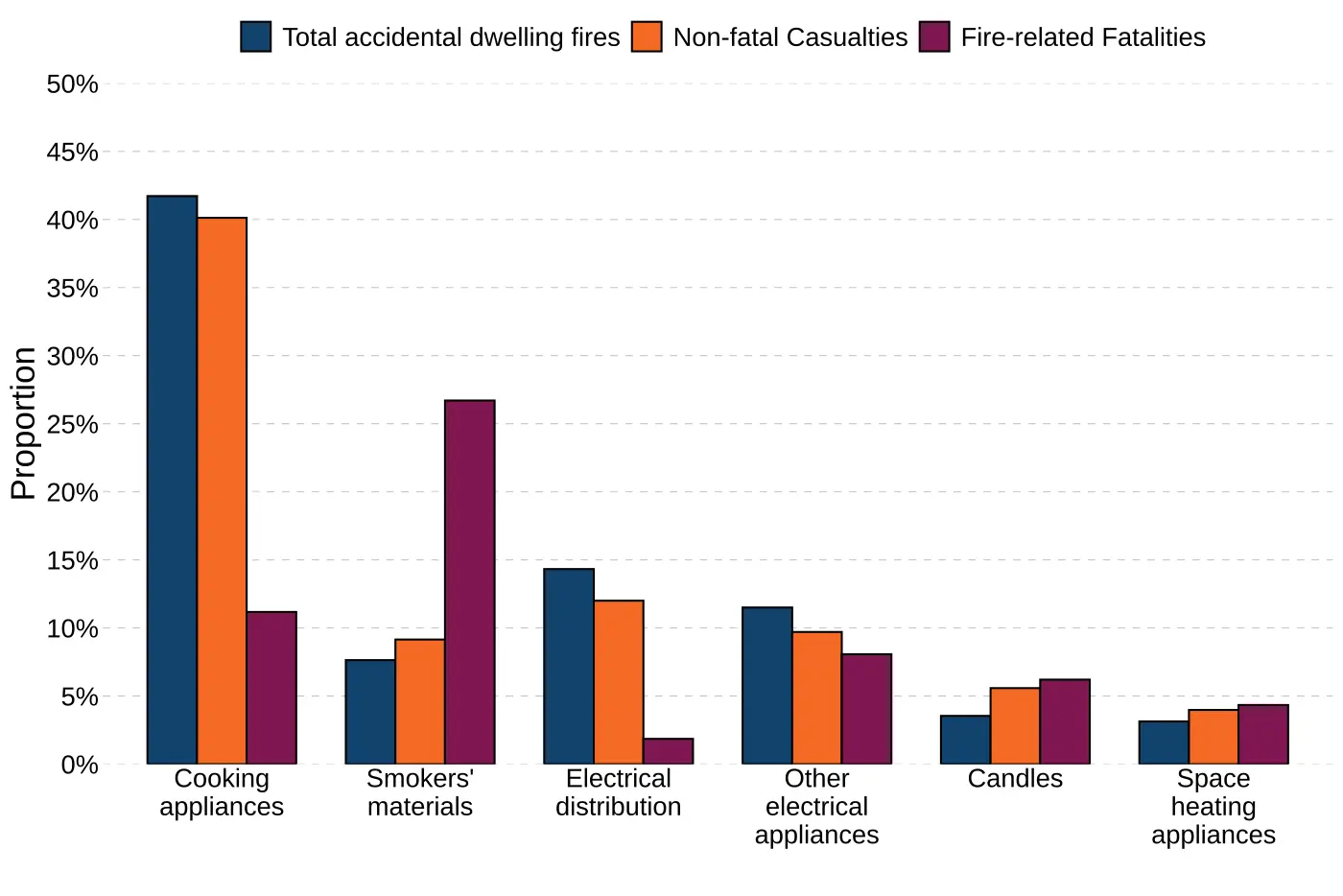
- Cooking starts 42% of accidental house fires in England, but smoking materials cause 27% of the deaths in them (MHCLG, Aug 2026)
- 30% of fires in non-domestic buildings spread beyond the room where they started, twice the 14% rate for house fires (MHCLG, Aug 2026)
- 46% of fires in non-domestic buildings had no smoke alarm, and 13 of the 17 deaths in those buildings happened where there was none (MHCLG, Aug 2026)
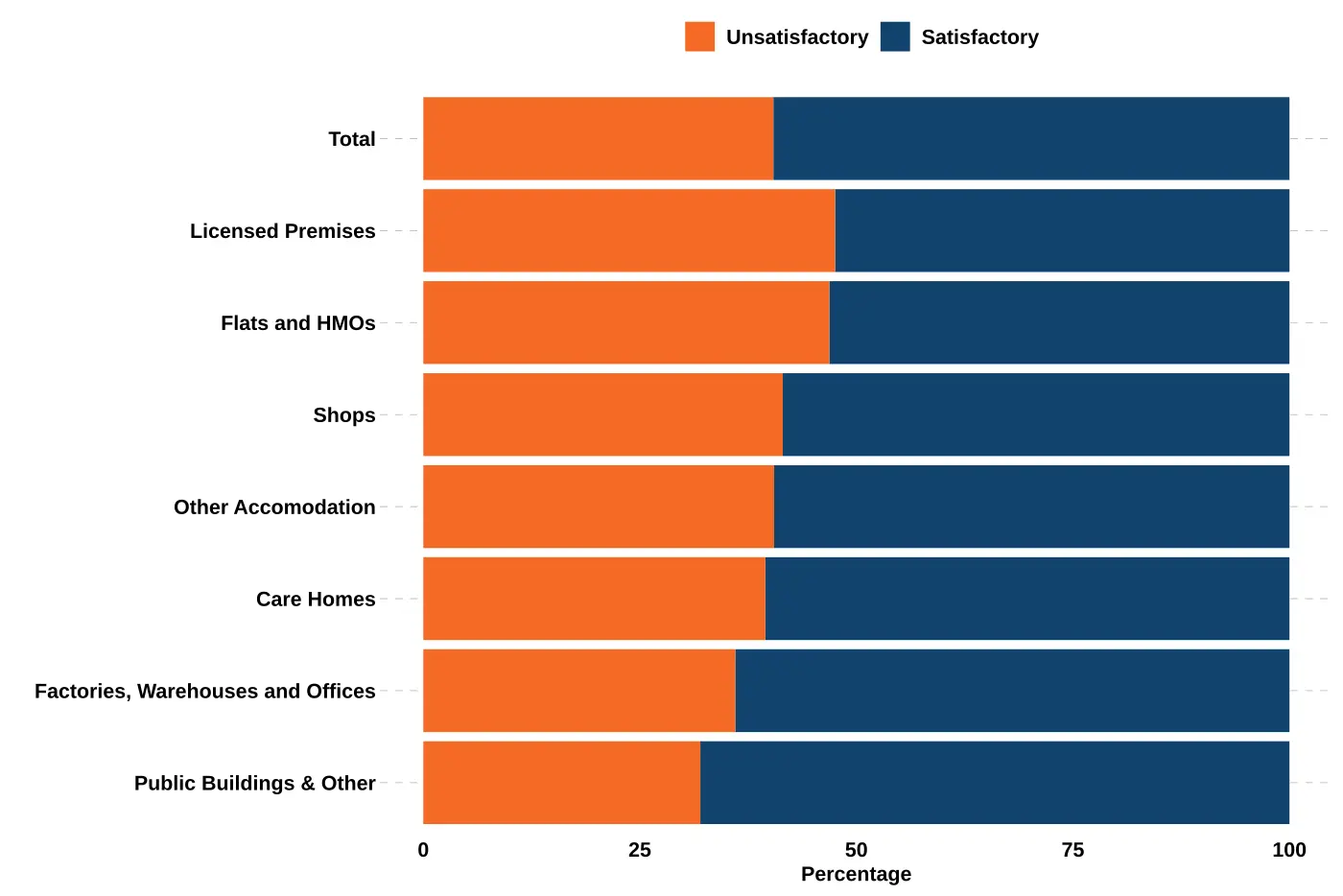
- 4 in 10 fire safety audits in England failed: 20,286 of 50,195 (MHCLG, Sep 2026)
- Blocked or unsafe emergency routes and exits were cited 11,286 times, the most common breach of fire safety law (MHCLG, Sep 2026)
- 2,111 buildings with unsafe cladding, 45% of those identified, have not started remediation (MHCLG, Oct 2026)
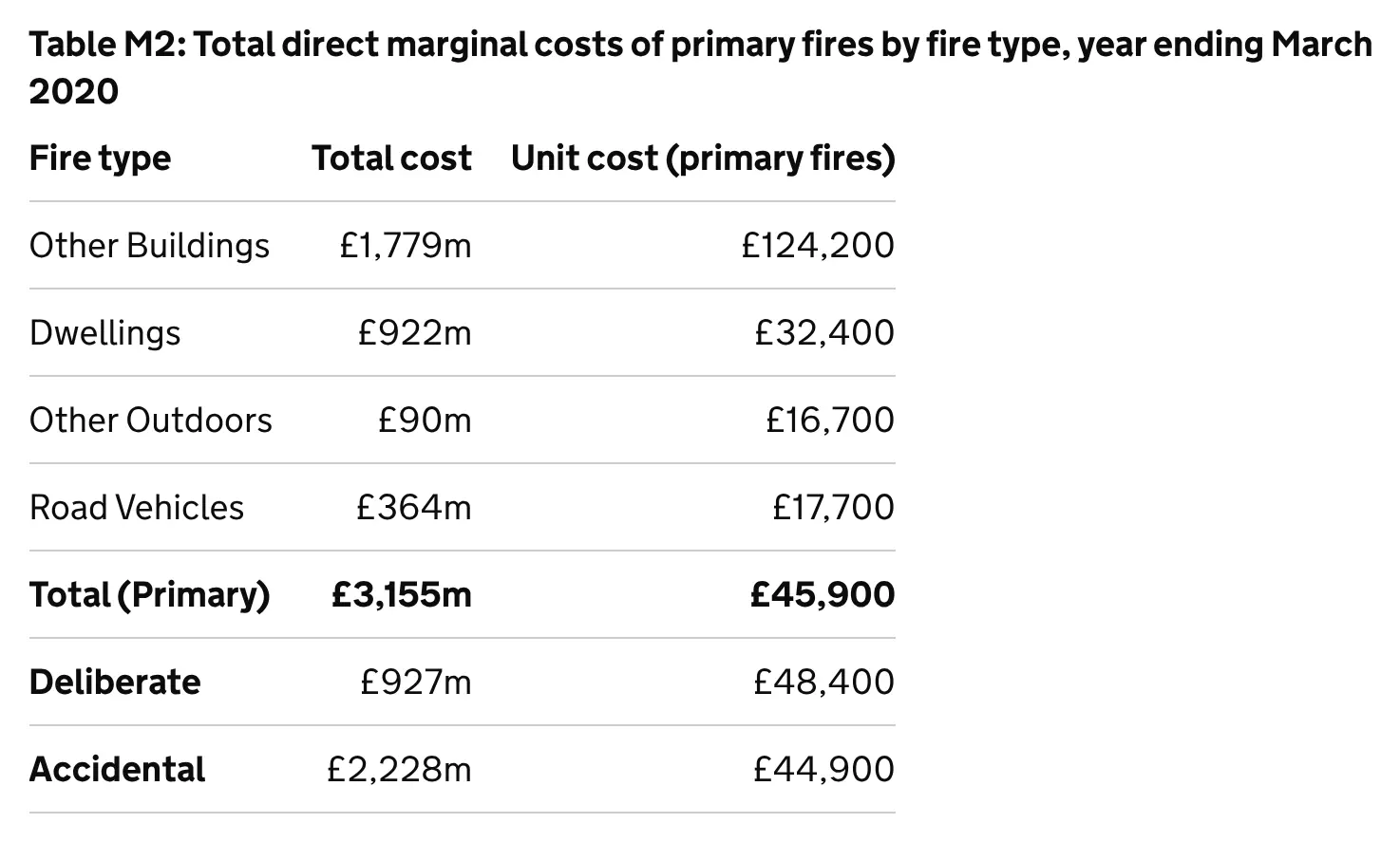
- A primary fire in a non-domestic building costs about £124,200, almost four times the £32,400 cost of a house fire (Home Office, Jun 2023)
- London had a record 206 e-bike and e-scooter fires in 2025 (London Fire Brigade, Jan 2026)
How many fires are there in the UK each year?
“Fewer fires” is only true for England. Scotland and Wales both had more fires this year, mostly outdoors, and Scotland’s rate per person is well above the rest of Great Britain.
How many fires do fire services in England attend?
Fires are now a quarter of the work. They made up 25% of incidents in the year to June 2026, against 41% for fire false alarms and 34% for non-fire incidents (MHCLG, Oct 2026).
- There were 65,453 primary fires, virtually unchanged on the year and 10% fewer than ten years earlier (MHCLG, Oct 2026)
- Fires in buildings totalled 39,478, 15% fewer than ten years earlier (MHCLG, Oct 2026)
- Fire false alarms rose 3.8% to 260,577, of which 178,003 were alarms or equipment operating in error (MHCLG, Oct 2026)
- Scotland attended 36,653 false alarms, up 3.3% (Scottish Fire and Rescue Service, Oct 2026)
- Wales attended 14,656 fire false alarms, down 14% and the fewest since 2019-20 (Welsh Government, Oct 2026)
How many fires are there in Scotland, Wales and Northern Ireland?
Both Scotland and Wales saw outdoor fires drive the increase, while fires in homes kept falling.
- Scotland had 9,086 primary fires, up 4.0%, and 16,033 secondary fires, up 15.7% (Scottish Fire and Rescue Service, Oct 2026)
- Scotland’s 3,968 dwelling fires were 3.3% fewer than last year and 30.0% fewer than in 2015-16 (Scottish Fire and Rescue Service, Oct 2026)
- More than half of Scotland’s fires, 54.4% or 13,833, were deliberate (Scottish Fire and Rescue Service, Oct 2026)
- Wales had 4,197 primary fires, up 7% and the most since 2019-20 (Welsh Government, Oct 2026)
- Wales had 6,985 secondary fires, up 16%, making up 61% of all its fires (Welsh Government, Oct 2026)
- Wales recorded 36 fires per 10,000 people, and the number and rate have more than halved since fire services were devolved in 2004-05 (Welsh Government, Oct 2026)
- Northern Ireland does not publish statistics comparable with the other three nations (Scottish Fire and Rescue Service, Oct 2026)
Which UK nation has the highest fire rate?
Scotland, on every measure the three nations share.
- Primary fires per million people: Scotland 1,638, Wales 1,322, England 1,128 (Scottish Fire and Rescue Service, Oct 2026)
- Dwelling fires per million people: Scotland 716, Wales 447, England 445 (Scottish Fire and Rescue Service, Oct 2026)
- Secondary fires per million people: Scotland 2,891, Wales 2,200, England 1,771 (Scottish Fire and Rescue Service, Oct 2026)
How many people die or are injured in UK fires?
Most fire deaths still happen at home, and the people most at risk are older, living alone, or both. England’s death toll fell this year while Northern Ireland’s rose to a 25-year high.
How many people died in fires in England this year?
England’s 233 deaths are among the lowest totals of the decade, but the number swings from year to year.
- 164 people died in dwelling fires, down 25%, which is 70% of all fire deaths (MHCLG, Oct 2026)
- The decade’s highest total was 344 in the year to June 2017, which included 71 deaths in the Grenfell Tower fire (MHCLG, Oct 2026)
How many fire deaths are there in Scotland, Wales and Northern Ireland?
- Scotland recorded 31 fire deaths, down from 36 and below its ten-year average of 40 (Scottish Fire and Rescue Service, Oct 2026)
- Scotland’s non-fatal fire casualties fell 24.9% to 804 (Scottish Fire and Rescue Service, Oct 2026)
- Half of Scotland’s non-fatal casualties, 50.1%, were overcome by gas, smoke or toxic fumes, and 16.4% had burns (Scottish Fire and Rescue Service, Oct 2026)
- Scotland had 5.6 fire deaths per million people, against 4.7 in Wales and 4.3 in England (Scottish Fire and Rescue Service, Oct 2026)
- Wales had 15 fire deaths, one fewer than the year before, and 87% of them were in dwelling fires (Welsh Government, Oct 2026)
- Wales had 464 non-fatal fire casualties, up 19% and the most since 2021-22 (Welsh Government, Oct 2026)
- In Northern Ireland, 75% of the people who died in house fires in 2025 lived alone (Northern Ireland Fire & Rescue Service, Jan 2026)
Who is most at risk of dying in a fire?
Age is the strongest single factor, followed by sex and deprivation.
- People aged 80 and over die in fires at 14.7 per million, against 4.3 per million for all ages in England (MHCLG, Aug 2026)
- Men die at 5.5 per million, women at 3.0 per million (MHCLG, Aug 2026)
- 40% of England’s fire deaths were people aged 65 or over (MHCLG, Aug 2026)
- 77.4% of Scotland’s fire deaths were male (Scottish Fire and Rescue Service, Oct 2026)
- In Scotland’s most deprived areas, the fire death rate is 1.7 times the national average over ten years (Scottish Fire and Rescue Service, Oct 2026)
- Alcohol or drugs played a part in 11.5% of Scotland’s accidental dwelling fires (Scottish Fire and Rescue Service, Oct 2026)
What are the main causes of fires in the UK?
The kitchen starts the most fires, but cigarettes kill the most people. Lithium-ion batteries are the newest cause, and the fastest growing.
What causes most house fires?
- Misuse of equipment or appliances caused 27% of England’s 23,795 accidental dwelling fires (MHCLG, Aug 2026)
- In Scotland, cooking appliances started 52.7% of accidental dwelling fires, 1,876 in total (Scottish Fire and Rescue Service, Oct 2026)
- Wales had 4,929 accidental fires, up 15%, and 6,444 deliberate fires, up 10% (Welsh Government, Oct 2026)
Which causes are most likely to kill?
- Textiles, upholstery and furnishings were mainly responsible for the spread of 22% of primary dwelling fires, but 48% of the deaths in them (MHCLG, Aug 2026)
- Half of Northern Ireland’s 16 house fire deaths in 2025 involved smoking materials, and electrical causes contributed to four (Northern Ireland Fire & Rescue Service, Jan 2026)
- Smoking materials caused 43% of Northern Ireland’s fatal house fire deaths over the past ten years (Northern Ireland Fire & Rescue Service, Jan 2026)
How fast are lithium-ion battery and e-bike fires growing?
- London had 521 fires involving lithium-ion batteries in 2025, up 28%; 109 people were injured and three killed (London Assembly Research Unit, Mar 2026)
- 228 of those London fires, 44%, involved e-bikes, and 91 involved electric cars (London Assembly Research Unit, Mar 2026)
- London’s e-bike and e-scooter fires rose from 7 in 2017; 171 of the 2025 fires involved e-bikes (London Fire Brigade, Jan 2026)
- Five Londoners have died in e-bike and e-scooter fires since 2023 (London Fire Brigade, Jan 2026)
- The product safety regulator received reports of 267 e-bike and e-scooter fires in 2025, 214 of them from London Fire Brigade (Office for Product Safety and Standards, Sep 2026)
- Batteries were the source of ignition in 88% of those fires (Office for Product Safety and Standards, Sep 2026)
- 38% of the e-bike fires reported involved converted bikes, 82 of 217 (Office for Product Safety and Standards, Sep 2026)
- 55% of the fires happened in homes or other indoor residential settings (Office for Product Safety and Standards, Sep 2026)
- 41% of fires involving converted e-bikes happened while charging, against 32% of all the fires reported (Office for Product Safety and Standards, Sep 2026)
- The reported e-bike and e-scooter fires killed two people and injured 98 (Office for Product Safety and Standards, Sep 2026)
Where do fires start, and how far do they spread?
This is where building design decides the outcome. A fire in an office, shop, care home or warehouse is twice as likely as a house fire to escape the room where it started, and it does more damage when it does.
How many fires are in homes, and how many in other buildings?
- England had 26,367 dwelling fires in the year to June 2026, up 1.3%, and 13,111 fires in other buildings, down 6.6% (MHCLG, Oct 2026)
- Electrical distribution was the largest specified source of ignition in non-domestic buildings, at 17% (MHCLG, Aug 2026)
- Wales’s dwelling fires fell 1% to the lowest in its records, while fires in other buildings rose 8% (Welsh Government, Oct 2026)
- Most of Northern Ireland’s fatal house fires in 2025 started in a bedroom, followed by the living room and kitchen (Northern Ireland Fire & Rescue Service, Jan 2026)
How often is a fire contained to the room where it started?
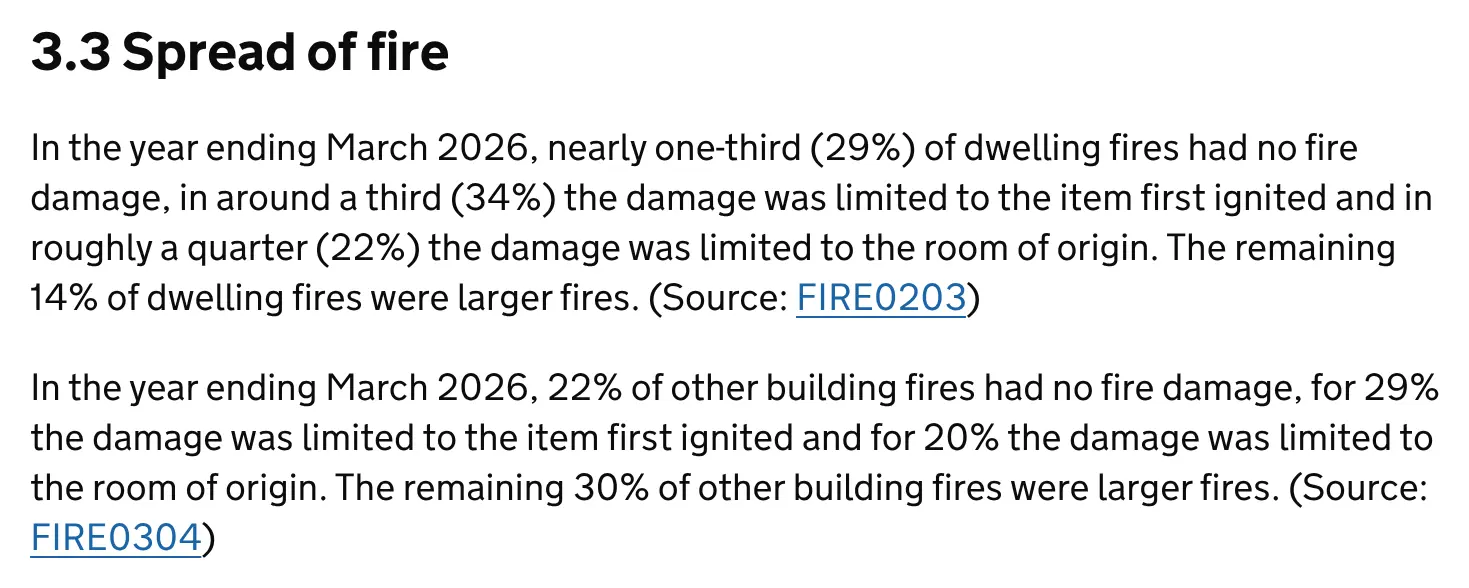
- In England, 34% of dwelling fires were limited to the item first ignited and 22% to the room of origin (MHCLG, Aug 2026)
- In non-domestic buildings, 29% were limited to the item first ignited and 20% to the room of origin (MHCLG, Aug 2026)
- The average area damaged in a non-domestic fire grew 4.9% to 23.4 m², against 14.6 m² in dwellings (MHCLG, Aug 2026)
- Fires in non-domestic buildings killed 17 people, up 21%, and injured 991, up 7.7% (MHCLG, Aug 2026)
- In Wales, 85% of dwelling fires were contained in the room where they started (Welsh Government, Oct 2026)
- In Scotland, 25.6% of dwelling fires spread beyond the item first ignited (Scottish Fire and Rescue Service, Oct 2026)
Compartmentation is what keeps a fire in its room of origin: fire-resisting walls, floors, fire-rated doors and fire-rated glazing that hold back flame and smoke long enough for people to get out.
How many fires happen in high-rise flats?
- England had 680 fires in purpose-built high-rise flats of 10 or more storeys, 1% fewer than the year before (MHCLG, Oct 2026)
- In the five years to June 2026, 3,566 high-rise fires caused 10 deaths, against 90 deaths in the five years to June 2021, a period that included Grenfell Tower (MHCLG, Oct 2026)
- High-rise flats had the lowest death rate per fire, 2.9 per thousand fires, against 7.8 in houses and 15.7 in bungalows (MHCLG, Aug 2026)
Do smoke alarms work, and how fast do fire services arrive?
Almost every home has a smoke alarm, yet only about half of house fires are caught by one. Response times, meanwhile, are creeping up.
How often is there no working smoke alarm?
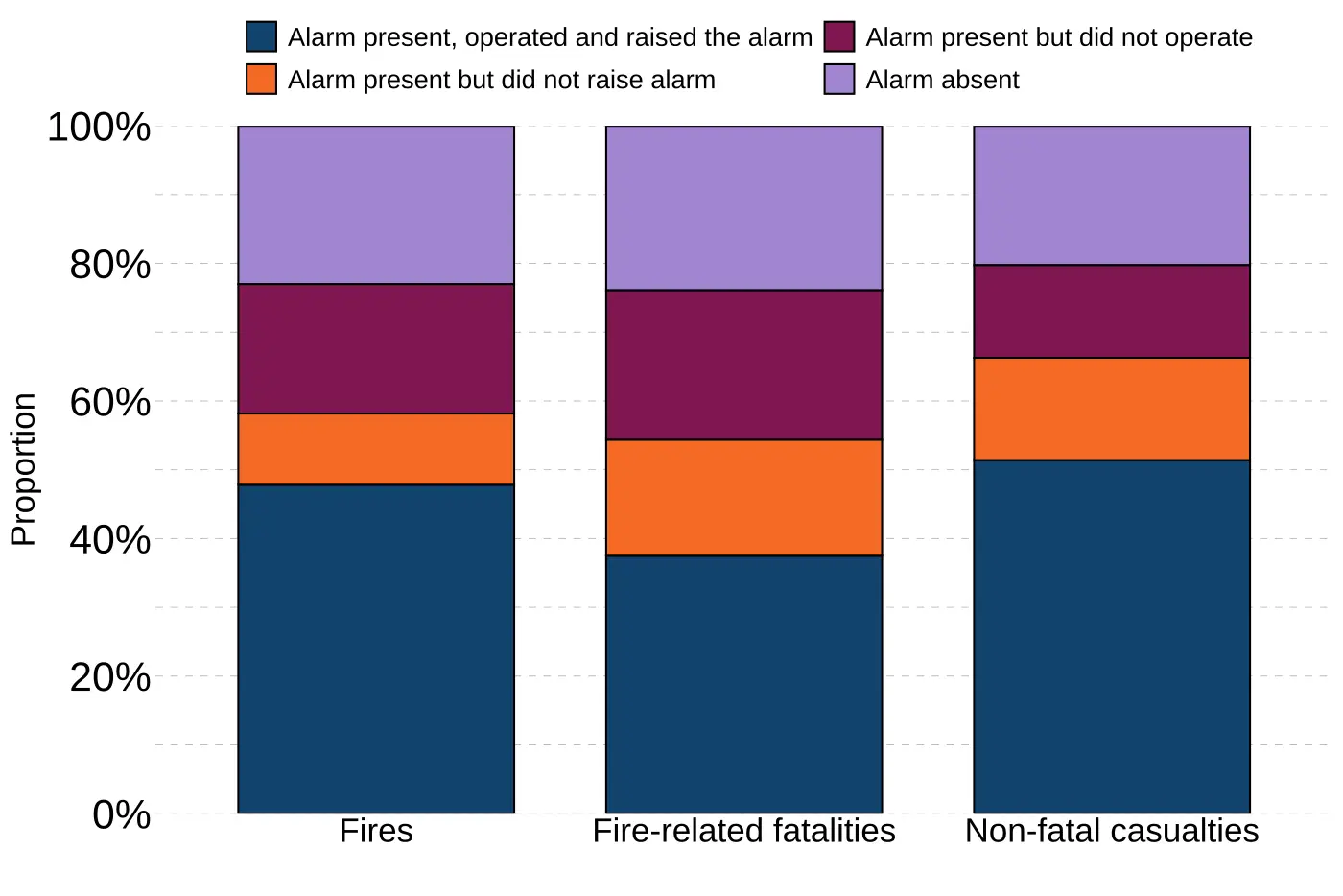
- There was no smoke alarm in 23% of England’s dwelling fires, 6,026 fires, and 24% of the deaths in them (MHCLG, Aug 2026)
- An alarm was present but did not operate in 19% of dwelling fires, and did not raise the alarm in a further 10% (MHCLG, Aug 2026)
- The most common reason an alarm did not operate was that fire products did not reach the detector, at 49% (MHCLG, Aug 2026)
- 93% of households in England say they own a working smoke alarm, but only 18% test it at least monthly (MHCLG, Sep 2026)
- In Scotland, there was no alarm in 20.1% of dwelling fires, and the alarm worked and raised the alarm in 57.9% (Scottish Fire and Rescue Service, Oct 2026)
- A third of Northern Ireland’s fatal house fires in 2025 had no working smoke alarm (Northern Ireland Fire & Rescue Service, Jan 2026)
- Scotland’s fire service fitted 10,740 alarms during home fire safety visits in 2025-26 (Scottish Fire and Rescue Service, Aug 2026)
- Scotland carried out 20,423 home fire safety visits, 40.0% fewer than the year before (Scottish Fire and Rescue Service, Aug 2026)
- Fire services in Wales completed over 50,000 home fire safety checks, and found at least one risk in 89% of the homes visited (Welsh Government, Oct 2026)
How long does a fire service take to reach a fire?
- The average response to a dwelling fire in England was 8 minutes 16 seconds, 33 seconds slower than five years earlier (MHCLG, Oct 2026)
- Drive time makes up 68% of the response, averaging 6 minutes 25 seconds (MHCLG, Aug 2026)
Are UK buildings meeting fire safety rules?
Four in ten buildings that fire services audit fail, and the most common failures are about escape routes and maintenance, the parts of a building where fire doors do their work. Enforcement is rising, and only 40% of the buildings found with unsafe cladding have been fixed.
How many fire safety audits fail, and why?
- England’s 60% pass rate is close to its lowest, 58% in 2023-24 (MHCLG, Sep 2026)
- Only 49% of audits of purpose-built flats of 6 to 9 storeys were satisfactory (MHCLG, Sep 2026)
- In flats of 10 storeys and over, the pass rate fell from 66% to 53% in a year (MHCLG, Sep 2026)
- Pass rates by building type: licensed premises 52%, shops 58%, care homes 61% (MHCLG, Sep 2026)
- Breaches of Article 17, the duty to maintain fire safety equipment and facilities, rose 12% to 9,727 (MHCLG, Sep 2026)
- Scotland completed 8,464 audits, 31.0% of them in houses in multiple occupation (Scottish Fire and Rescue Service, Aug 2026)
- Wales audited 1,896 non-domestic premises, 2% of those it knows about (Welsh Government, Oct 2026)
How many enforcement notices, prohibitions and prosecutions are there?
- Formal notices rose 11% to 3,355, and 46% on six years earlier (MHCLG, Sep 2026)
- Prohibition notices, which ban or restrict use of a building, rose 27% to 1,224 (MHCLG, Sep 2026)
- Scotland issued 41 notices, including 29 prohibition notices (Scottish Fire and Rescue Service, Aug 2026)
How many buildings still have unsafe cladding?
- 4,732 buildings of 11 m and over have been identified with unsafe cladding; 2,621 have started or finished work and 1,878 are complete (MHCLG, Oct 2026)
- The government estimates 5,900 to 7,400 buildings of 11 m and over have or had unsafe cladding, 8% to 14% of the stock (MHCLG, Oct 2026)
- 505 of 516 high-rise buildings with Grenfell-type ACM cladding, 98%, have started or finished remediation (MHCLG, Oct 2026)
How quickly are high-rise buildings being approved, and what do fire door rules require?
- The Building Safety Regulator now approves 92% of new high-rise building applications, with a median of 22 weeks; a year earlier it approved 39% in 43 weeks (Building Safety Regulator, Sep 2026)
- Remediation applications are approved at 89%, with a median of 33 weeks (Building Safety Regulator, Sep 2026)
- Internal refurbishment of existing high-rise buildings is approved at 78%, with a median of 32 weeks (Building Safety Regulator, Sep 2026)
- Since January 2023, multi-occupied residential buildings over 11 m must have communal fire doors checked every three months and flat entrance doors every year (Home Office, Jul 2023)
- The Grenfell Tower Inquiry found that the tower’s fire doors, through damage or disrepair, did not stop smoke and gases spreading (Home Office, Jul 2023)
Specifying fire doors or glazing?
For a commercial or high-rise project, Fire Resist supplies certified EI15 to EI90 systems. Send us your drawings or door schedule and we will price it.
What does fire cost the UK?
Most of what fire costs is spent before any fire starts. When a fire does happen in a commercial building, it costs several times as much as a house fire, because more is damaged and business stops.
What is the total economic and social cost of fire?
These are the newest official estimates. They cover England only, in 2019/20 prices.
- Fire cost England £12.0 billion a year, of which £3.2 billion is the cost of fires that happen (Home Office, Jun 2023)
- £8.8 billion is spent anticipating fire: protection, prevention and preparedness (Home Office, Jun 2023)
- £4.6 billion of that is spent on fire protection in buildings, such as fire doors and compartmentation (Home Office, Jun 2023)
- The fire and rescue service budget was about £2.2 billion (Home Office, Jun 2023)
- Property damage cost about £2.0 billion (Home Office, Jun 2023)
- Fire deaths were valued at £314 million (Home Office, Jun 2023)
How much does a single building fire cost?
- Averaged across every fire attended, the total cost is £78,000 per fire (Home Office, Jun 2023)
- Fires in non-domestic buildings cost £1,779 million, more than half of the £3,155 million cost of all primary fires (Home Office, Jun 2023)
- Wider property damage adds 133% to the direct damage in non-domestic buildings, against 28% in dwellings (Home Office, Jun 2023)
- Lost business output from fire damage and closures cost £170 million (Home Office, Jun 2023)
What do fire statistics look like in London?
London Fire Brigade is busier than at any time in the last decade, battery fires are rising fastest, and fire deaths are above the Brigade’s own target. Fire Resist works mostly in London and the South East, so this is the local picture.
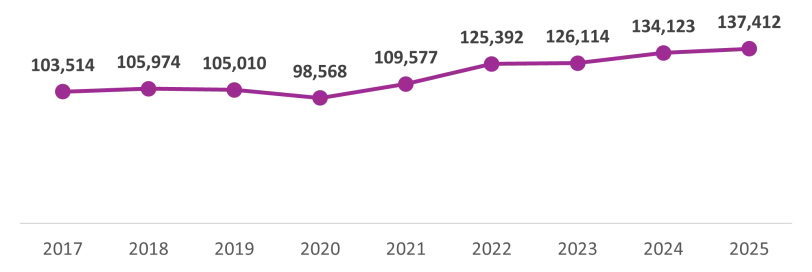
How many fires does London Fire Brigade attend?
- LFB attended 137,412 incidents in 2025, 376 a day and 33% more than in 2017 (London Assembly Research Unit, Mar 2026)
- It attended 19,542 fires, concentrated in Westminster, Newham and Tower Hamlets (London Assembly Research Unit, Mar 2026)
- The five-year rolling average of fire deaths was 41 in December 2025, above LFB’s target of 39 (London Assembly Research Unit, Mar 2026)
- 96 of the new high-rise building and conversion applications at the regulator’s gateway 2 stage are in London, against 40 in the rest of England (Building Safety Regulator, Sep 2026)
How quickly does London Fire Brigade reach a fire?
- The first fire engine arrived in about 5 minutes 30 seconds on average in 2025, inside the 6-minute target but slower every year since 2020 (London Assembly Research Unit, Mar 2026)
Working in London or the South East?
Fire Resist supplies and installs fire-rated systems across London and the South East. See our projects and the areas we cover.
Glossary
- Primary fire: a fire in a building, vehicle or outdoor structure, or any fire with casualties or five or more fire engines.
- Secondary fire: a smaller outdoor fire, such as grass or rubbish, not involving people or property.
- Dwelling: a home, including houses, flats and bungalows.
- Other building: any non-domestic building, such as an office, shop, care home, hospital or warehouse.
- Room of origin: the room where a fire started.
- Compartmentation: dividing a building into fire-resisting sections, with walls, floors, fire doors and glazing, to slow the spread of fire and smoke.
- EI rating: the European fire resistance class; E is integrity, I is insulation, and the number is minutes, as in EI60. See our FAQ.
- Fire safety audit: a fire service inspection of a non-domestic building against the Regulatory Reform (Fire Safety) Order 2005.
- Article 14: the part of that Order covering emergency routes and exits.
- Prohibition notice: a notice that bans or restricts use of a building until a serious fire risk is fixed.
- ACM: aluminium composite material, the cladding used on Grenfell Tower.
- HMO: house in multiple occupation.
- MHCLG: Ministry of Housing, Communities and Local Government, which publishes England’s fire statistics.
- OPSS: Office for Product Safety and Standards.
Methodology and Sources
Every statistic on this page comes from the organisation that produced the data: government statisticians, fire and rescue services, regulators and the London Assembly. Each source page or document was opened and the figure checked against it in November 2026. England, Scotland, Wales and Northern Ireland publish on different periods, so each figure carries its own period and the nations are compared only through rates per person. England’s fire data moved from the Incident Recording System to the Fire and Rescue Data Platform in November 2025, so year-on-year changes should be read with care. Cost figures are the newest official estimates and cover England in 2019/20 prices. The page is reviewed monthly, and figures are replaced when a source publishes a newer release.
Sources
- Building Safety Regulator: Building control approval application data, June to August 2026, Sep 2026
- Home Office: Economic and social cost of fire, Jun 2023
- Home Office: Fact sheet: Fire doors (regulation 10), Fire Safety (England) Regulations 2022, Jul 2023
- London Assembly Research Unit: London Fire Brigade data analysis, Mar 2026
- London Fire Brigade: Record number of e-bike and e-scooter fires across London in 2025, Jan 2026
- MHCLG: Building Safety Remediation: monthly data release, September 2026, Oct 2026
- MHCLG: Detailed analysis of fires and response times, England, year ending March 2026, Aug 2026
- MHCLG: Fire and rescue incident statistics, England, year ending June 2026, Oct 2026
- MHCLG: Fire prevention and protection statistics, England, April 2025 to March 2026, Sep 2026
- Northern Ireland Fire & Rescue Service: NIFRS reveals highest house fire fatalities in 25 years, Jan 2026
- Office for Product Safety and Standards: Fires in e-bikes and e-scooters, 2025, Sep 2026
- Scottish Fire and Rescue Service: Fire Safety and Organisational Statistics 2025-26, Aug 2026
- Scottish Fire and Rescue Service: Fire and Rescue Incident Statistics 2025-26, Oct 2026
- Welsh Government: Fire and rescue authorities operational statistics: April 2025 to March 2026, Oct 2026
- Welsh Government: Fire and rescue authority performance: April 2025 to March 2026, Oct 2026
- Welsh Government: Fire and rescue incident statistics: April 2025 to March 2026, Oct 2026