


A fire risk assessor finds a carbon dioxide (CO2) extinguisher next to a commercial fryer. Nobody caught the mismatch on the last fire risk assessment, or “FRA,” the inspection most UK premises must legally carry out. That’s a class F risk beside the wrong extinguisher, exactly what fire classification, grouping fires by what’s actually burning, is meant to prevent. Get the classes of fire wrong and the extinguisher on the wall becomes a liability, not a safeguard.
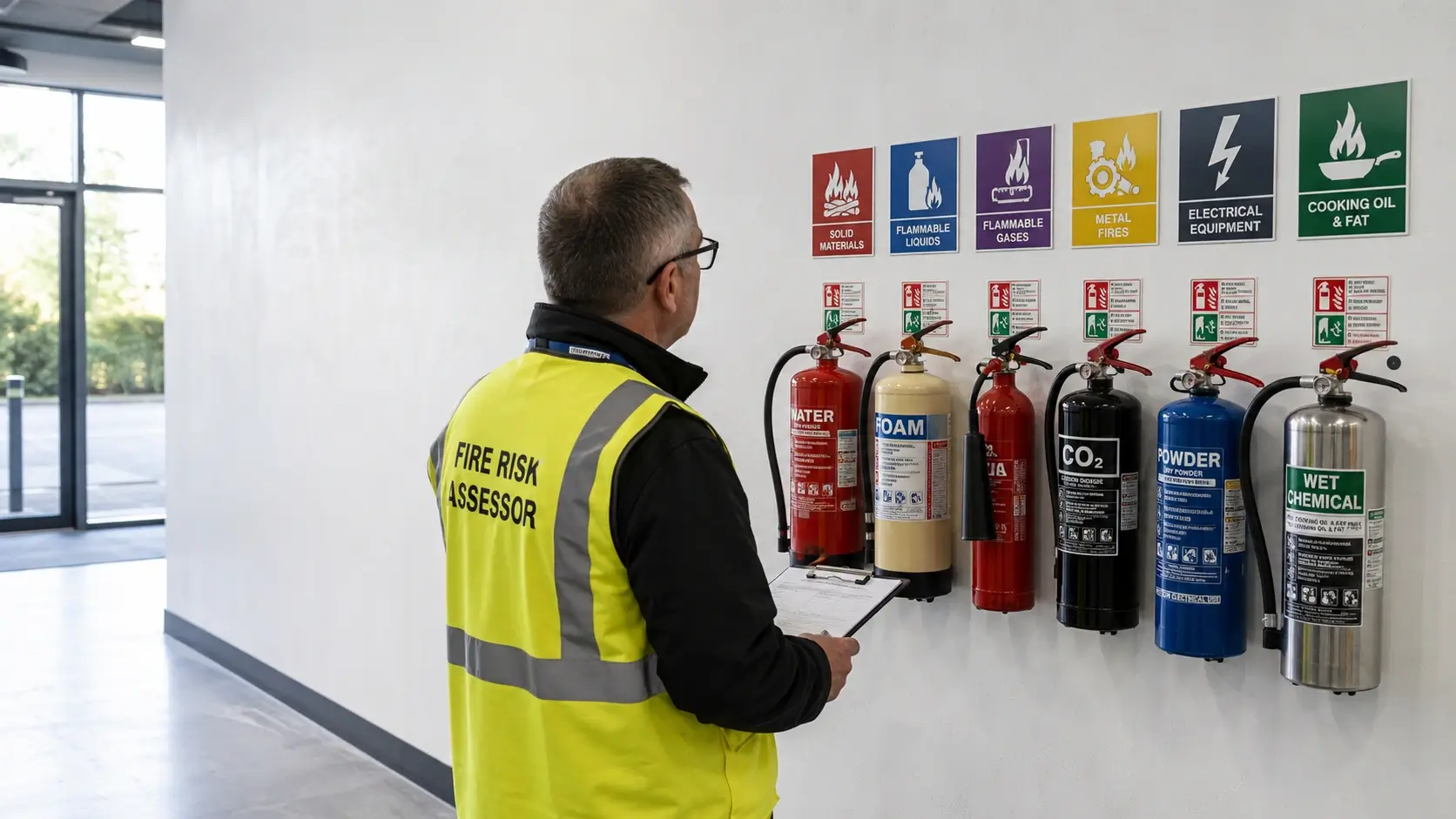
The 6 Classes of Fire and Their Extinguishers
UK fire classification is set out in a standard called BS EN 2, which groups fires by what’s actually burning, not where the fire happens to be. These are the classes of fire on most extinguisher labels:
- Class A: solid combustibles like wood, paper and most plastics. Water or foam.
- Class B: flammable liquids like petrol, solvents and paint. Foam, dry powder or CO2; never water.
- Class C: flammable gases like propane and butane. Dry powder, once the gas supply is off.
- Class D: burning metals like magnesium and titanium. Specialist dry powder only.
- Class F: cooking oils and fats. Wet chemical, or a fire blanket for small pan fires.
Five classes of fire with a clear answer each. The sixth, electrical, is where confusion usually creeps in.
Why “Class E” Isn’t Really a Class
Plenty of guides still list “Class E” for electrical fires, but there is no Class E in BS EN 2’s classes of fire. Electricity itself doesn’t burn; what’s alight is whatever the current ignited, usually cable insulation or a plastic casing. An extinguisher rated for electrical use actually carries a “dielectric rating,” confirming it’s safe near live equipment up to a stated voltage. Treat “Class E” on a spec sheet as shorthand, not a real standard.
What Is a Class C Fire, and Why Reach for the Powder?
Of all the classes of fire, Class C behaves most differently once the flames are out. It’s fuelled by a gas, so putting out the visible flame on a leaking gas line doesn’t stop the leak; unburned gas keeps escaping, and a spark can reignite it more violently than before. Order matters: turn off the gas supply first, extinguish second, never the reverse. Dry powder is standard because it interrupts the chemical reaction rather than just cooling the fire.
Class B and Class F: The Risks Audits Miss
Class B covers flammable liquids: petrol, thinners, adhesives, most aerosols. Water spreads a burning liquid rather than putting it out, so never use it here. Foam separates fuel from oxygen; CO2 removes the oxygen altogether, suiting enclosed plant rooms. On sites storing “polar solvents” (liquids that mix with water, like methylated spirits), check the foam is alcohol-resistant, since ordinary foam breaks down against them almost immediately.
Class F, cooking oil, ignites far hotter than most expect and doesn’t behave like the other classes of fire once alight. Water causes a violent steam explosion; foam and powder are largely ineffective against a fryer fire. Wet chemical extinguishers turn the oil’s surface into a cooling, fire-retardant soapy layer, and NFPA 10, the US fire code, requires one in every commercial kitchen using cooking oil. Most homes just need a fire blanket for pan fires.
Fire Classification Types Around the World: UK, US and Maritime Systems Compared
Ask what the classes of fire are in three countries and you’ll get three different, equally correct answers, since fire classification isn’t one global standard. The UK and Europe use BS EN 2: six classes, A through F, by fuel type. The US uses NFPA 10, from the National Fire Protection Association, which combines liquids and gases into one Class B and uses Class K instead of Class F for cooking oil. Confusingly, Class C in the US means energised electrical equipment, not gas, worth knowing if specifying products for both markets.
Classes of fire under SOLAS, the treaty covering ship safety, add a wrinkle: the term also covers a separate system rating how long a ship’s walls resist fire, not what’s burning. Worth checking which “class” a compliance document actually means.
The New Class L: Lithium-Ion Batteries Rewrite the Rulebook
In January 2026, the British Standards Institution updated the international fire classification standard, BS ISO 3941:2026, adding Class L for fires involving lithium-ion batteries (e-bikes, power tools, home battery storage), the first change to fire classification in nearly two decades. Once a cell fails, a self-sustaining reaction called “thermal runaway” takes hold: the battery generates its own heat and oxygen internally, so cooling the outside doesn’t stop what’s happening within, and re-ignition hours later is a documented risk.
An older inventory may still show six classes of fire when the real number just became seven, because the labelling standard, BS EN 3, hasn’t caught up. No extinguisher carries an official EN 3 rating for Class L yet, so suitability has to be checked against the manufacturer’s certification, not the label.
Where Fire Classification Meets Fire Resistance
Everything above answers what’s burning. It says nothing about how long a wall or door can hold fire back, a separate classification system. UK fire doors are rated FD30 or FD60, tested to resist fire for 30 or 60 minutes under BS 476-22. The equivalent European ratings, EI30 and EI60, come from BS EN 1634-1: “E” is integrity, how well the door stops flames and hot gases, and “I” is insulation, how well it stops the far side getting dangerously hot. The rating covers the whole doorset, leaf, frame, hinges and seals together, not the leaf alone.
For residential blocks above 11 metres, Regulation 10 of the Fire Safety (England) Regulations 2022, introduced after the Grenfell Tower fire, requires quarterly checks on flat entrance doors; below that height, annual inspection is generally accepted practice. Getting the extinguisher classes of fire right protects the room a fire starts in; getting the doorset rating right protects everyone who isn’t in that room yet.
Where This Leaves Your Next Fire Risk Assessment
Check your extinguisher schedule against the classes of fire above for the two mistakes that come up most: powder or CO2 near a fryer that needs wet chemical, and no plan for lithium-ion risk. Then check your fire doors against their certification labels, not just how they look. BS EN 3 will eventually catch up with Class L; until then, that gap is yours to manage, not the label’s to explain.