


A sliding fire door can solve a real design problem when a hinged fire doorset would obstruct circulation, reduce usable escape width or clash with operational traffic. It is most relevant in buildings where the opening needs certified fire resistance, but the surrounding space makes a conventional swing door difficult to justify.
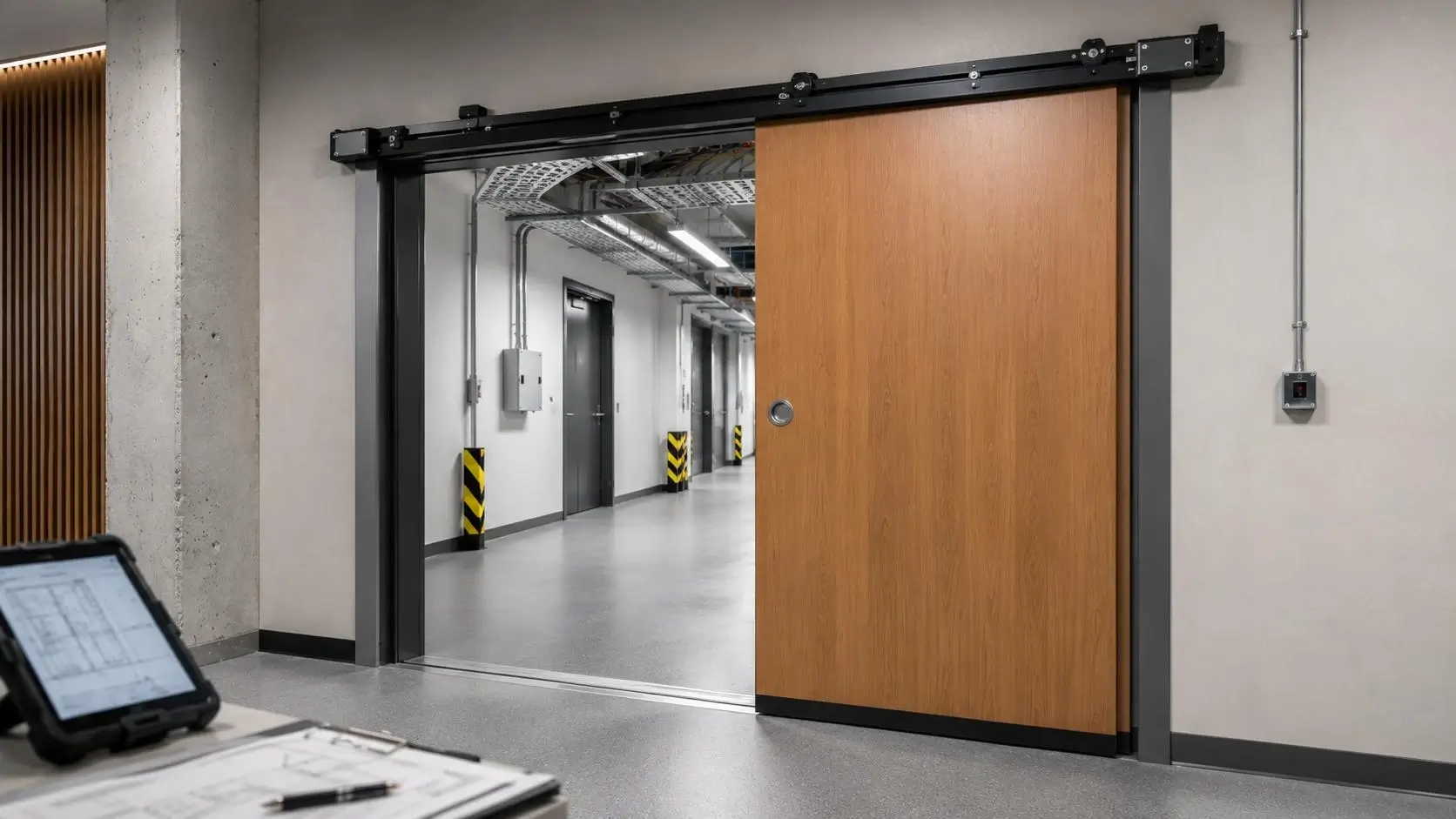
This article is for architects, specifiers, contractors, developers, facilities managers and property owners who need to decide whether a sliding fire door is suitable before the fire strategy, door schedule or supplier package is finalised. The answer depends on the opening, the escape strategy, the certification evidence, the closing mechanism and the maintenance regime that will exist after handover.
Where a sliding fire door works best
A sliding fire door is usually specified for space management, not as a general upgrade from a hinged fire door. It can be useful where the door leaf would otherwise swing into a route used by people, equipment, beds, trolleys or vehicles.
Common applications include healthcare corridors, industrial buildings, service areas, large plant rooms, warehouses, retail back-of-house areas and mixed-use buildings where circulation space is limited. A horizontal sliding fire door can also help where the client needs the opening to remain visually or physically clear during normal use, provided the system closes reliably when required.
The key question is whether the sliding arrangement is solving a genuine design or operational constraint. If a standard hinged doorset can provide the required fire rating, self-closing performance, smoke control and accessibility with less complexity, it will often be the simpler and lower-maintenance choice.
A sliding fire door should therefore be considered early in the design process, not added late as a convenient way to save space. The wall construction, head detail, track support, clear side space and closing path all need coordination. If those points are not checked until procurement, the project may be forced into a compromise that weakens either usability or compliance.
How a horizontal sliding fire door differs from a hinged doorset
A hinged fire doorset relies on a leaf rotating into a frame. The frame, stops, seals, closer, latch and threshold details all form part of the tested assembly. A sliding system works differently. The leaf moves along a track, so the fire-stopping and smoke control strategy must account for the leading edge, trailing edge, head, sill and track arrangement.
This is why a horizontal sliding fire door is more than a fire-rated leaf on sliding gear. The track, carrier system, closing mechanism, seals, guides, frame or surround, threshold detail and any hold-open device all need to be covered by the relevant test evidence or certification scope.
The field of application is especially important. It defines which variations remain within the tested scope, including size limits, construction, hardware, seals, glazing and installation conditions. If the proposed opening falls outside that scope, the claimed performance may not apply.
This is also where sliding systems can become more restrictive than expected. A hinged fire door may have a wider range of tested configurations, while a sliding fire door may be certified only for specific dimensions, tracks, closing devices and wall types. That does not make sliding systems unsuitable, but it does mean the certificate needs to be checked before the opening size and surrounding construction are locked.
Sliding fire door regulations and UK compliance checks
Sliding fire door regulations should be considered through the project fire strategy, Building Regulations requirements, Approved Document B guidance and the specific evidence supplied for the doorset. A compliant specification should not rely on a manufacturer’s brochure alone.
For a sliding fire door uk project, check whether the system has been tested to the relevant fire resistance standard and whether the certificate covers the actual arrangement being installed. The evidence should match the leaf size, rating, track system, frame or surround, seals, closing mechanism, smoke control requirement, glazing if included and supporting construction.
If the door is on an escape route or protects a compartment line, self-closing performance becomes critical. A sliding fire door may use a counterweight, spring-driven closer, motorised actuator or electromagnetic hold-open arrangement linked to the fire alarm system, depending on the design. That mechanism must be part of the certified or approved system, not an improvised site addition.
Smoke control should also be checked separately. Fire resistance and smoke leakage performance are not the same thing. If the fire strategy requires cold smoke control, the system should include appropriate smoke seals and supporting evidence for that performance. This is especially important in protected corridors, residential common parts and buildings where evacuation may take longer.
Sliding fire doors in residential projects
Sliding fire doors in residential projects need careful justification because apartment blocks, private homes and mixed-use residential schemes often depend on predictable escape routes, protected corridors, compartmentation and ongoing inspection. In apartment blocks, common corridors, lobbies, plant rooms and service areas may need fire-resisting doors, but a sliding system should only be used where it fits the fire strategy and can be maintained correctly.
For higher-risk residential buildings, the project team should also think about traceability. The handover record should identify the product, location, rating, certification evidence, compatible hardware, installation details and inspection requirements. A sliding fire door with moving parts, tracks and seals will usually need more active maintenance than a standard hinged doorset.
In private homes, a sliding fire door may be considered for unusual layouts, garages, open-plan refurbishments or spaces where a hinged door is impractical. Even then, the same principle applies. The product must be a tested fire-resisting assembly, not a standard sliding door upgraded with strips or non-certified components.
The residential question is not only whether the door can be installed. It is whether the end user will keep it operational. A sliding system that is blocked by furniture, held open incorrectly, poorly cleaned or rarely inspected can lose the reliability that made it acceptable on paper.
What cannot be upgraded on site
A common mistake is assuming that a normal sliding door can become a sliding fire door by adding intumescent seals. That is not how fire-resisting doorsets are proven.
Fire performance depends on the complete assembly. The leaf, track, seals, closing device, frame or surround, guides, threshold and hardware need to work together under test conditions. If those components have not been tested or assessed as a system, the project team should not treat the result as a compliant fire door.
This matters during value engineering. If the design drawing says sliding fire door but no certified product has been confirmed, the contractor may be left trying to match a design intent with whatever is available late in procurement. That is when substitutions, untested assemblies and incomplete evidence can enter the project.
Any later modification should be treated with the same caution. Access control hardware, additional locks, new handles, replacement rollers or alternative closers may affect certification if they are not within the approved scope. A fire door is not just a door leaf. It is a tested arrangement.
What to check before specifying one
Before adding a sliding fire door to the door schedule, confirm:
- The required fire rating and smoke control requirement from the fire strategy
- The clear opening width and whether a hinged doorset would genuinely create a problem
- The test evidence or third-party certification for the full doorset
- The field of application for the exact size and configuration
- The approved track, guide, closer, actuator or hold-open system
- The seal arrangement at the leading edge, trailing edge, head and sill
- The supporting wall or structure covered by the evidence
- The inspection and maintenance regime required after handover
This check should happen before the supplier is selected, not after the opening has already been built. It also helps avoid a common specification problem: describing the desired door type without confirming that a certified product exists for the actual opening.
A good supplier should be able to provide technical evidence, installation instructions, maintenance guidance and clear limits on what can and cannot be changed. If the answer depends on a custom assessment, that should be resolved before procurement, not left for site teams to interpret.
Installation and maintenance risks
A sliding fire door is less forgiving than a standard sliding partition or architectural feature. Track alignment, sill clearance, closing force, seal condition and wall interface all affect performance. If the tested arrangement allows a specific gap or fixing method, the installation should follow that requirement exactly.
Maintenance is also more demanding. Tracks can collect debris, rollers can wear, guides can loosen, seals can be damaged and closing devices can drift out of adjustment. If the system is held open, the release mechanism must work reliably when activated.
For facilities managers, the question is not only whether the product was certified on day one. It is whether the sliding fire door will still close, seal and perform after years of daily use.
The handover pack should therefore include more than a certificate. It should explain the inspection routine, compatible replacement parts, cleaning requirements, release mechanism checks and any restrictions on future modifications. Without that information, the building owner inherits a system without a clear maintenance path.
When a hinged fire door is still the better answer
A sliding fire door is not the default choice for every restricted opening. If a hinged FD30, FD60 or higher-rated doorset can meet the fire strategy without blocking circulation or reducing escape capacity, it is often the more robust option.
Hinged doorsets are usually simpler to inspect, easier to maintain, more familiar to installers and less dependent on track systems or mechanical release devices. For many protected corridors, lobbies, stair cores and residential common areas, that simplicity is a strength.
Choose a sliding system when the building genuinely needs it. Do not choose it only because it looks cleaner on plan or keeps the opening visually open. The best solution is the one that supports the fire strategy, works for the users and can be maintained throughout the life of the building.
Final decision before the schedule is locked
Before committing, take one opening marked for a sliding system and test the decision. Does the fire strategy require a fire-resisting door at that point? Does the space constraint justify a sliding arrangement? Does the proposed product have certification for the actual size, configuration and installation condition? Does the client understand the inspection and maintenance responsibility?
If the answer is yes to all of those questions, a sliding fire door can be a practical and compliant solution. If the answer is uncertain, the safer move is to resolve the evidence, design and maintenance questions before the schedule is locked.
A sliding system can be the right choice, but only when it is specified as a complete tested assembly, installed within scope and maintained as part of the building’s fire safety strategy.