


This FD60 fire doors guide is for contractors, architects, developers, landlords and facilities managers who need to specify, install or approve 60-minute fire doors without relying on assumptions. FD60 doors are commonly used where the fire strategy requires a longer period of compartmentation than FD30, such as stair enclosures, plant rooms, basement routes, service risers and higher-risk internal separations.
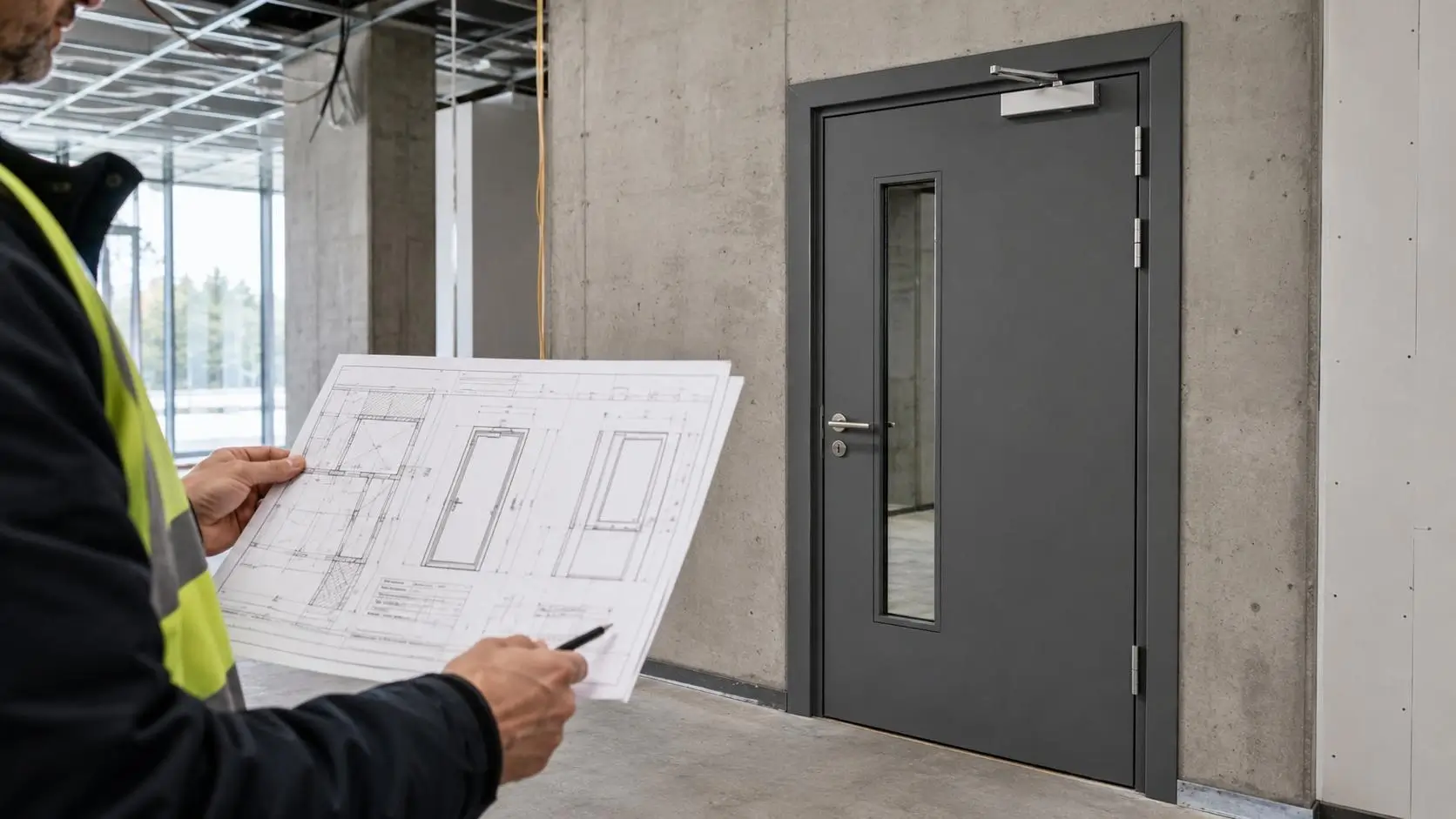
The risk is that a door leaf can be FD60 certified while the completed doorset is not. A mismatched frame, incorrect glazing system, unsuitable closer, missing seal or undocumented hardware substitution can move the installation away from the tested evidence. This FD60 fire doors guide explains what to check before an FD60 door reaches sign-off.
What FD60 Means
FD60 means the door has been tested to provide 60 minutes of fire resistance for integrity when installed as part of a tested assembly. Older evidence may refer to BS 476: Part 22, while newer documentation may reference BS EN 1634-1. The fire door certificate, not the product name, should confirm the tested performance.
Integrity means resistance to flames and hot gases. It tells you what the doorset was tested to resist under the test conditions. It does not tell you that every installation bearing the same label will perform the same way if the frame, seals, ironmongery or fixing method have changed.
This is why the evidence must be read before the door is ordered or installed. A product sheet may be useful for early selection, but the certificate, declaration of performance, assessment, installation instructions and ironmongery schedule are the documents that decide what can be used.
What FD60 Does Not Prove
FD60 does not automatically mean 60 minutes of insulation on the unexposed face. If the project requires both integrity and insulation, the fire strategy may require an EI-rated doorset rather than standard FD60. That distinction matters where heat transfer to an adjacent escape route, room or protected area is part of the design concern.
This FD60 fire doors guide also makes another important point: FD60 is not a guarantee attached to the leaf in isolation. The rating depends on the fire door assembly. A certified leaf fitted into an unsuitable frame, fitted with the wrong closer or altered outside the permitted scope may create a compliance risk.
FD60 Fire Door Specification
A proper FD60 fire door specification starts with the certificate, declaration of performance, third-party certification or manufacturer’s tested evidence. Before ordering, check the certified size range, door leaf construction, approved frame, permitted ironmongery, seal arrangement, threshold detail and glazing allowance.
FD60 assemblies are often less forgiving than FD30 because the doorset has to maintain performance for longer. Door size, lipping, core type, hinge grade, closer strength, latch type, intumescent strip and smoke seal should all be verified against the tested configuration.
If a blank is cut down, altered, rebated on site, fitted with substitute hardware or used outside the permitted size range, it may not comply. The issue is not whether the work looks tidy. The issue is whether the completed doorset still matches the tested evidence.
This FD60 fire doors guide should be used as a practical checklist, but the final authority is always the manufacturer’s tested evidence and installation instructions.
FD60 Doors Are Not Just Heavier FD30 Doors
FD60 is not simply an upgraded FD30. The leaf construction, frame detail, ironmongery schedule, glazing system and sealing arrangement may all be different. A component approved for an FD30 doorset does not automatically become suitable for FD60 doors.
This matters on site because substitutions often look harmless. A closer may appear strong enough, a hinge may look similar, or a glazing bead may fit neatly. None of that proves compliance. The component must be allowed by the FD60 fire door specification for that doorset.
The same applies to installation methods. A fixing detail that is acceptable for a 30-minute doorset may not be the method required for a 60-minute doorset. Contractors should check the FD60 instructions rather than adapting familiar FD30 practice.
FD60 Internal Doors and Compartmentation
FD60 internal doors are specified where the building needs a longer period of compartmentation. That may include stairwells, riser cupboards, plant rooms, corridors, basement routes, service areas or locations identified in the fire strategy. The exact requirement should be confirmed against Approved Document B where relevant, the project fire strategy and the building control route.
In these locations, a poor installation is not just a joinery defect. It can weaken the compartmentation plan that the building relies on for escape, firefighting access and fire spread control. This FD60 fire doors guide treats the door as one part of a wider safety system.
For designers and specifiers, the important step is to identify FD60 requirements early. Late changes from FD30 to FD60 can affect frame depth, leaf weight, hardware, glazing, lead times and opening preparation.
FD60 Fire Door and Frame Compatibility
The FD60 fire door and frame should be specified as a compatible assembly. A certified leaf fitted into an unsuitable retained frame may not provide the performance claimed for the tested doorset. Frame material, section size, rebate depth, intumescent protection, fixing method and compatibility with the surrounding structure all matter.
This is a common issue in refurbishment work. Existing frames may look solid, but they may not match the evidence for the new FD60 leaf. Before retaining a frame, confirm that the proposed arrangement is supported by the manufacturer’s certificate, installation instructions or a competent assessment.
Pre-hung FD60 doorsets can reduce risk because the leaf, frame, seals and ironmongery are supplied as a coordinated package. They do not remove the need for competent installation, but they reduce the number of site decisions that can compromise compliance. Where a retained frame or irregular opening is involved, get the arrangement assessed before installation, not after completion.
Glazing in FD60 Doors
Glazing is one of the easiest details to get wrong. Fire-rated glazing must be suitable for the FD60 doorset, but the glass alone is not enough. Aperture size, bead material, bead fixing, glazing seals and the door leaf construction must all match the evidence.
If the schedule calls for glazed FD60 doors, check the approved glazing system before manufacture. Do not assume that glass suitable for a screen, partition or lower-rated door can be placed into an FD60 leaf. The tested evidence should confirm the permitted glass type, aperture dimensions, bead arrangement and fixing method.
This FD60 fire doors guide recommends treating glazing as part of the tested assembly, not as a separate upgrade added later. If glazing is introduced after the door has been specified, review the certificate again before approval.
FD60 Fire Door Installation Checks
FD60 fire door installation should be carried out by a competent installer who has access to the correct instructions. Before installation starts, confirm that the site team has the certificate, drawings, installation method and ironmongery schedule.
Before sign-off, confirm the leaf size, frame type, ironmongery, seals, glazing and fixing method against the certificate. Check gaps with a gauge rather than by eye, using the tolerances stated by the manufacturer or project specification. Confirm that intumescent strips and smoke seals are seated correctly and undamaged.
Test the closer through repeated cycles and make sure the door latches without manual assistance. Closer grade should be checked against the ironmongery schedule, especially on heavy leaves or doors exposed to draughts and pressure differences.
This FD60 fire doors guide also recommends recording any deviation immediately. If the installation does not match the tested evidence, it should be reviewed by a competent specialist before the door is accepted.
Hardware, Closers and Seals: Details That Matter
Hinges, closers, latches, locks, handles, seals, screws and intumescent protection all affect the fire door assembly. These parts should not be treated as interchangeable simply because they are marketed for fire doors.
The ironmongery schedule should confirm what is permitted. If an item is substituted because of stock, price or installer preference, confirm against the tested evidence before fitting. Unsuitable screws, incorrect hinge grades or missing intumescent hinge pads can all create problems.
Seals also need attention. Intumescent strips should be the correct size, seated cleanly and not painted over or damaged. Smoke seals, where required, should be continuous and not crushed by poor fitting. A seal that is present but damaged is not the same as a seal performing as intended.
What to Check Before Sign-Off
Before approving FD60 doors, ask four practical questions. Does the FD60 fire door specification match the fire strategy? Does the FD60 fire door and frame match the tested evidence? Has the FD60 fire door installation followed the manufacturer’s instructions? Are the seals, glazing, closer, latch and gaps working as a complete doorset?
Site managers should also check that records are complete. The handover file should include the fire door certificate or relevant evidence, installation instructions, ironmongery details, maintenance guidance and any inspection records. This helps the responsible person manage the door after occupation.
What to Check During Maintenance
For existing buildings, responsible persons should make sure FD60 doors are inspected and maintained as working assemblies. Checks should include the door leaf, frame, hinges, closer, latch, seals, glazing, signage and visible damage.
The door should close and latch reliably. Gaps should be checked with a suitable gauge and compared with the applicable manufacturer or inspection requirements. Any damage, unauthorised alteration or missing component should be recorded and reviewed. The Fire Safety Act 2021 clarified the relevance of flat entrance doors in multi-occupied residential buildings, but ongoing duties should be managed through competent fire risk assessment and maintenance records.
What to Do if Existing FD60 Doors Look Non-Compliant
If an existing FD60 doorset appears to deviate from the tested configuration, do not treat it as a simple joinery repair. Start by identifying the manufacturer, certificate, label, plug or project records. Then compare the installed door against the available evidence.
If the frame, glazing, ironmongery or seals do not match, ask for competent assessment. Some issues may be resolved with approved replacement components. Others may require a new doorset. Undocumented alterations can create further compliance risk, even when they are made with good intentions.
Final Sign-Off Guidance
The main lesson from this FD60 fire doors guide is simple. FD60 performance depends on the whole assembly, not the label on the leaf. Use this FD60 fire doors guide early in specification, again during installation and once more before sign-off.
A final check against the tested evidence is far cheaper than discovering after occupation that the door, frame, glazing or closer does not comply. When FD60 doors are specified, installed, recorded and maintained as complete doorsets, they have a much stronger chance of performing as the fire strategy intends.