


In a block of flats, the front door of each home does more for fire safety than any other single item. Most blocks in the UK rely on a stay put approach, where residents of unaffected flats remain inside while firefighters deal with the one that is burning. That only works if a fire stays behind the door where it started, and if every other door keeps smoke out of the homes along the corridor. FD30 flat entrance doors are the product built for that job. This guide explains what the rating means, what a compliant door consists of, and what the law now asks of owners and managers. By the end you will be able to check a door for its obvious faults, read a supplier’s claims with some scepticism, and know who is responsible for putting problems right.
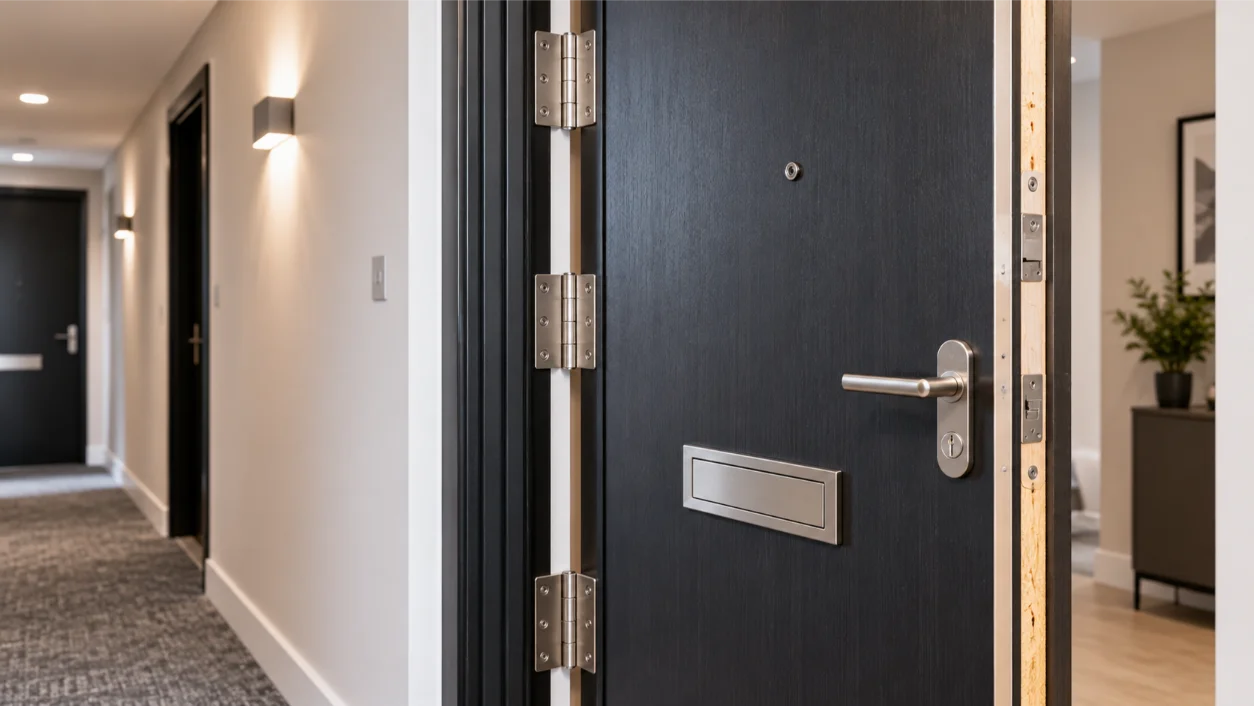
What is an FD30 door?
FD stands for fire door, and 30 is the number of minutes it held back flame in a standard test. A laboratory builds the door into a wall, heats one face in a furnace that passes 800°C before the half hour is up, and times how long the assembly keeps fire from breaking through. The British test is BS 476-22.
For a flat entrance you need one more letter. FD30S adds smoke control, the S confirming that seals around the edges limit the cold smoke that seeps through gaps long before any flame arrives. Approved Document B (ADB), the government fire safety guidance for England, asks for FD30S doors with a self-closing device at the entrance to every flat.
Smoke is the reason that letter matters so much. In residential fires it reaches people sooner than heat does, and a corridor full of it cuts off the only way out.
You will also meet a European label for the same idea. E30 Sa comes from a different test, BS EN 1634-1, with E for integrity and Sa for smoke leakage at room temperature. The two systems sit side by side for now, but ADB withdraws its recognition of the BS 476 route on 2 September 2029, so newer doors increasingly quote the European class.
What the 30 minutes does not mean
It is not a promise about your building. The half hour describes performance against a fixed heating curve in a laboratory, with the door closed, correctly gapped and fitted in a matching frame. Real fires burn hotter or cooler, and real doors get planed, repainted and propped open.
Treat the figure as a grade, then. A door that earned it will outlast one that did not by a wide margin, and that margin is what buys time for neighbours and fire crews.
What goes into FD30 front doors?
A fire door is a set of parts that passed the furnace together. Take one away, or swap it for something similar, and the evidence no longer describes what is hanging in the opening.
- The leaf, usually 44 mm thick for a 30 minute rating
- The frame, matched to that leaf in the test
- Intumescent strips, which swell in heat and close the gap around the edge
- Cold smoke seals, the brush or blade that stops smoke at room temperature
- Three fire-rated hinges
- A self-closing device, known on site as the closer
- Tested ironmongery: lock, handles, letterplate and door viewer
The gaps count as a component too. Between leaf and frame you are looking for about 3 mm along the top and sides, enough for the door to swing and tight enough for the strips to bridge when they expand. Under a smoke-sealed door the usual limit is also 3 mm, or a threshold seal that closes the space. People are often surprised by how small those figures are. A pound coin, close to 3 mm thick, slid into the edge gap is a fair first check.
Pay particular attention to the letterplate. An ordinary letterbox is a slot cut straight through the fire barrier, so a compliant one has an intumescent liner that seals the opening in heat. The same logic applies to any glass in or beside the door: a vision panel, a side screen or a fanlight above the frame has to be fire-rated glazing fitted in the tested manner, which is the part of this subject FireResist works on directly.
Doorset or door assembly?
A doorset arrives from one manufacturer with leaf, frame, seals and hardware already matched and certified as a unit. A door assembly is put together on site from parts sourced separately, each with its own evidence.
Both routes are permitted. My own view is that for a flat entrance you should buy the complete doorset every time, and some experienced joiners will disagree, pointing out that a skilled fitter can build a compliant assembly for less. They can. The difficulty is proving it afterwards, when an inspector asks which test report covers that leaf in that frame with that lock.
Why are FD30 front doors for flats harder to get right than internal fire doors?
Because a flat entrance door has several jobs at once, and they pull against each other.
An internal fire door in an office only has to resist fire and close itself. The door to a flat is also somebody’s front door. It has to keep burglars out, which in new homes means meeting the PAS 24 security standard. It has to keep noise and draughts down, and where it opens onto an outdoor walkway it has to cope with rain and cold as well. Each of those needs brings extra locks, thicker cores, glazing or weather seals, and every addition has to appear in the fire evidence.
Then there is direction. A fire may start inside the flat or out in the corridor, so the door must perform with either face towards the flames. A door that is not built the same on both sides can behave differently depending on which side burns.
What the 2018 door tests showed
That point stopped being theoretical after the Grenfell Tower fire of June 2017. Police investigators tested a flat entrance door of the type fitted in the tower, a glass-reinforced plastic composite model supplied by Manse Masterdor and sold as giving 30 minutes. In March 2018 the government reported that it had failed after roughly 15.
Officials then tested composite doors from a range of manufacturers, and a number fell short. One cause that emerged was evidence resting on a test from a single face. The guidance that followed asked for bi-directional testing, meaning proof with the fire on each side in turn.
The lesson for a buyer is short. Ask whether the door has fire evidence from both faces, and whether its fire and security certificates describe the same doorset with the same hardware. Two separate certificates for two slightly different builds are worth much less than they appear.
So who is supposed to be asking?
Who is responsible for FD30 flat entrance doors?
In law, the responsible person: usually the freeholder, landlord or managing agent who controls the shared parts of the building. For years there was an argument over whether a flat’s own front door fell within their remit or belonged purely to the resident. The Fire Safety Act 2021 ended it. Flat entrance doors now sit plainly inside the Fire Safety Order, the main fire safety law for buildings in England and Wales.
The detail arrived with the Fire Safety (England) Regulations 2022, in force since 23 January 2023. Regulation 10 sets two duties.
In every block with shared areas, the responsible person must tell residents why fire doors matter: keep them shut, leave the closer alone, report damage. In blocks taller than 11 m, they must also check the fire doors in communal areas every three months and make best endeavours to check each flat entrance door once a year.
Best endeavours is the phrase to notice. The law accepts that a manager cannot force entry to inspect the inside face of a door, so the duty is to try properly and keep a record of the attempts. A single unanswered letter does not meet it.
Where leaseholders fit
Many leases make the front door the leaseholder’s property. That does not remove the manager’s duty to check it, and it does not free the leaseholder to fit whatever they like. If you own your flat, expect to be asked for access, and expect to pay if your door turns out to be non-compliant and the lease puts it in your hands.
If you manage a block over 11 m and have no dated record of this year’s flat door checks, that is the most pressing item on your list. Enforcement officers ask for it early.
The routine itself should not worry anyone. An annual check is visual, takes a few minutes per door, and needs a trained eye, not a laboratory.
What goes wrong with FD30 flat entrance doors in real buildings?
The pattern you’ll notice walking any corridor is that the doors differ from flat to flat, and each difference tells a story.
The closer removed by the resident heads the list. People find a self-closing door heavy or noisy, so they unscrew the arm, and a fire door that stands open protects nobody. Close behind is the uPVC swap, where an owner replaces the original with a smart double-glazed unit from a home improvement firm that has no fire rating at all. Strips and seals vanish under layers of gloss paint. A letterplate gets changed for a prettier one with no liner. Somebody cuts in a cat flap. A carpenter planes the bottom edge to clear new carpet and leaves a gap you could post a pencil through. And new leaves get hung in tired old frames that were never part of any test.
Removing a closer to save a little effort each day is penny wise and pound foolish.
Finding the label
A certified door carries proof on itself. Look along the top edge of the leaf for a label from the BWF Fire Door Alliance or Certifire, or on the hinge edge for the coloured plastic plugs of the BM TRADA Q-Mark scheme. These marks show third-party certification, meaning an independent body audits the factory as well as the test. No label does not prove a door is unsafe. It does mean nobody can easily prove the opposite.
Do older doors have to be replaced?
Not always, and this reassures a good many owners. Blocks built before modern certification often have solid timber doors that met the standard of their day, known in the trade as notional fire doors. Where such a door is sound, fits well in its frame and closes by itself, a fire risk assessor may accept it in a lower-risk building, perhaps with strips, smoke seals and a new closer added. In most cases that judgement depends on the height of the block, its layout and the condition of each door, so it has to be made on site and written down.
Where the advice runs out
Replacing a doubtful door with a certified doorset is the cleanest answer, and it fails in some buildings. A leaseholder who owns the door can refuse, and the legal route to compel them is slow. Mansion blocks and converted houses have arched or oversized openings that no standard product fits, and a bespoke doorset with full evidence costs several times the usual price. Even a perfect door disappoints when the wall around the frame was never sealed. A new door is the start of the fix in those cases, not the whole of it.
Checking or buying FD30 front doors for flats: a working order
Whether you are a resident looking at your own door or a manager with two hundred of them, the same sequence applies.
- Open the door fully, let go, and watch it close and latch unaided.
- Check the gaps along the top and sides with a pound coin, then look at the space underneath.
- Run a finger along the edge for the strips and smoke seals, and make sure paint has not buried them.
- Look for a certification label on the top edge or plugs on the hinge side.
- Inspect the letterplate, viewer and any glass for signs of later changes.
- Record what you found, with a date and a photograph.
- Where a door fails, ask a fire risk assessor whether repair, upgrade or a new certified doorset is the right course.
For a replacement, ask the supplier for three things before you order: evidence from both faces, fire and security certification covering one and the same doorset, and an installer who will fit and seal the frame to the tested detail.
FD30 flat entrance doors are a modest piece of joinery carrying a large share of a building’s safety. The rating means half an hour of resistance to flame in a standard test, and the S that should follow it means the door holds back smoke as well. That performance belongs to the whole set of parts, from the 44 mm leaf and its frame to the closer, seals and letterplate, and it holds only while the gaps stay tight and nobody has altered anything. Front doors to flats face harder demands than internal ones because they must also be secure and must resist fire from either side, a point the composite door failures of 2018 made plain. The law in England now places clear duties on whoever manages the block, with regular checks in taller buildings and information for residents everywhere. Older doors can sometimes stay, altered doors usually cannot, and a closer left in working order remains the cheapest safety measure in the building.