


A fire rated sliding window can be useful when a building needs fire-resisting glazing that also opens for ventilation, access, pass-through use, or another practical function. Fixed fire-rated glazing may meet the fire strategy, but it cannot provide movement where the design brief requires it.
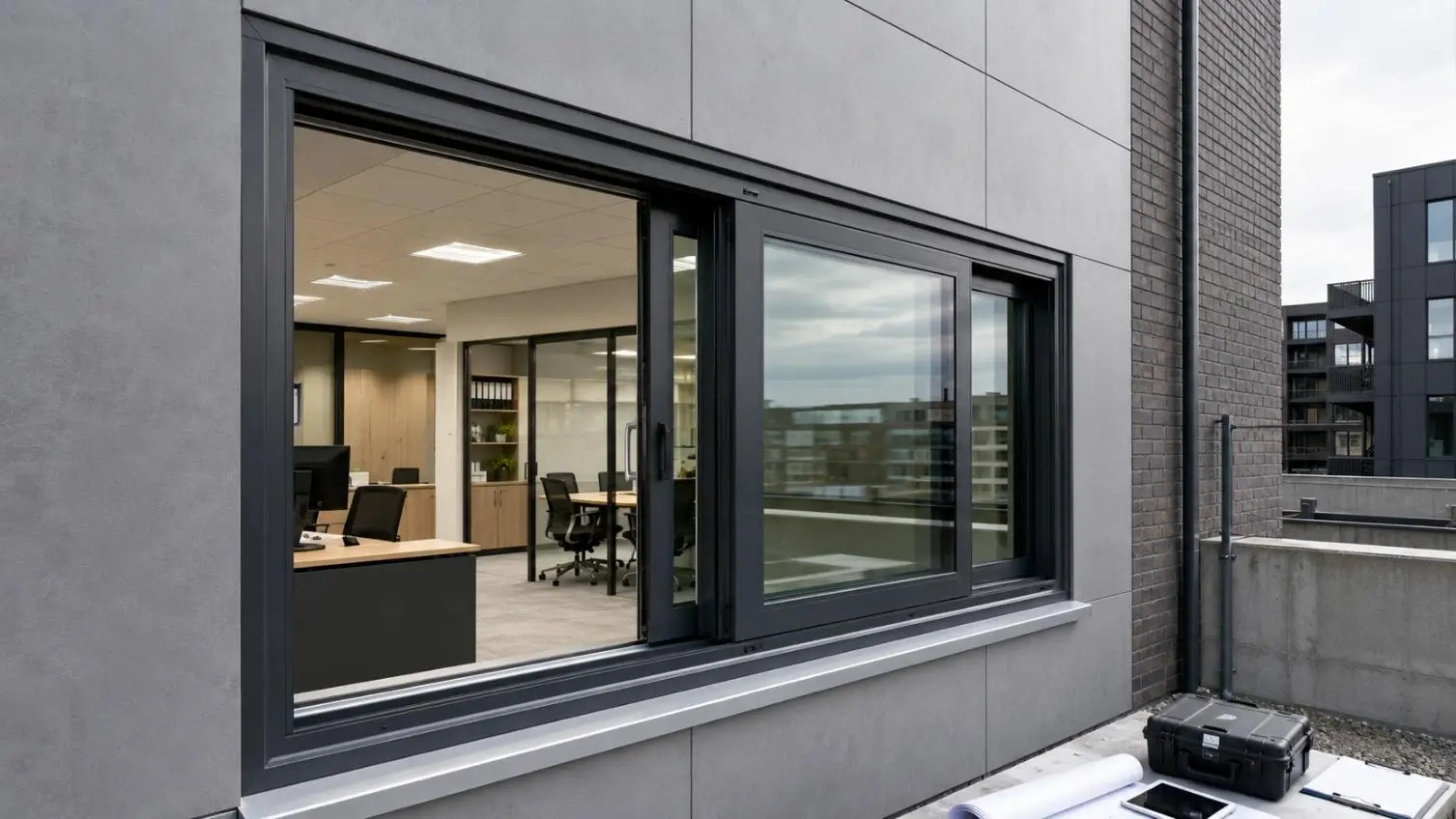
However, a fire rated sliding window is more complex than a fixed panel. The track, moving leaf, frame, seals, closing position, and installation tolerances must all match the tested assembly. This article explains when sliding fire-rated glazing makes sense, how it differs from fixed systems, and what to check before specifying 90-minute or 2-hour fire rated windows.
When a fire rated sliding window makes sense
Fixed fire-rated glazing handles many situations where a glazed compartment barrier is required. It is usually simpler to specify, easier to install and easier to maintain. A fire rated sliding window earns its place only where the opening needs movement as well as fire resistance.
The most common reason is ventilation. In some residential, commercial or mixed-use spaces, the design may require an openable window while the surrounding wall or glazed partition still forms part of a fire-resisting line. In those cases, the fire rated sliding window must perform as a fire-rated assembly when closed, while also serving the intended ventilation function during normal use.
Access is another reason. In industrial facilities, reception areas, service hatches, laboratories, healthcare spaces or internal commercial layouts, a sliding fire-rated glazed opening may provide controlled access through a compartment wall without using a full doorset. This can reduce the footprint of the opening while preserving visibility and separation.
The specification should start with function. If the project only needs visibility and fire resistance, fixed glazing may be the better option. If the project needs visibility, fire resistance and an opening function, a fire rated sliding window becomes more relevant.
How it differs from fixed fire-rated glazing
A fixed fire-rated window is a passive system. The glass, frame, beads, seals, fixings and supporting structure are tested or assessed as a static assembly. There are no sliding tracks, moving clearances or closing positions to manage.
A fire rated sliding window has to do more. It must maintain fire performance when the leaf is closed, while allowing controlled movement during normal use. That means the track, leading edge, trailing edge, sill, head, seals, frame and glass all matter. The fire performance depends on the complete tested arrangement, not only on the glass.
This is where mistakes happen. A standard sliding window cannot become fire rated simply because fire-rated glass is inserted into it. The frame, track, seals and closing detail must also be part of the tested or assessed system. Likewise, a fire-rated glass type used in a fixed partition may not automatically be approved for a sliding configuration.
The field of application is critical. It defines which sizes, configurations, materials and installation conditions remain within the approved scope. If the proposed window size, track type, glass type or frame condition falls outside that scope, the project team should not assume the claimed rating still applies.
Understanding 90 minute and 2 hour fire ratings
90 minute fire rated windows and 2 hour fire rated windows describe different periods of fire resistance. In specification terms, these ratings should be treated as performance requirements that must match the fire strategy and the product evidence.
A 90-minute requirement may be relevant where the fire strategy calls for that level of protection in a compartment line or protected area. A 2-hour requirement, often expressed as 120 minutes, may be used where the design requires a longer fire resistance period. The correct rating depends on the building type, location, compartmentation strategy, adjacent risks and fire engineer’s design.
The difference is not just a label. Higher fire resistance periods can affect glass build-up, frame depth, seal design, weight, sightlines, installation requirements and available sizes. In sliding configurations, these limits can be especially important because the moving leaf still has to close accurately and seal correctly.
This is why 90 minute fire rated windows and 2 hour fire rated windows should not be specified by name alone. The schedule should identify the required rating, the performance type, the exact system, the approved dimensions and the supporting evidence.
Residential and commercial use cases
Fire rated windows residential projects may require careful coordination because the window can affect compartmentation, escape routes, ventilation, resident use and long-term maintenance. Apartment blocks, private homes and mixed-use residential schemes can all include glazed elements that need fire resistance, but sliding functionality should be justified by the layout and use of the space.
In residential settings, a fire rated sliding window might be considered for a lobby, internal partition, service area, garage separation, unusual refurbishment layout or controlled opening where fixed glazing would not meet the brief. However, the system must still be suitable for the people who will use and maintain it. If the window is likely to be obstructed, forced, left open or poorly maintained, a simpler fire-rated solution may be safer in practice.
Commercial and industrial projects create different drivers. A fire rated sliding window may support a pass-through point, control room opening, reception counter, warehouse partition, laboratory separation or production area interface. In these locations, durability, cleaning, impact risk and access control may be just as important as the rating itself.
The same rule applies across sectors. The window should support the fire strategy, not work against it.
Certification and product evidence
Before specifying a fire rated sliding window, request the test evidence, certificate or assessment documentation for the full assembly. A brochure is not enough for a professional specification.
The evidence should confirm the fire rating, glass type, frame system, track arrangement, seal configuration, maximum and minimum sizes, supporting construction and installation limits. If smoke control is required, that should be checked separately through the relevant evidence for the system.
The specification should also limit substitutions. Changing the track, glazing bead, seal, frame section, glass type or hardware may affect the certified performance. A contractor may view a substitution as minor, but the field of application may not.
A strong specification should ask the supplier to confirm that the proposed product matches the actual opening. That confirmation should happen before procurement, not after installation.
Installation details that need attention
A fire rated sliding window is sensitive to installation quality. The leaf must close into the correct position. The face clearance, sill detail, head detail, track alignment and seal contact must match the manufacturer’s instructions and approved scope.
Small gaps can matter because the system depends on controlled clearances. If the leaf binds, the window may not close fully. If the clearance is too wide, the seals may not work as intended. If the frame is fixed into the wrong supporting construction, the test evidence may not apply.
The installer should follow the approved details rather than treating the product like standard sliding glazing. Photographs, product labels, installation records and sign-off notes should be retained for the handover file. This is especially important on projects where the window forms part of a fire strategy, a regulated building record or a long-term maintenance plan.
What a fire rated sliding window does not solve
A fire rated sliding window does not compensate for an unclear fire strategy. It also does not remove the need for compatible construction around the opening. The wall, frame, glass, seals and supporting structure must work together as a complete fire-resisting line.
It may also create operational issues if the opening is heavily used. Tracks can wear, seals can be damaged, dirt can collect in the sill and the leaf can drift out of alignment. If the window is used as a service hatch or access point, the design team should consider safe operation, closing speed, user behaviour and maintenance access.
Where the opening does not genuinely need to move, fixed fire-rated glazing may be the more robust answer. Where access is frequent, a tested fire-rated doorset or hinged fire-rated window may sometimes offer better control.
What to check before the schedule is locked
Before confirming a fire rated sliding window, check:
- Whether sliding functionality is genuinely needed
- The required fire resistance rating from the fire strategy
- Whether E, EW or EI performance is required
- Whether the evidence covers the exact size and configuration
- The approved glass, frame, track, seals and sill detail
- The supporting wall or structure covered by the evidence
- Any smoke control requirement
- Installation tolerances and access for fitting
- Maintenance instructions and permitted replacement parts
- Supplier confirmation that the proposed system remains within scope
These checks should be completed before the window schedule is priced. If the product cannot be evidenced for the actual opening, the design may need a different size, different rating, different system or different fire strategy approach.
Final decision
A fire rated sliding window can be the right choice when the project needs an opening glazed element that also supports compartmentation or another fire safety function. It can be useful in residential, commercial, industrial and mixed-use buildings, but only when the sliding function is necessary and the product evidence is clear.
The safest approach is to specify the complete system, not just the glass. Check the certificate, field of application, frame, track, seals, rating, installation conditions and maintenance requirements before the schedule is locked.
If fixed glazing can meet the brief, it will often be simpler. If the opening must slide, the fire rated sliding window should be treated as a certified fire safety assembly from the start.