


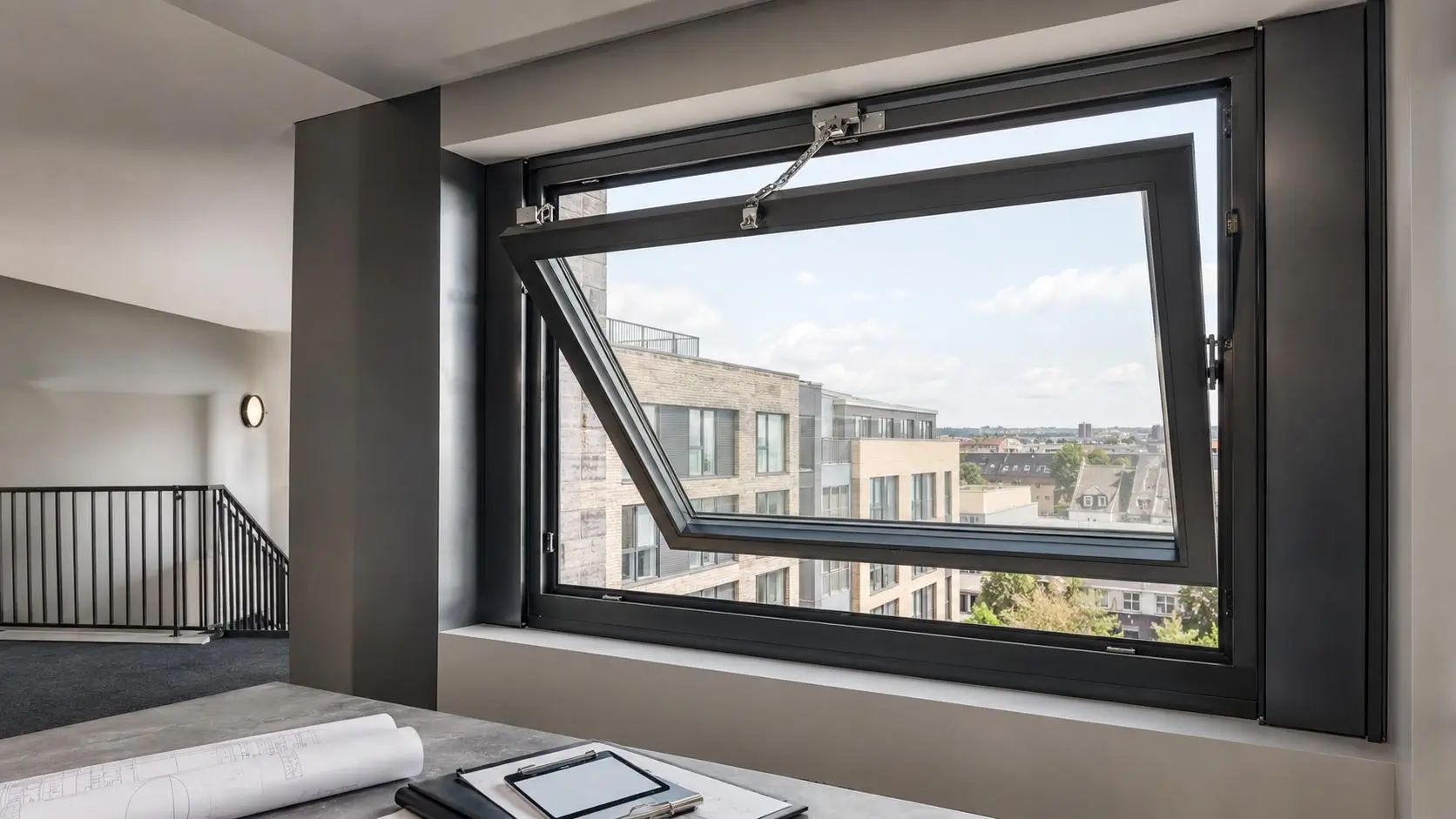
An automatic release fire window is used when a building needs fire-rated glazing that can also open automatically for smoke ventilation, heat exhaust, pressure relief, or another fire strategy function. Because it must perform both as a fire-resisting window and an operable release system, the specification needs more care than a fixed fire-rated window.
Fixed fire-rated glazing and operable systems are not the same
Fixed fire-rated glazing is a passive barrier. It is designed to resist fire for a stated period without opening. Depending on the system, it may provide integrity only, integrity with insulation, or integrity with a level of radiation control.
An automatic release fire window has a different job. It must perform as a fire-resisting glazed assembly in the closed position, while also opening under a defined trigger condition. That trigger may come from a smoke control system, a fire alarm interface, an actuator, an electromagnetic hold-open arrangement or a temperature-sensitive release mechanism.
This is where specification errors often start. A fire rated opening window is not automatically suitable as a smoke ventilator. A window with an actuator is not automatically an AOV. A product that has evidence for fire resistance may still need separate evidence for smoke ventilation performance if that is part of the fire strategy.
A correct fire rated window specification should therefore define the required fire rating, opening function, control method, smoke ventilation duty if applicable, glazing type, frame system, supporting structure and evidence required for approval.
When an AOV fire rated window is relevant
An AOV fire rated window may be relevant where the building design uses natural smoke ventilation or a smoke shaft strategy. In simple terms, the window opens automatically when signalled so that smoke and hot gases can be released from a defined area. This can help protect escape routes, support firefighting access or form part of a wider smoke control design.
The important performance figure is the free area. This is the unobstructed opening through which smoke and gases can pass. The free area depends on the window size, opening angle, hinge or pivot arrangement, actuator travel, frame obstruction and surrounding conditions. A window that appears large on elevation may deliver less useful free area than expected if it only opens partly or if the frame geometry restricts flow.
Make-up air also matters. Smoke cannot be exhausted effectively unless replacement air can enter the system. That is why the automatic release fire window should be coordinated with the smoke control engineer, mechanical engineer and façade package, not specified as a standalone glazing item.
If the window is expected to function as part of a smoke and heat exhaust ventilation system, the evidence should support that use. The project team should check the relevant test or classification information rather than assuming that fire resistance and smoke ventilation are covered by the same certificate.
Fire rated window regulations UK and compliance checks
Fire rated window regulations UK should be read through the project fire strategy, Building Regulations context, Approved Document B guidance, relevant standards, Building Control expectations and product evidence. The same product can be acceptable in one location and unsuitable in another if the required function is different.
For fire rated windows UK projects, the first check is whether the window is protecting a compartment line, forming part of an escape route, supporting smoke ventilation, providing day-to-day ventilation, or combining more than one of these roles. Each function can affect the evidence required.
An automatic release fire window in a common corridor, smoke shaft, plant room, atrium, stairwell approach or façade interface may need more than a basic fire resistance claim. The documentation should show the tested configuration, rating, opening dimensions, control arrangement, seals, glass type, frame type, supporting construction and installation requirements.
For higher-risk or more complex projects, traceability is also important. The handover information should allow the building owner or facilities team to identify the product, its rating, its approved components, its maintenance requirements and any restrictions on future modification.
The glazing and frame specification
The glazing is not interchangeable just because it is fire rated. Fire-rated glass must be compatible with the specific frame, beads, gaskets, glazing tapes, seals and fixing method used in the operable system. A glass type that works in fixed glazing may not be approved in the same way inside an automatic release fire window.
The rating also needs to match the fire strategy. E-rated glazing provides integrity. EI-rated glazing provides integrity and insulation. EW-rated glazing provides integrity with radiation control. The correct choice depends on the location, the distance to escape routes or combustible materials, the compartmentation requirement and the fire engineer’s design intent.
Frame movement is another factor. Operable fire rated windows must maintain alignment and sealing performance while being opened, closed, tested and maintained. That makes tolerances, actuator position and installation quality more important than they may appear on a window schedule.
If the system includes larger glazed areas, unusual dimensions or high-performance EI requirements, the project team should confirm lead time and manufacturing feasibility early. Bespoke automatic release fire window systems may need longer coordination than standard fixed fire-rated glazing.
Release mechanisms and control strategy
The release mechanism should match the role of the window. Some systems are designed to open on signal from a smoke control panel or fire alarm interface. Others may use temperature-sensitive release mechanisms or manual override arrangements. The right choice depends on whether the priority is smoke exhaust, heat release, compartmentation support, day-to-day ventilation or a combination of functions.
An automatic release fire window used for smoke ventilation must open reliably under the designed activation condition. If it is normally closed, the actuator must have the power and travel needed to open it to the required position. If it is normally held open or used for background ventilation, the fire strategy must make clear what position it should take during a fire scenario.
This is not only a controls issue. It affects product selection, cabling, power supply, commissioning, fire alarm coordination and later testing. A window can be well manufactured but still unsuitable if the release logic does not match the fire strategy.
Installation and maintenance risks
An automatic release fire window is more sensitive to installation than a fixed pane of glass. The frame must be fixed into the approved supporting construction, the seals must be installed as tested, the actuator must be aligned correctly and the opening path must remain clear. Small deviations can affect both fire resistance and opening performance.
Maintenance also needs to be planned. Actuators, hinges, control wiring, release devices, seals and drainage paths can deteriorate over time. External exposure can make this more demanding, especially on façades affected by wind, rain, salt air or difficult access.
The maintenance regime should be agreed before handover. The operation of the automatic release fire window should be tested, recorded and linked to the building’s fire safety management plan. Facilities teams should also know which parts can be replaced like for like and which changes need manufacturer approval.
A compliant product at installation can become a weak point later if the actuator is disconnected, the opening is obstructed, the seals are damaged or replacement components fall outside the tested scope.
What to check before specifying one
Before confirming an automatic release fire window, the project team should check:
- The required fire rating and whether E, EI or EW performance is needed
- Whether the window is also required to provide smoke ventilation
- The free area required by the smoke control design
- The test evidence or certification for the exact system
- The field of application for size, glass type, frame, seals and supporting construction
- The actuator, release device or control method
- Coordination with fire alarm, AOV controls or building management systems
- Installation instructions and access requirements
- Maintenance, testing and replacement part guidance
These checks should be completed before procurement. If the product is selected first and the evidence is checked later, the project may discover that the chosen system does not match the fire strategy or opening size.
Before the schedule is locked
An automatic release fire window can be a practical and compliant solution when it is specified as a complete system. It can support smoke ventilation, preserve a glazed design, protect compartmentation and provide a controlled opening function where fixed glazing would not meet the building’s needs.
It is also a product that needs careful coordination. The window, glass, frame, actuator, controls, free area, fire rating, installation condition and maintenance regime all need to align.
Before the schedule is locked, take each proposed automatic release fire window and test it against the fire strategy. Does it need to open, resist fire, ventilate smoke or perform more than one function? Does the evidence cover the actual configuration? Can it be installed and maintained correctly? If the answer is clear, the specification can move forward with confidence. If not, resolve the technical gaps before the product is priced, ordered or installed.