


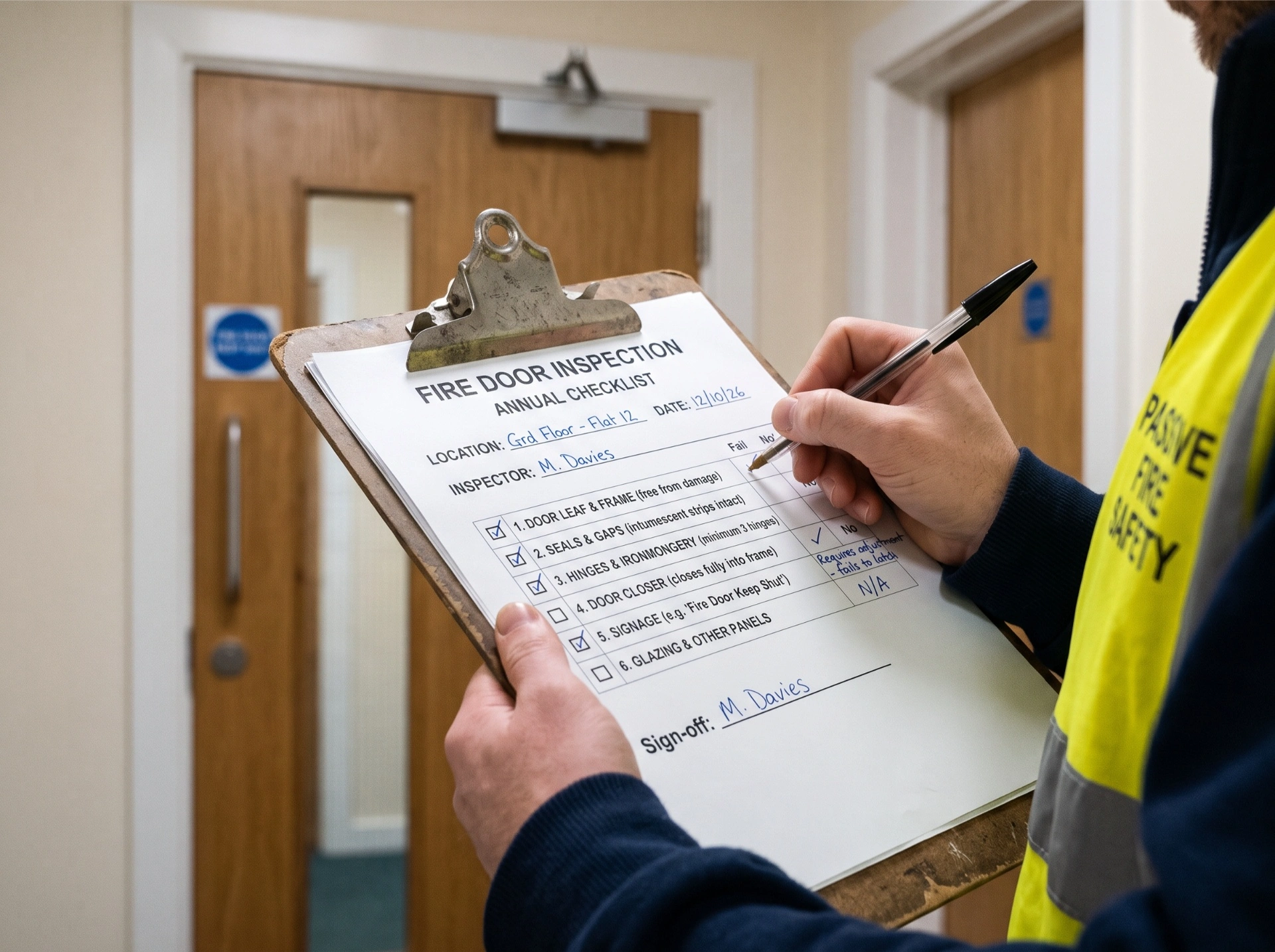
An annual fire door inspection form is the record of a once-a-year check on each fire door in a building: what the door is, what condition it is in, what needs fixing and by when. It sits alongside the more frequent walk-round checks that many buildings carry out, and it is usually the document an enforcing officer, insurer or fire risk assessor asks to see first. A good form does two jobs. It guides the inspector through every part of the door that affects its performance, so nothing gets skipped, and it leaves a trail that shows defects were found, logged and put right. A poor one ticks boxes and proves very little. What follows sets out who needs the annual check, what the form should record, a full annual fire door inspection checklist component by component, how to log results so they lead to repairs, and where any form, however thorough, falls short.
Who needs an annual fire door inspection?
Any building with fire doors needs them kept in working order. The Fire Safety Order, the main fire safety law for workplaces, public buildings and the shared parts of blocks of flats in England and Wales, places that duty on the responsible person, usually the employer, owner or managing agent. It does not set a fixed inspection frequency. It expects checks often enough to catch problems, and a documented annual inspection is the accepted baseline in most premises.
For residential blocks the law is more specific. Since 23 January 2023, Regulation 10 of the Fire Safety (England) Regulations 2022 has required that, in blocks with a top storey more than 11 m above ground:
- fire doors in the communal areas are checked at least every three months
- the responsible person uses best endeavours to check every flat entrance door at least once a year
That annual flat entrance check is where most searches for an annual fire door inspection form begin. Best endeavours means trying properly and keeping proof of the attempts: letters, visit dates, notes of refusals. One unanswered letter does not count.
Busy buildings often need more than once a year. Schools, hospitals, care homes and offices with heavy foot traffic commonly inspect every six months, because doors on busy corridors wear out faster than any annual cycle can catch.
Who should carry it out?
A competent person. The law does not define the term, but in practice it means someone with training and experience in fire doors specifically, not a general handyman. Several schemes certify individual inspectors, among them the Fire Door Inspection Scheme (FDIS) and BM TRADA’s Q-Mark Fire Door Inspection scheme. Using a certified inspector is not a legal requirement. It does make your records far easier to defend.
So what should that inspector be writing down?
What belongs at the top of an annual fire door inspection form
Before anyone looks at a hinge, the form has to pin down which door it describes. Without that, a year’s worth of records cannot be matched to anything.
The header for each door should capture:
- a unique door ID, matching a label on the frame and an entry on the door register
- the location, written so a stranger could find it: block, floor, corridor, room
- the required rating, such as FD30S or FD60S, taken from the fire strategy or door schedule
- the certification evidence found: label, plug, certificate number, or none seen
- the door type: single, double, leaf-and-a-half, glazed or solid, timber or steel
- the date, the inspector’s name and their competence or scheme number
The certification line matters more than it looks. A door with a BWF-Certifire label or a Q-Mark plug can be checked against its manufacturer’s data sheet, which tells you exactly which closers, hinges and glazing it may carry. A door with no evidence can only be judged on what is visible, and the form should say so plainly instead of leaving the box blank.
One door, one record, every year. That is the whole principle of the header.
A door register ties it together: a single list of every fire door in the building with its ID, location and rating. Inspectors work from it, and you can see at a glance which doors were missed. Buildings without one tend to discover forgotten doors in riser cupboards and plant rooms years after the last check.
The annual fire door inspection checklist, part by part
Fire Door Safety Week, the campaign run each autumn by the BWF Fire Door Alliance and FDIS, promotes a five-step check for residents: certification, gaps, seals, hinges and closing. It is a good starting point. An annual inspection goes further, and the form should walk through the door in a fixed order so nothing gets missed.
Leaf and frame
- Is the leaf free of holes, splits, delamination or swelling?
- Is the lipping intact along every edge, with no trimming that has cut into it?
- Are any old screw holes or redundant lock cut-outs filled with suitable material?
- Is the frame firmly fixed, with no movement when the door shuts?
- Is the gap between the frame and the wall sealed with fire-rated material?
Gaps
The gaps around the leaf are where many doors quietly fail. The usual tolerance along the head and both jambs is 2 to 4 mm, though the door’s data sheet has the final word. Under a door with smoke seals at the bottom, or where cold smoke control matters, many data sheets allow around 3 mm; without them, larger threshold gaps may be permitted. Record the widest gap measured, not an average.
Seals
- Are intumescent strips present on the edges or frame, continuous and undamaged?
- Are smoke seals in place, where the door is rated with an S, and not torn or painted over?
- Are the seals the type and size the door was supplied with?
Hardware
- Are there at least three hinges, all fire-rated, with every screw present and tight?
- Does the closer bring the door shut and engage the latch from any open position?
- Is the latch or lock working, with no unapproved additions?
- Are any letterplate, viewer or kick plates of a fire-rated type and fitted as tested?
- Are the hold-open devices, where fitted, releasing on the alarm?
Glazing and signage
Any glass should be fire-rated, carry its marking, and sit in beads and seals that are intact. The door should also display the correct mandatory sign, such as fire door keep shut, on the right face.
The closing test deserves its own line on the form. Open the door fully, let go, and watch. Then open it to about 15 degrees and let go again. A closer that copes with the wide swing but fails from a small opening is one of the most common faults inspectors find.
Recording results so the form leads to repairs
An inspection that finds faults and fixes nothing is worse than useless, because it proves you knew. The second half of the form exists to turn findings into work.
For each item, a simple pass, fail or not applicable is enough. Against every fail, the form should record what is wrong, what action it needs and how urgent that action is. Most inspectors use three priorities, along these lines:
- immediate: the door cannot do its job, such as a closer that does not latch or a missing leaf, and needs action within days
- short term: a defect that weakens the door, such as gaps out of tolerance or damaged seals, for repair within weeks
- planned: minor wear that can wait for the next maintenance round
Photographs belong on the form too, one of the whole door and one of each defect. They settle arguments later and let a contractor price the work without a second visit.
Then close the loop. Each defect needs a completion entry: who fixed it, when, and how, ideally with a photo of the finished repair. The pattern you’ll notice in buildings that struggle at audit is the same every time. Inspections happen on schedule, defect lists grow, and nothing shows them being cleared, so the same faults reappear on next year’s form with a new date on top.
If your last annual inspection produced a list of immediate actions and you cannot point to the completion records, chase them this week.
Paper or digital?
Either works if it holds the information. Digital forms on a tablet make photographs, door IDs and defect tracking far easier, and many inspection firms use dedicated software that produces a report per door. Paper still works for a small building with a dozen doors. What matters is that the record survives, can be found again, and forms part of the building’s safety information, which for higher-risk buildings now falls under the Golden Thread duties of the Building Safety Act 2022.
What an annual fire door inspection checklist cannot tell you
A completed form is not a certificate of compliance. This is the misconception worth correcting, because many managers file the year’s forms and treat the doors as signed off.
An inspection records the condition of a door on one day, judged by what an inspector can see and measure. It cannot confirm what lies inside the leaf, whether the core matches the original certification, or whether the frame was fixed properly behind the architrave. Where a door carries no label or plug, the inspector can say it looks sound and closes well, but not that it is a fire door in any provable sense. A good form says that honestly, with a line for evidence not found, instead of passing the door by default.
Annual checks also miss what happens in between. A closer that a resident unscrews in February will sit disabled until next January’s visit. That is why the law asks for quarterly checks of communal doors in taller blocks, and why busy buildings inspect more often still.
Here is my view, and some inspection firms will not like it. Long, densely ticked forms with sixty boxes per door often produce worse results than shorter ones, because inspectors rush them and readers skip them. Twenty well-chosen checks, a clear priority on every defect and two photographs per door will tell a manager more than a booklet nobody reads. Spend the effort on closing defects, not on adding boxes.
When the form should trigger a bigger decision
Some findings go beyond repair. A door with no certification evidence, several significant defects and an altered leaf may cost more to patch each year than to replace. When the same door appears on the immediate list two years running, treat that as a signal to price a new certified doorset, fitted by a certified installer, instead of booking another round of remedials.
The inspection tells you the state of the door. The decisions afterwards are yours.
Setting up your annual fire door inspection routine
If you are starting from scratch, take it in this order.
- Build a door register listing every fire door, with an ID label on each frame.
- Confirm the required rating of each door from the fire strategy or door schedule.
- Decide the frequency: annual as a minimum, quarterly for communal doors in blocks over 11 m, more often on busy routes.
- Appoint a competent inspector, ideally one certified under a recognised scheme.
- Use a form that records the header details, the full checklist, priorities and photographs.
- Plan access to flat entrance doors early, and keep evidence of every attempt.
- Track every defect to completion, with a dated record of the repair.
- Review the year’s results and decide which doors to replace, not just repair.
A small building with a handful of doors can run all of this from a spreadsheet and a folder of photos. A large estate needs software and a contractor on call.
Seen as a whole, an annual fire door inspection form is a simple tool with a clear purpose. It identifies each door, checks it part by part against a fixed list covering the leaf, frame, gaps, seals, hardware, glass and signage, and turns every fault into a prioritised action with a photo and a completion record. The law sets the baseline: the Fire Safety Order expects fire doors kept in working order, and in English blocks over 11 m, Regulation 10 adds quarterly communal checks and annual best-endeavours checks of flat entrance doors. A form records condition, not certification, and it cannot see what happens between visits, so frequency and follow-through matter as much as the checklist. A stitch in time saves nine: keep the register current, keep the forms honest, close every defect, and next year’s inspection will be shorter than this one.