


Specifying an FD90 fire door is not just about choosing a heavier door leaf. In higher-risk UK projects, a 90-minute fire door must support the fire strategy, match the compartmentation requirement, and remain compliant through procurement, installation, inspection, and handover.
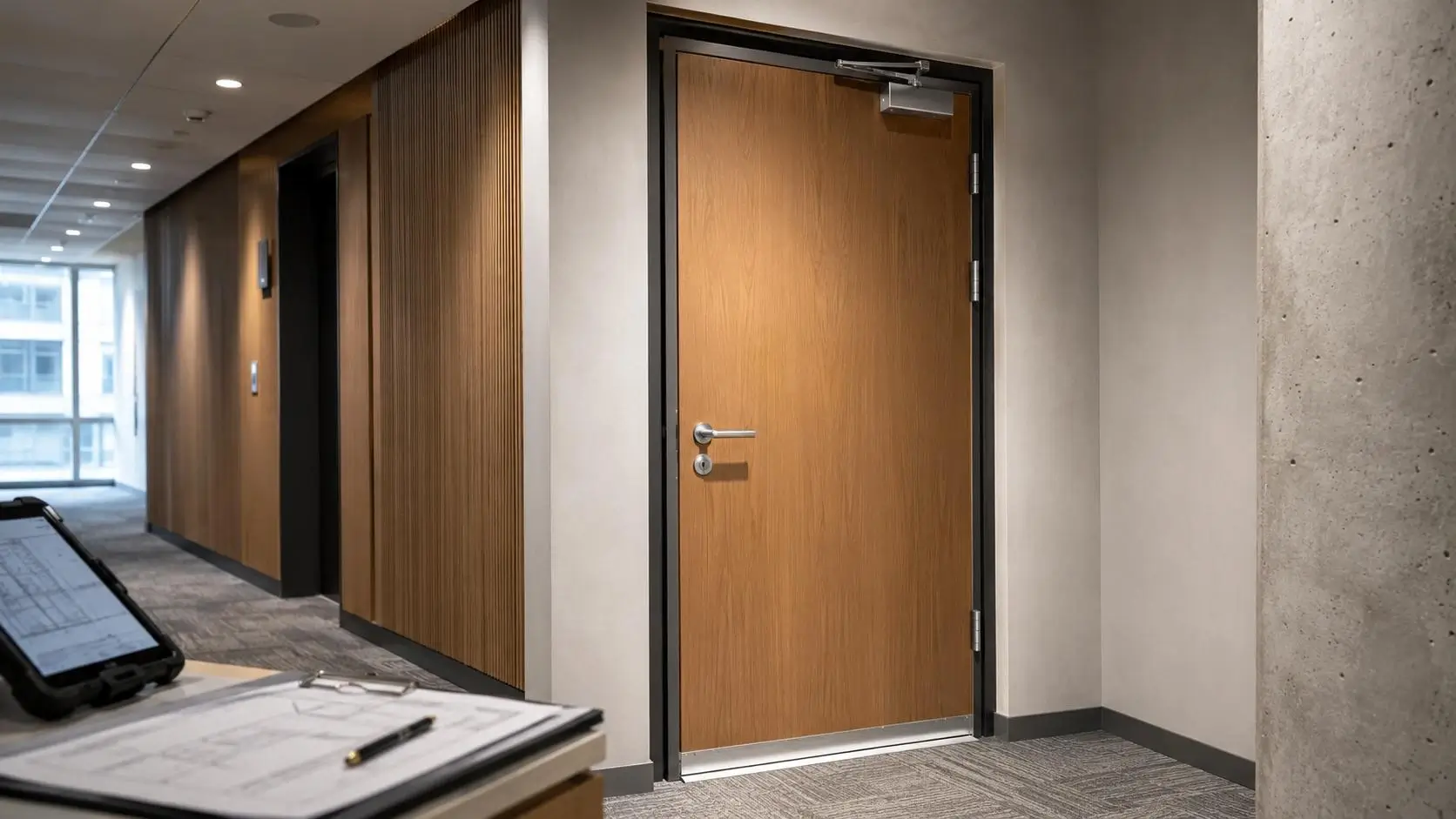
This FD90 fire doors guide explains what FD90 means, when it is the right rating, what certification should prove, why the door leaf, frame, seals, hardware, closer, threshold, and glazing must be treated as one tested system, and what records should be kept after installation.
What FD90 means
FD90 means that a fire doorset has achieved at least 90 minutes of fire resistance for integrity under a relevant fire resistance test, commonly BS 476-22 or BS EN 1634-1, depending on the certification route. In practical terms, the assembly has been tested to resist the passage of flames and hot gases for the stated period when installed in the tested configuration.
For specifiers, the important point is that FD90 is not just a label. It must be supported by valid test evidence, certification, installation instructions, and a clear field of application. The field of application explains which variations remain within the tested scope, such as permitted sizes, configurations, frames, seals, glazing, and ironmongery.
Some FD90 doors may also carry an EI90 classification. The E element refers to integrity. The I element refers to insulation, meaning the door also limits temperature rise on the unexposed face within the test criteria. This distinction matters in locations where the unexposed side of the door may remain occupied, used for evacuation, or form part of a protected route.
This is why an FD90 fire door specification should not simply say FD90 door to suit. It should state the required performance, test standard, certification route, compatible frame, seals, ironmongery, closer, glazing, threshold detail, smoke control requirement where applicable, and the evidence required for approval.
When FD90 doors are the right specification
Approved Document B does not operate as a simple product shopping list. It sets out fire safety provisions, including compartmentation and fire resistance expectations, while the project fire strategy and Building Control process determine the performance required in each location.
FD90 doors are normally considered where the fire strategy requires a 90-minute fire-resisting barrier and the door opening must
maintain that level of protection. Common examples include:
- Compartment lines in higher-risk residential projects
- Plant rooms with significant fire load or critical services
- Protected escape routes in complex buildings
- Hospital sub-compartments where phased or progressive evacuation is part of the strategy
- Industrial facilities where process areas sit close to escape routes or occupied zones
- Service risers, lobbies, and circulation areas where the fire strategy requires extended resistance
The key rule is simple. The door should not be specified in isolation from the wall, floor, route, and fire strategy it forms part of. A 90-minute door in a weaker surrounding construction may not add meaningful protection. A 60-minute door in a 90-minute compartment line may create a compliance issue.
For that reason, this FD90 fire doors guide recommends checking the fire strategy, door schedule, wall type, opening location, and certification evidence before selecting a product.
FD90 fire door and frame requirements
The FD90 fire door and frame should be treated as a single certified assembly. This is one of the most important points in this FD90 fire doors guide.
A tested FD90 doorset is usually assessed as a system. That system may include the door leaf, frame, intumescent seals, smoke seals where required, hinges, lock, latch, closer, glazing system, threshold arrangement, fixings, and supporting construction. Changing one component can affect the certification unless the change is clearly allowed within the field of application.
This is where many specifications become vulnerable. A project may begin with a compliant doorset, then procurement decisions separate the leaf from the frame, substitute ironmongery, change the closer, alter the glazing aperture, or select a different seal arrangement. If those changes fall outside the approved scope, the installed door may no longer represent the tested system.
A robust FD90 fire door specification should therefore require:
- Evidence of testing or third-party certification
- Confirmation of the full doorset configuration
- A compatible frame, not a separately chosen generic frame
- Approved hinges, locks, latches, closers, seals, and threshold details
- Clear limits on permitted sizes, glazing, finishes, and hardware changes
- Installation instructions specific to the tested assembly
- Identification tags, certification labels, or traceable product records where applicable
This FD90 fire doors guide treats certification as a procurement control, not a paperwork exercise. If the evidence does not match the installed assembly, the risk has already moved from design to site.
FD90 internal doors and higher-risk buildings
FD90 internal doors are often specified in buildings where internal compartmentation has to remain reliable under demanding conditions. In higher-risk residential buildings, healthcare environments, student accommodation, industrial premises, and complex mixed-use schemes, internal doors may form part of the fire strategy rather than just the interior package.
For higher-risk buildings, the Building Safety Act has also increased the importance of accurate safety information and traceable records. Project teams need to be able to show what was specified, what was installed, what evidence supports the installation, and what needs to be inspected or maintained after handover.
For FD90 internal doors, that means the door schedule should be more than a list of sizes and finishes. It should identify the location, rating, smoke control requirement, certification reference, compatible components, installation requirements, and maintenance obligations.
This FD90 fire doors guide recommends treating every critical FD90 location as a recordable life safety asset. The door may satisfy Building Control at completion, but it also needs to remain inspectable, maintainable, and traceable throughout occupation.
FD90 fire door installation: where compliance is lost
FD90 fire door installation is often where a compliant specification becomes a non-compliant building element. A certified doorset can only perform as intended if it is installed in line with the tested scope and manufacturer’s instructions.
Common installation risks include excessive gaps, incorrect frame fixing, incompatible hinges, missing or damaged intumescent strips, poorly fitted closers, altered threshold details, and site modifications made without checking the certificate. Even small deviations can matter because fire doors are tested as complete assemblies, not as loose collections of parts.
Key installation checks should include:
- Head and jamb gaps within the manufacturer’s stated tolerance
- Threshold gaps matching the tested or approved detail
- Correct frame type and fixing method for the supporting wall
- Fire-rated hinges and ironmongery listed within the approved scope
- Intumescent and smoke seals fitted in the correct position
- Door closer adjusted so the leaf closes reliably from any open position
- Glazing, vision panels, and beads installed as tested
- No unauthorised drilling, trimming, routing, or hardware changes
- Installation photographs and records retained for handover
The installation section of this FD90 fire doors guide is intentionally practical. On site, the issue is rarely whether someone has heard of FD90. The issue is whether the final installed doorset still matches the evidence used to approve it.
What FD90 does not automatically provide
FD90 is a fire resistance rating. It does not automatically prove every other performance requirement.
For example, cold smoke control must be specified separately where it is needed. A door may have an FD90 fire resistance rating but still require appropriate smoke seals and suitable classification for smoke control. If smoke leakage performance is required, the relevant smoke control evidence should be checked alongside the fire resistance evidence.
FD90 also does not automatically confirm acoustic performance, security rating, durability classification, access control compatibility, or suitability for every wall type. These requirements need to be specified and evidenced separately.
This FD90 fire doors guide also separates the original certified condition from later maintenance changes. If a facilities team drills through the leaf for access control, changes the closer, removes seals, planes the door, or replaces ironmongery with an unapproved product, the door may no longer reflect the certified assembly. Maintenance instructions should make those limits clear.
Supplier selection and evidence checks
Before selecting a supplier, the project team should ask for evidence that matches the actual intended doorset. A supplier should be able to provide more than a brochure and a rating claim.
For an FD90 doorset, request:
- Test reports or third-party certification
- Field of application documentation
- Full component schedule
- Frame details
- Hardware compatibility
- Seal and threshold details
- Glazing evidence where vision panels are required
- Installation instructions
- Maintenance guidance
- Product identification and traceability information
This is where an FD90 fire doors guide becomes directly useful during procurement. The safest supplier is not always the one offering the fastest substitution or lowest price. It is the one that can prove the proposed door, frame, hardware, and installation method remain within the tested and certified scope.
Practical checklist before sign-off
Use this FD90 fire doors guide as a final review before approval, procurement, or handover.
Check the fire strategy first. Confirm that 90-minute resistance is required in that location and that the wall, frame, and surrounding construction are aligned with the same strategy.
Check the evidence next. The certificate, test report, or third-party certification should match the proposed door configuration, including size, frame, seals, glazing, hardware, and threshold.
Check the procurement route. Avoid splitting the leaf, frame, and ironmongery into separate decisions unless the full assembly remains within the approved scope.
Check the installation. Record gaps, fixings, closers, seals, hinges, glazing, and any site changes before the door is covered, decorated, or handed over.
Check the handover file. The client should receive clear information on certification, inspection, maintenance, replacement parts, and restrictions on future modifications.
A professional FD90 fire doors guide should end with a simple principle. Do not specify FD90 as a word on a schedule. Specify, install, inspect, and maintain the tested doorset as a complete fire-resisting system.