


The Fire Door Fitters are packing their van. Frames look clean, closers are on, doors sit flush. You do a quick walk-round, nod, and they’re gone. Three months later, a fire risk assessor flags two doors as non-compliant, and the paperwork to prove otherwise doesn’t exist.
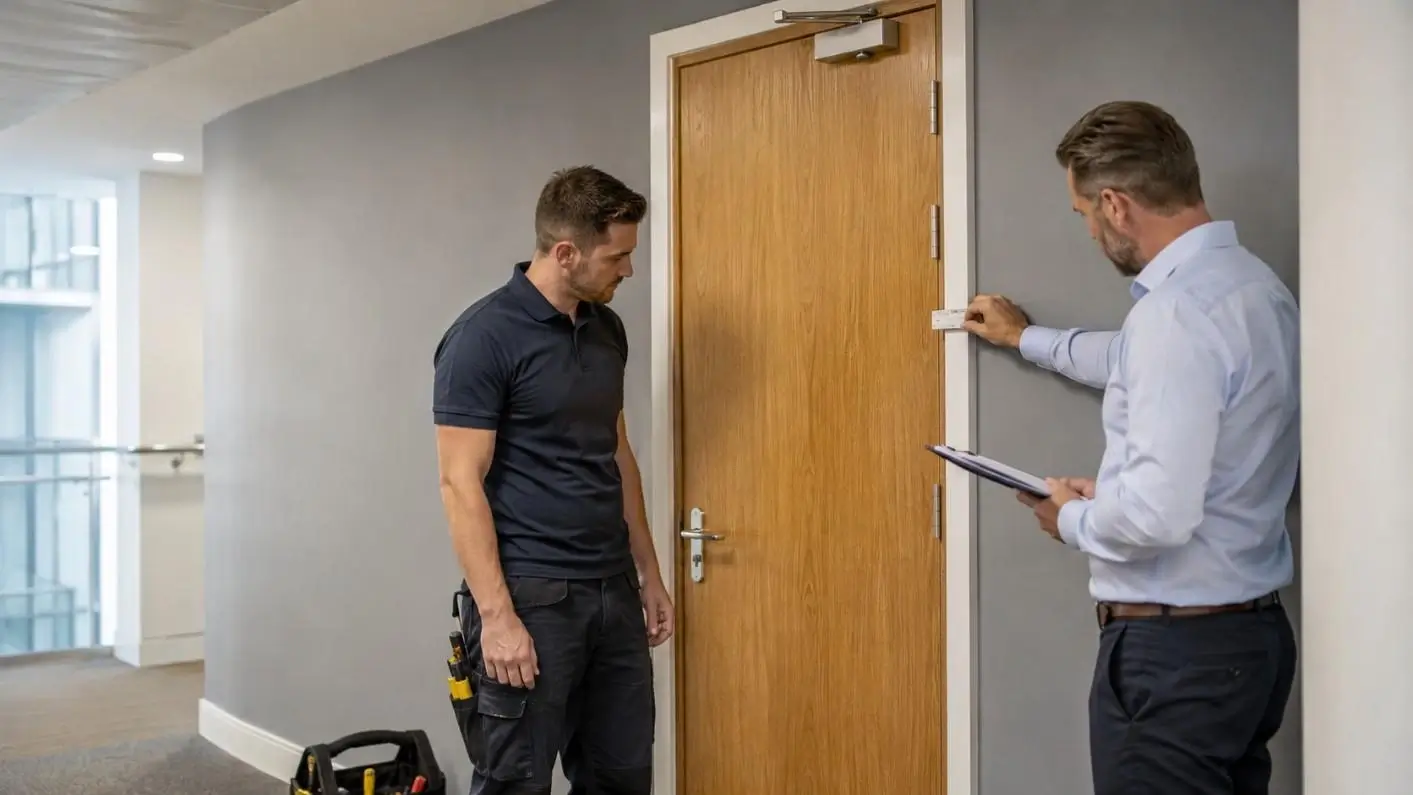
This happens more often than anyone in passive fire protection likes to admit. The installation may have been perfectly good. But without your own sign-off check, you carry the liability, and the fitters signing it off is not a defence under the Regulatory Reform (Fire Safety) Order 2005.
By the end of this, you’ll know exactly what to check, what to demand in writing, and what to watch for in the weeks after your Fire Door Fitters leave the site.
Why the Sign-Off Moment Is Yours, Not Theirs
Under the RRO, the responsible person, whether that is the building owner, employer, or whoever has control of the premises, carries ongoing legal accountability for fire door condition. Your fitters install the product. You’re accountable for what stays in your building.
Since the Building Safety Act 2022, there’s a second layer to this: the golden thread of information. Higher-risk residential buildings now require as-fitted records, certification references, and a door schedule that matches the actual installed product. Fire Door Fitters who can’t produce that documentation aren’t just being unhelpful. They may be leaving you with an undefendable compliance position before you’ve even noticed.
Five checks. None require specialist tools. All of them need to happen before anyone drives away.
1. Measure the Leaf Gap — All Four Sides
This is the first measurement any FDIS-qualified inspector will take, and it’s the one most likely to catch a problem.
The gap around the door leaf, including the hinge side, latch side, and top, should be no more than 3mm. The threshold gap underneath is typically permitted up to 8mm where no threshold seal is fitted, but that tolerance narrows if the door forms part of a smoke compartmentation boundary. A cheap gap gauge or a set of feeler gauges will tell you everything you need. Run them around all four edges. If any single side exceeds tolerance, the door set hasn’t been fitted correctly, regardless of how good everything else looks.
Here’s where most guides stop. Don’t.
A persistent misconception on site is that a slightly oversized gap is fine because the intumescent strip will expand to cover it. It won’t, at least not in the way that matters. Intumescent material activates under heat. It does nothing against cold smoke, which travels through a 4mm gap long before temperatures rise. Cold smoke seal and intumescent strip serve entirely different functions. Both must be present, correctly fitted, and in good contact with the rebate. Check that the seal is continuous, with no breaks and no sections sitting proud of the routing.
2. Verify Certification — Not Just the Label
An FD30 or FD60 label on a door blank is a starting point, not a finish line.
What you actually need is evidence that the complete door set, including the frame, leaf, seals, glazing beads if present, and all ironmongery, has been assessed as a certified combination. Alternatively, each component should carry its own third-party certification from a scheme like CERTIFIRE or BM TRADA Q-Mark. Ask your Fire Door Fitters for the product data sheets and installation instructions before they leave. On site, this is usually just called the spec. If they can’t produce it, that’s worth taking seriously.
The CERTIFIRE and BM TRADA Q-Mark databases are publicly searchable. Look up the certificate numbers against what’s been installed. Five minutes per door type can save a facilities manager a very uncomfortable conversation with their insurer.
One thing worth saying plainly: this process only works when Fire Door Fitters have used certified products. If the door leaf arrived on site without documentation, which is common with cheaper supply chains, you may have a door that looks right but carries no defensible compliance evidence. That conversation needs to happen before installation, not after.
3. Test Every Self-Closing Device From Multiple Positions
Open the door fully. Let go. It must close completely and latch positively, with no assist, no near-miss, and no almost. Test it from 45 degrees. Test it from 15 degrees. The self-closing device must do its job from any open position.
Overhead closers are adjustable, and some Fire Door Fitters turn down the closing force out of consideration for building occupants, such as elderly residents or staff carrying things, without realising the compliance implications. A door that swings shut nicely from 90 degrees but fails to latch from 15 degrees has failed positive latching requirements. It looks fine. It won’t perform in a fire.
Does every door in your building actually self-close and latch? Walk them all. You may be surprised.
4. Count the Hinges and Check What Type They Are
FD30 doors need a minimum of three hinges. FD60 doors need three fire-rated hinges, and the type matters. Not all hinges carry fire certification, and substituting standard butt hinges for cost reasons is more common than it should be.
Ask to see the ironmongery schedule. It specifies every piece of hardware used, including hinge type and quantity, latch or lock spec, and closer model, mapped against the certification framework for that door. Each component should either be covered by the door’s original certification or carry its own approval. A fire door is only as strong as its weakest component. That’s literally the basis on which CERTIFIRE and Q-Mark assessments are structured.
5. Get the As-Fitted Records Before Anyone Drives Away
The installation can be technically perfect, with correct gaps, continuous seals, certified products, and a proper closer, and still leave you non-compliant if you can’t document it.
Your fire risk assessment will require evidence. So will your insurer if it ever comes to that. What you need from your Fire Door Fitters includes installation certificates, certification references such as CERTIFIRE numbers or Q-Mark numbers, photographs taken during installation showing the intumescent routing and frame condition before the leaf was hung, and a door schedule mapping each door to its location, rating, and certification status.
Some Fire Door Fitters provide all of this without being asked. Others, perfectly competent with tools, treat paperwork as someone else’s problem. Under the RRO, it isn’t someone else’s problem. It’s yours.
What This Checklist Doesn’t Do
These five checks get you through sign-off. They don’t replace an annual inspection by an FDIS-qualified assessor, and they’re not meant to. High-use doors in residential common areas, the kind opened and closed hundreds of times a week, wear faster than their installation date suggests. Closers drift. Seals compress. Gap tolerances that passed on day one can fail by month nine.
The sign-off check is the start of your compliance responsibility, not the end of it.
Before You Sign Off Today
If any of the above checks fail, don’t sign off. Get the issue corrected on site, documented, and re-checked. If your Fire Door Fitters, whether in London or anywhere else, aren’t carrying certification documentation with them, ask them to send it in writing by close of play. Not sometime next week. Today.
Then set a reminder for 30 days out. Walk every installed door again. Check the closers haven’t been adjusted. Check no one has propped a fire door open with a fire extinguisher. It happens every week, in every type of building. The installation is one moment. Your obligation to those doors runs for the life of the building.