


Gas fire suppression is designed to work fast, deliver the correct agent concentration, and then hold that concentration long enough to control the fire. None of that happens reliably if the pipework leaks, fittings are compromised, or the enclosure cannot retain the agent after discharge. A properly executed gas pressure test is one of the most decisive quality gates in the lifecycle of a clean agent system.
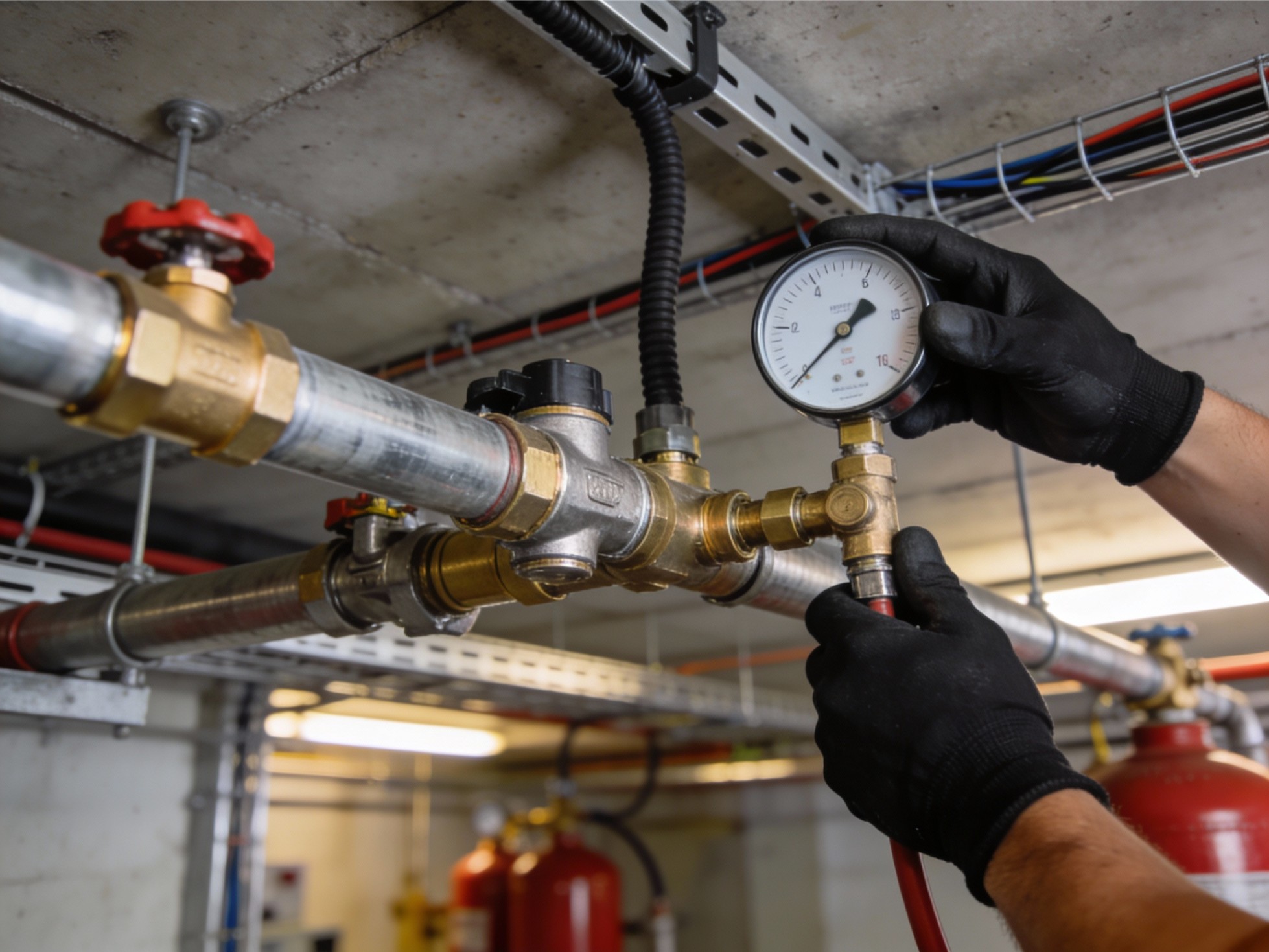
This article explains what a gas pressure test is, when it is required, how it is typically carried out on suppression pipework, and how it links to broader performance checks such as room integrity. It is written for building owners, facilities teams, main contractors, and project managers who need clear expectations from installers and maintainers.
What a gas pressure test is and what it is not
In the context of fixed gaseous fire suppression (for example FM-200, Novec 1230, inert gas systems), a gas pressure test is used to verify the strength and tightness of field-installed pipework and related components before the system is placed into service.
It is different from:
- Room integrity testing (often called an enclosure integrity fan test), which checks whether the protected room can retain the extinguishing concentration for the required hold time. Many guidance sources reference a typical minimum hold time of 10 minutes for clean agent enclosures, aligned with ISO 14520 / EN 15004 methodologies and also mirrored in NFPA 2001 practice.
- Cylinder periodic testing, which is a separate pressure vessel compliance topic handled under the cylinder regime and manufacturer guidance.
A project can pass a room integrity assessment and still fail operationally if the distribution pipework leaks or is incorrectly installed. That is why the gas pressure test sits at the centre of commissioning, alongside functional checks of detection, release control, and safety interfaces.
Why gas pressure testing matters in real buildings
A suppression discharge is unforgiving. The agent is released rapidly, the enclosure pressure changes, and the system relies on predictable flow through pipework and nozzles. Gas pressure testing gives you confidence in three practical outcomes:
- No unintended loss of agent through leaks that reduce design concentration.
- No hidden defects in joints, fittings, hoses, or valves that could worsen under discharge conditions.
- A defensible handover with evidence that the installed pipework was verified before occupation.
Maintenance guidance for gaseous suppression routinely includes the expectation that pipework showing corrosion or mechanical damage should be replaced or pressure tested and repaired as necessary. This is a useful operational signal: pressure verification is not only a commissioning step, it is also a condition-based maintenance tool.
Gas pressure test requirements: what drives the specification
When people ask about gas pressure test requirements, they are usually trying to confirm three things:
- Which standard or guidance governs testing
- The test medium and test pressure
- The acceptance criteria and documentation
In the UK, designers and installers typically align gaseous suppression work to the fixed firefighting standards for gas extinguishing systems such as EN 15004 / ISO 14520 (and, where relevant, NFPA 2001 for projects that reference US practice). The component ecosystem also sits within the EN 12094 series for control and related components, depending on the system architecture.
For the pipework itself, industry guidance from the Fire Industry Association includes detailed discussion of fittings and testing pressures, noting that test pressure is often set as 1.5 times maximum working pressure in practice. Your gas pressure test requirements should always reconcile the project fire strategy, manufacturer instructions, and any authoritative guidance used on the job.
Strength test vs tightness test: two different aims
A robust gas pressure test programme usually distinguishes between:
- Strength testing: verifies the pipework can withstand the test pressure without permanent deformation or failure.
- Tightness testing: verifies leak tightness at operating pressures and at critical joints.
In some engineering contexts, you may see hydrostatic testing used because water is less compressible than gas and therefore stores less energy. In clean agent installations, pneumatic tests using dry air or nitrogen are common because the pipework must remain clean and dry, and moisture contamination can create downstream issues.
General pressure testing guidance in the industrial gases sector explains that the chosen test pressure depends on method and code, and highlights the importance of procedure and safety controls, especially for pneumatic testing.
The gas pressure test process: a step-by-step site workflow
Below is a practical sequence that aligns with how competent contractors run gas pressure testing on field-installed suppression pipework. Exact values and steps must follow the system manufacturer and the project specification.
1) Planning and isolation
Before pressurising anything, confirm:
- The section of pipework to be tested and the boundary points
- Which components must be isolated or removed (for example delicate devices not rated for the full test pressure)
- Gauge calibration and range suitability
- Access planning for all joints, nozzles, hose assemblies, valves, and concealed runs
The goal is to avoid false passes caused by untested sections, and avoid damage caused by pressurising components outside their allowable limits.
2) Visual inspection before pressurisation
A gas pressure test should never be the first time someone looks critically at the installation. Check:
- Correct pipe specification and supports
- Thread engagement, torque, and sealing method where applicable
- Evidence of mechanical damage, corrosion, or abrasion
- Correct nozzle installation and orientation
- Correct identification and labelling
This step catches defects that a pressure hold might not reveal immediately.
3) Choose a safe test medium and set up monitoring
For pneumatic methods, nitrogen is commonly used because it is dry and inert. Dry compressed air can also be used depending on the specification. Ensure:
- Regulators are rated and fitted correctly
- Test points include a reliable gauge and, where required, a data logger
- Relief provisions are in place to prevent over-pressurisation
Pressure testing procedures in multiple engineering domains emphasise controlled pressurisation and staged increases, particularly for pneumatic testing due to stored energy risk.
4) Controlled pressurisation and stabilisation
Bring the system up gradually, pausing to stabilise. In practice, this reduces temperature-related pressure swings and allows early detection of gross leaks. A staged rise also gives the team time to listen, observe, and verify that valves and isolation points are behaving as expected.
5) Hold period and acceptance criteria
During the hold period, record:
- Start pressure and time
- Ambient temperature considerations
- End pressure and time
- Any intervention or adjustments made during the test window
Acceptance criteria depend on the test type and the project specification. The important point is consistency: the hold must be long enough to show meaningful stability and should be repeatable.
6) Gas leak pressure test techniques to pinpoint faults
If the pressure falls outside tolerance, move immediately into leak location work rather than repeating the same test blindly. A gas leak pressure test approach usually combines:
- Soap solution checks at joints and suspect areas
- Ultrasonic leak detection where practical
- Targeted isolation to narrow the search zone
Industrial leak testing guidance commonly references soap bubble and ultrasonic methods as practical tools when pressure drop indicates leakage.
After repair, retest the affected section and document the corrective action. This is where the second Gas leak pressure test is valuable: it demonstrates that the fix was verified, not assumed.
7) Depressurisation and reinstatement
Depressurise safely and reinstate the system into its intended configuration:
- Refit any isolated components
- Confirm nozzle caps and protective covers are correctly managed
- Restore control interfaces and confirm the system is back to the correct supervisory state
A clean handover is not only about passing the test. It is about returning the system to an operational, supervised condition.
What commonly fails a gas pressure test on suppression systems
In practice, failures cluster around predictable weak points:
- Threaded joints with poor sealant control or contamination
- Mechanical damage to pipe sections in congested ceiling voids
- Flexible hose assemblies and adaptors at cylinder manifolds
- Valves not rated or not seated correctly
- Poor support spacing leading to movement under pressure
If a gas pressure test is repeatedly failing on the same project, it is often a workmanship and supervision problem rather than a product problem. Tightness discipline, inspection access, and clear responsibility lines typically fix it.
How this links to room integrity and pressure relief
For gas suppression to work, you need both distribution integrity and enclosure integrity.
Room integrity testing checks the leakage characteristic of the room and calculates whether the agent can be retained for the required duration. UK-facing guidance and industry commentary repeatedly point to a typical 10-minute minimum hold time expectation for clean agent enclosures under ISO 14520 / EN 15004 type methodologies.
Separate from retention is the issue of pressure relief. Discharging gas into a sealed room can create transient pressure changes that may stress the building envelope. The Fire Industry Association has published guidance on pressure relief and post-discharge venting for enclosures protected by fixed gaseous fire fighting systems, emphasising that pressure venting is essential to avoid structural integrity problems during discharge.
A competent commissioning plan treats these as linked checks:
- Gas pressure testing validates the pipework distribution.
- Room integrity testing validates the enclosure hold time.
- Pressure relief design validates enclosure resilience during discharge.
Ignoring any one of the three increases project risk.
Documentation: what you should expect in the handover pack
A professional contractor should provide:
- A completed gas pressure test record: method, test medium, test pressure, hold duration, results
- Identification of the tested sections and boundary points
- Calibration evidence for gauges or instruments where applicable
- Rectification records if any Gas leak pressure test work was needed
- As-built drawings showing pipe routes, nozzle positions, and isolation points
- Commissioning summary tying pipework tests into the broader system acceptance process
If you operate regulated premises or have insurer oversight, that documentation is often as important as the physical outcome because it proves due diligence.
Practical FAQs
How often should gas pressure testing be repeated
There is no single universal interval. It is most common at commissioning, after modifications, and as a response to visible corrosion, damage, or repeated faults. Condition-based guidance for gaseous suppression systems explicitly points to pressure testing when pipework condition raises concern.
Are gas pressure test requirements the same for every agent
The underlying integrity principles are the same, but the system pressures, component ratings, and manufacturer instructions can differ. Always align the gas pressure test requirements to the specific system design and documentation used on the project.
Is a gas pressure test the same as a room integrity test
No. A gas pressure test focuses on pipework and components. Room integrity focuses on whether the enclosure retains the agent concentration for long enough.
Conclusion
A clean agent installation is only as credible as the evidence behind it. A properly executed gas pressure test confirms that the pipe network is sound, a disciplined gas pressure testing regime catches defects before occupation, and a structured Gas leak pressure test process prevents small leaks from becoming system-level failures. When you connect that pipework verification to room integrity and pressure relief considerations, you have a commissioning approach that is both technically sound and operationally defensible.