


A fire rated drop ceiling can be a practical way to improve fire performance, protect a floor above, and maintain a clean services zone, but only when the full ceiling kit is specified and installed exactly as tested. This fire rated drop ceiling guide is for clients, contractors, and facilities teams who need clear, accurate steps for choosing a compliant system that will stand up to Building Control review and ongoing maintenance expectations.
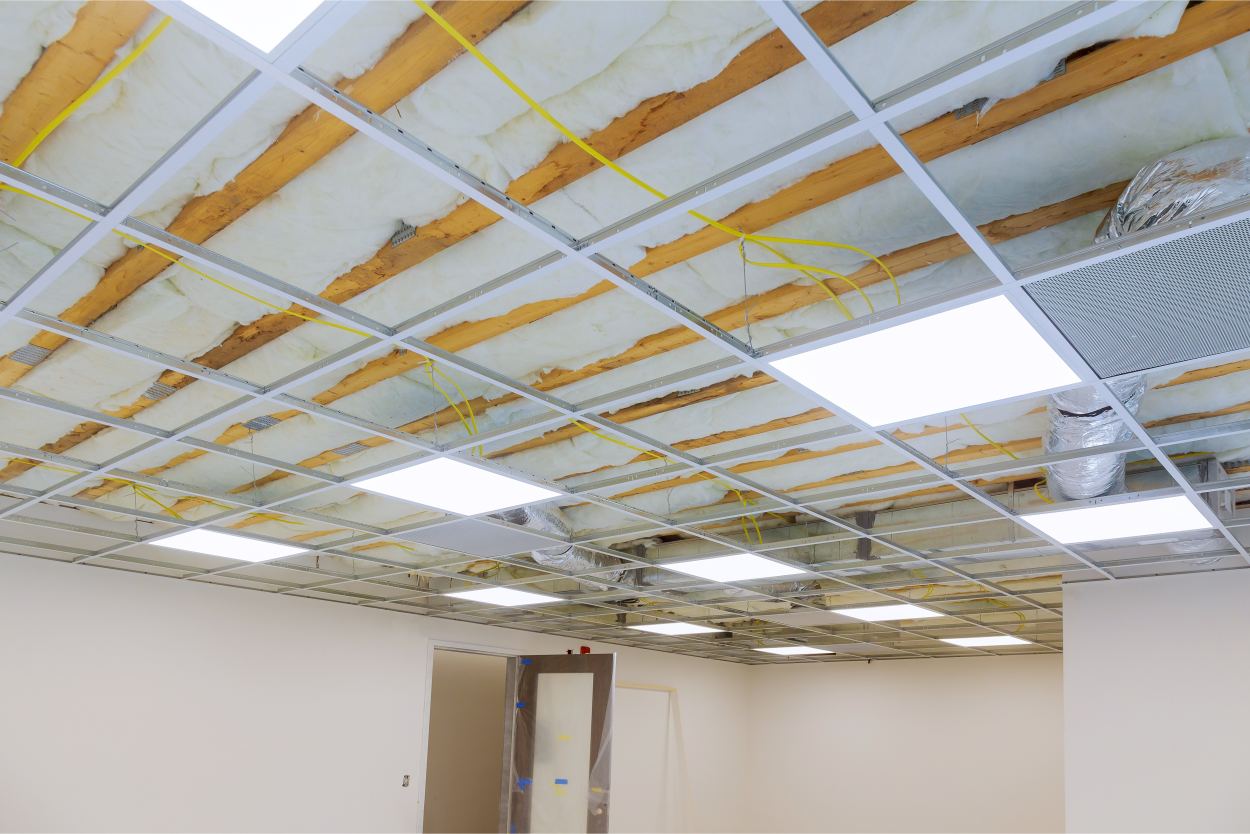
In everyday conversation, people often mix up fire resistance, reaction to fire, and simple product claims like 60 minute tiles. The reality is that the drop ceiling fire rating depends on the complete system, including tiles, grid, hangers, perimeter details, and how all penetrations and fittings are handled. Use this fire rated drop ceiling guide as a framework for specifying the right evidence, coordinating interfaces, and avoiding the mistakes that cause ceilings to underperform in real buildings.
Fire rated ceiling ratings explained
A key point in any fire rated drop ceiling guide is understanding the two different kinds of fire performance used in specifications.
Reaction to fire describes how a material contributes to fire growth, such as flame spread, smoke production, and burning droplets. In the UK and EU context, reaction to fire classifications are set out under BS EN 13501-1, and the old UK Class 0 designation is also still referenced in UK practice. Reaction to fire is important for surface linings, but it is not the same thing as a fire resisting ceiling that can hold back heat and flames for a defined time.
Fire resistance is the measure most people mean when they ask for a drop ceiling fire rating. Under BS EN 13501-2, fire resistance classification uses criteria such as R, E, and I, where R relates to loadbearing capacity, E relates to integrity, and I relates to insulation limiting temperature rise on the non exposed side. A crucial detail is that classifications based on BS EN 13501-2 can apply to a whole structural element, not just the suspended ceiling layer on its own.[
Which test standards appear in UK evidence packs
For a fire rated suspended ceiling, the fire resistance test method depends on whether the ceiling is considered non loadbearing on its own, or part of a loadbearing floor and ceiling arrangement.
EN 1364-2 is a test method for non loadbearing ceilings, including suspended ceilings, and it can test exposure from below or from above to simulate fire in the cavity. Where the fire resistance of a loadbearing floor is assessed in conjunction with a suspended ceiling, EN 1365-2 is used. This distinction matters because a ceiling that performs well as a membrane beneath a floor might have different limitations if the fire is assumed to start in the void above the ceiling.
Setting the specification goal: 1 hour vs 2 hour
Before you choose products, decide what the ceiling is meant to achieve in the building. This is the quickest way to make your fire rated drop ceiling guide useful rather than generic.
Common objectives include:
- Upgrading the fire resistance of a floor or compartment boundary
- Protecting structural members from heating too quickly
- Creating a protected zone below a services plenum
- Supporting an escape route strategy by improving separation and limiting early smoke spread, alongside other measures
In UK compliance terms, designers commonly use Approved Document B as guidance for meeting Building Regulations fire safety requirements in England. The required period of fire resistance depends on building height, use, and compartmentation strategy, and it should be confirmed by a competent fire engineer or building control body for the project.
1 hour fire rated drop ceiling
A 1 hour fire rated drop ceiling is usually specified where a 60 minute period is required for part of the structure or separation strategy, and where a tested ceiling and support arrangement exists for that build up. Fire resistance classifications under BS EN 13501-2 include durations such as REI 60, which are widely used to describe 60 minute performance for structural elements. If your project is targeting a 1 hour fire rated drop ceiling, the specification should state whether the rating is required from below only, or whether fire in the ceiling void must also be considered, because test orientation and assumptions change the system choice.
2 hour fire rated drop ceiling
A 2 hour fire rated drop ceiling is often used in higher risk areas, taller buildings, or where a fire strategy requires longer structural protection, but it must still be supported by evidence for the complete assembly. Fire resistance classifications under BS EN 13501-2 include REI 120, which is a 120 minute classification used for structural elements. If you need a 2 hour fire rated drop ceiling, treat it as an engineered system, not a stronger tile, because the hangers, grid, perimeter, and every accessory can become the weak point.
A useful rule for clients is to write the target as a performance statement, then list acceptable evidence types. For example, require classification to BS EN 13501-2 supported by appropriate fire resistance test reports, and make clear the ceiling must be installed as a kit using the tested components.
Fire rated suspended ceiling system components you must control
Most failures in a fire rated suspended ceiling happen at interfaces, not in the main field of tiles. This section of the fire rated drop ceiling guide focuses on what to lock down in your specification so the installed ceiling matches the tested system.
The ceiling is a kit, not a mix and match build
Manufacturer technical guidance for fire resistant ceiling systems emphasises that fire performance claims depend on using the same components and layout as used in the test, and that changing components can invalidate certification. Some systems also note that for fire resistance, a UKCA label and Declaration of Performance may be required for the whole kit, meaning tiles plus subconstruction, under BS EN 13964 requirements for suspended ceilings.
In practice, your fire rated drop ceiling specification should define:
- Tile type, size, thickness, and edge detail
- Grid and subconstruction type, including main tee spacing and hanger spacing where relevant to the evidence
- Hanger type and top fixing requirements, including suitability for the substrate
- Perimeter trims and fixings, including any spacing limitations referenced by the test report
This is how you prevent a situation where the site team buys alternative grid or hangers due to availability, then unknowingly breaks the basis of the fire rating.
Lighting, access hatches, and service penetrations
Recessed luminaires and access points are common weak spots. One fire resistant ceiling system guide states that when recessed luminaires are installed, a fire box enclosure should be used to maintain continuity of fire resistance, and the fire box performance should match the ceiling performance. Even if you use a different manufacturer, the principle holds: every opening needs a tested method to maintain the ceiling rating.
For a fire rated suspended ceiling specification, include a clear rule that no penetrations, access hatches, speakers, detectors, or lights are permitted unless they are covered by tested details or a suitable assessment. This avoids unplanned holes being cut late in the programme.
The void above the ceiling
A drop ceiling can hide services and improve aesthetics, but it can also create a concealed route for smoke and fire spread if compartment lines are not maintained through the void. Coordinating with sfs walls or similar framing ensures penetrations and barriers prevent vertical spread, tying the ceiling into the building’s overall fire strategy. ASFP guidance on inspecting passive fire protection highlights that passive measures include compartmentation and the protection of escape routes, and that these measures can be compromised by changes and alterations. In practical terms, your ceiling design should coordinate with fire stopping, cavity barriers, and service riser sealing so the void does not bypass the fire strategy.
5. FAQs, mistakes, and practical answers
Is a fire rated drop ceiling the same as a fire resisting floor?
Not always. Some evidence and classifications refer to the whole structural element, such as floor plus suspended ceiling, rather than the suspended ceiling alone, so you must confirm exactly what the test and classification cover.
What is the most common mistake with a fire rated suspended ceiling?
Mixing components, changing hanger spacing, swapping grid parts, or adding untested openings. Guidance for fire resistant ceiling systems stresses that changing components and layout from what was tested can invalidate certification and prevent valid declarations.
How many ratings should I ask for, EI, REI, 60 minutes?
Use the language that matches the fire strategy and evidence pack. BS EN 13501-2 uses R, E, and I criteria, and the time in minutes is tied to the classification outcome.
Can the ceiling be tested for fire in the void?
Yes, depending on the test method. EN 1364-2 allows testing of non loadbearing ceilings with exposure from above to simulate fire within the cavity above the ceiling, as well as exposure from below.
Do I need a 1 hour fire rated drop ceiling or a 2 hour fire rated drop ceiling?
That depends on the building and the fire strategy, but the decision should be made first, then the ceiling system chosen to match it. Approved Document B is the main government guidance document used in England for meeting Building Regulations fire safety requirements, and it is the usual starting point for compliance conversations. If the project calls for a 2 hour fire rated drop ceiling, make sure the whole kit and every accessory is supported by evidence for that duration, not just the tiles.
Closing thoughts
A fire rated drop ceiling can add real value to a fire strategy, but only if it is treated as a tested system with controlled interfaces, not as a decorative finish. Use this fire rated drop ceiling guide to keep your specification focused on the evidence, the kit components, and the details that most often fail, especially penetrations, lighting, access, and compartment continuity through voids. When you need a fire rated suspended ceiling for a 1 hour fire rated drop ceiling or a 2 hour fire rated drop ceiling, write the performance requirement clearly, insist on the correct classification documents, and make sure the installation matches the tested layout so the drop ceiling fire rating is real, not assumed.