


In most buildings, the smoke vent is the visible part of the system: a roof hatch, a louvre, or a top-hung window at high level. Yet in an actual fire, the part that often decides success or failure is much smaller and much less obvious. It is the actuator.
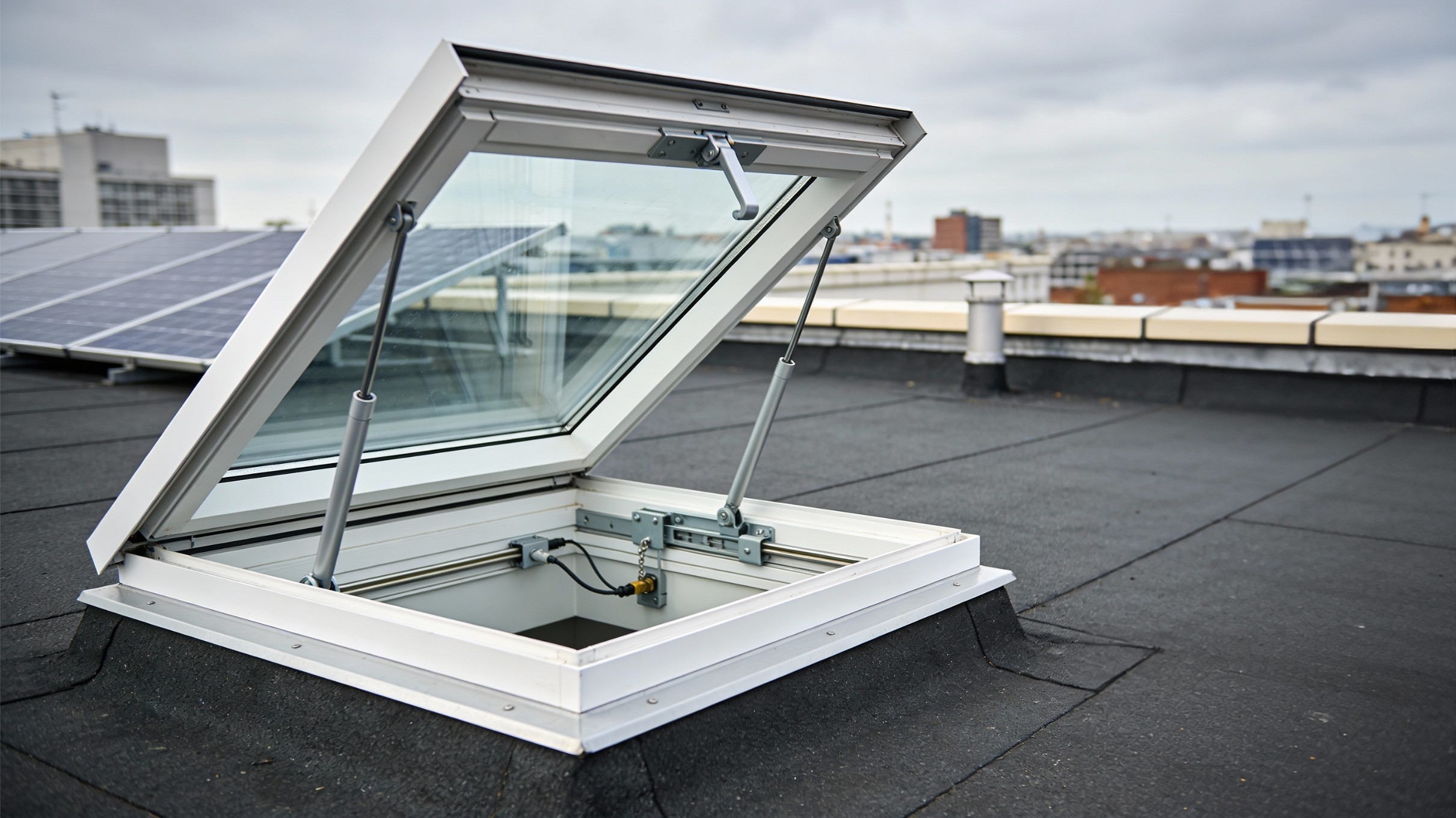
These AOV actuator specifics matter because the actuator is the muscle of the vent. If it cannot overcome wind load, opening friction, misalignment, or cold-weather stiffness, then the opening area you designed for does not exist in real life. This guide breaks down the actuator choices, key performance parameters, and installation realities that building owners and contractors should insist on when specifying natural smoke ventilation.
Why AOV actuator specifics are a frequent weak point
Most performance failures in natural smoke ventilation are not dramatic component breakages. They are slow, predictable degradations: batteries that age, hinges that bind, seals that swell, cable terminations that loosen, or an actuator selected for comfort ventilation that is later expected to perform as a life-safety device.
Good AOV actuator specifics start with a simple principle: smoke ventilation is not just automation. It is emergency operation under adverse conditions, including low temperatures, wind effects, and the requirement to open under load as part of a certified product.
Standards context: what compliant actuator selection really means
A common misconception is that any suitable actuator can be added to any window to create an AOV. In the UK market, that is a fast route to non-compliance.
Smoke Control Association guidance is explicit that an NSHEV is generally a single product comprising the ventilator and actuator, and that both components must be tested together as one product under EN 12101-2, manufactured or completed under audited factory production control, and certified accordingly. It also warns that components are not interchangeable unless they are within the tested and approved configuration.
This is one of the most important AOV actuator specifics for clients: a retrofit actuator onto an existing window may look correct, but if that pairing is not part of a tested and certified product configuration, it creates a handover and liability problem.
You will also see this reflected in industry documents discussing product compliance routes, UKCA or CE marking expectations, and the requirement for Declaration of Performance evidence under the construction products framework.
AOV actuator specifics by actuator type
There are several actuator types used for natural smoke ventilation. Choosing between them is not just a cost decision; it is about force, stroke, reliability, and compatibility with the vent geometry.
Chain actuators: common for windows and lightweight vents
An aov window actuator is often a 24V DC chain actuator, especially on top-hung and bottom-hung windows used for smoke ventilation and daily natural ventilation. Chain actuators are widely available with different stroke lengths, commonly ranging from roughly 400 mm up to 1000 mm depending on model.
Key AOV actuator specifics for chain actuators include:
- Stroke length versus required opening angle and free area
- Force rating (push and pull) versus sash weight, seals, and wind effects
- Multi-chain or dual-chain options for wider and heavier vents (commonly used to reduce racking)
Spindle and screw actuators: controlled motion and higher loads
Spindle actuators (sometimes called screw actuators) are often selected where higher loads and longer controlled movement are needed. They can be appropriate for façade louvres, larger vents, or installations where the geometry demands a more rigid drive.
The main AOV actuator specifics here are load handling, mounting rigidity, and alignment. They are less tolerant of installation inaccuracies than chain actuators, but can provide stronger mechanical performance when specified correctly.
Linear actuators: strong thrust and predictable performance
Linear actuators are used when you need high thrust and a straightforward push-pull motion. They are a common option for certain roof vents and louvre mechanisms. Similar to spindle drives, they depend heavily on correct alignment, suitable brackets, and a tested configuration as part of the ventilator product.
Pneumatic actuation: niche but relevant
Pneumatic solutions exist for specific applications and environments, but they should be treated as specialist systems with careful attention to maintenance and commissioning. The same compliance principle applies: pairing must be certified for smoke ventilation use within the relevant product route.
The core AOV actuator specifics that determine performance
If you remember only one thing from this aov guide, it should be this: actuator selection is engineering, not guessing. Below are the parameters that should be documented, justified, and verified.
1) Voltage, power, and the reality of standby operation
Most modern systems use 24V DC actuation for life-safety smoke ventilation because it pairs well with monitored power supplies and battery standby.
However, the actuator is only as dependable as the system that feeds it. Control equipment and power supplies sit within the EN 12101 ecosystem, and industry guidance emphasises that power supplies for smoke control should comply with EN 12101-10 and be supported by appropriate Declarations of Performance.
This is also where AOV actuator specifics connect directly to project risk: the actuator may be correct, but the panel capacity, battery sizing, cable selection, and fault monitoring can quietly undermine performance.
2) Force, thrust, and the trap of underpowered selection
Force ratings are routinely misunderstood. Actuators are sold with a stated force figure, but actual required force depends on:
- Vent weight and hinge geometry
- Seal compression
- Wind suction and pressure differentials
- Opening under load expectations within EN 12101-2 performance testing
If a vent is wide, a single chain drive may twist the sash during opening. Dual-chain options exist specifically to increase power and maintain sealing performance when closed, which is important for both weathering and reliable emergency opening.
A practical way to validate AOV actuator specifics is to insist on a manufacturer selection method that accounts for geometry, not only weight.
3) Stroke length and real free area
Stroke length is not a cosmetic spec. It is a primary determinant of opening angle, and opening angle influences aerodynamic free area and smoke exhaust effectiveness.
Manufacturers commonly supply actuators with multiple stroke options, such as 400, 600, 800, and 1000 mm variants. If the selected stroke cannot achieve the intended fire-open position, you may technically have an actuator but functionally lose the designed smoke ventilation performance.
This is why AOV actuator specifics must always be checked against the vent’s declared free area in its fire-open state, not its daylight appearance.
4) Opening time under load and environmental resilience
EN 12101-2 testing includes reliability, opening under load, wind load, low ambient temperature operation, and heat exposure, among other characteristics. Industry summaries commonly reference that vents must prove opening under load within a defined time and demonstrate low-temperature operation (for example, repeated operation at negative temperatures), alongside cycle reliability expectations.
From an operational perspective, this means your AOV actuator specifics should include:
- Tested performance under wind suction scenarios
- Demonstrated operation at low temperatures appropriate to the building environment
- Declared reliability classification consistent with smoke ventilation duty
5) Feedback signals and fault monitoring
A smoke vent that opens but cannot confirm its position creates a serious management problem during weekly tests and during a real incident.
Good AOV actuator specifics include:
- End-of-travel confirmation or position feedback
- Fault reporting (open circuit, short circuit, overload)
- Compatibility with zoned control logic and firefighter switches
Position feedback becomes particularly important on larger vents and smoke shafts where the building manager needs confidence that the commanded state was achieved.
AOV controls: how the actuator, panel, and cause-and-effect must align
Actuators are not standalone. They live inside a system logic. Good aov controls do three things:
- They provide reliable power, including standby where required.
- They enforce the cause-and-effect matrix so the correct vents open in the correct sequence.
- They provide visible system health and fault status so failures are detected early.
Industry documents commonly frame smoke control delivery as requiring alignment between BS 7346 guidance and the BS EN 12101 series, while also recognising that power supply standards such as EN 12101-10 are central to compliance.
From a practical standpoint, the actuator selection and aov controls selection must be coordinated. If the panel is under-sized, battery capacity is inadequate, or zoning logic is wrong, then the actuator performance becomes irrelevant.
Commissioning checks that validate AOV actuator specifics on site
A strong commissioning plan is where theoretical AOV actuator specifics become verified reality. At minimum, commissioning should confirm:
- The vent opens fully to its fire-open position without binding
- The actuator achieves opening under realistic resistance, not only when brand new
- Position indication and fault monitoring work correctly
- Manual overrides and firefighter switch functions operate correctly within the designed logic
- The system returns to the correct standby condition with faults cleared and logged
This is also where you validate that the actuator and ventilator configuration matches what was certified and declared for EN 12101-2 compliance, rather than an improvised pairing.
Maintenance: keeping actuators dependable over time
Maintenance is not a generic recommendation; it is a structured expectation for life-safety equipment. Industry maintenance guidance for smoke control equipment sets out routine checks, including daily inspection of status panels and weekly actuation checks for natural smoke control systems, with faults logged and addressed promptly.
In practice, actuator-focused maintenance should include:
- Functional actuation checks to confirm smooth movement
- Inspection for corrosion, water ingress, and mechanical wear
- Verification of battery condition and panel fault history
- Confirmation that vents are not obstructed by later building works
Ignoring these basics is how actuator performance quietly degrades until the first real demand.
Common specification mistakes to avoid
If you want a fast quality filter, look for these red flags:
- Selecting an actuator for comfort ventilation and assuming it is suitable for smoke ventilation duty
- Retrofitting an actuator onto an existing vent without evidence of tested pairing and certification under EN 12101-2
- Underestimating wind effects and seal resistance, leading to incomplete opening under load
- Using a single chain where a dual-chain solution is required for width and stiffness
- Treating controls as generic, rather than aligning with smoke control power supply expectations and documented cause-and-effect
Each of these failures shows up later as delayed handover, repeated faults, or poor performance during inspections.
Selecting the right actuator: a short decision framework
Use this as a practical checklist when reviewing proposals. It captures the essential AOV actuator specifics without getting lost in marketing claims.
- Confirm the ventilator and actuator are certified as a combined product for EN 12101-2 use, with Declaration of Performance evidence.
- Verify actuator force and stroke against the vent geometry and required fire-open position.
- For windows, confirm whether an aov window actuator requires single or dual-chain configuration to avoid twisting and ensure full opening.
- Ensure the control panel and power supplies are suitable for smoke control duty, including EN 12101-10-aligned expectations and correct battery capacity.
- Require commissioning records that prove the vent achieved full fire-open position and that indication and fault monitoring were verified.
Final thoughts
The actuator is rarely the headline item in smoke ventilation discussions, but it is often the component that determines whether the system is genuinely fit for purpose. Treat AOV actuator specifics as a life-safety engineering topic: tested pairing, correct force and stroke, reliable power and monitoring, and maintenance that is structured rather than occasional.
If you apply that discipline, your AOV actuator specifics stop being an afterthought and become a measurable part of a smoke control system that performs consistently, passes inspection with evidence, and is ready when it is needed most.